Lightweight steel tube is widely used in construction, fabrication, and distribution thanks to its strength, cost efficiency, and easy handling. For distributors, agents, and wholesalers, understanding where it performs best—and where its limits matter—is essential for choosing the right products, meeting project standards, and reducing sourcing risks in competitive global markets.
What is lightweight steel tube, and why do buyers ask about it so often?
In practical steel trading, lightweight steel tube usually refers to steel tubing designed to deliver adequate mechanical performance while keeping section weight low. It may be produced in round, square, or rectangular shapes, and it is often selected for projects that need easier handling, lower transport cost, and faster installation. For distributors and project suppliers, this matters because many customers are not simply buying steel by tonnage; they are buying a balance of strength, fabrication efficiency, and budget control.
The term does not always point to one fixed standard or one specific grade. In many markets, lightweight steel tube can include thin-wall structural tube, cold formed hollow sections, mechanical tubing, or selected galvanized tubes used in non-heavy-load applications. That is exactly why the topic generates questions. End users want lighter materials to improve logistics and site efficiency, but they also need reassurance on load capacity, welding suitability, corrosion performance, and code compliance.
From a business perspective, lightweight steel tube is attractive because it helps reduce freight volume, improve warehouse turnover, and support a wide range of downstream uses, from frames and supports to partitions, racks, handrails, light industrial structures, and agricultural systems. However, the wrong choice can create failures in service life, structural safety, or customer satisfaction. That is why distributors should understand not only the advantages, but also the boundaries of use.
Where does lightweight steel tube perform best?
Lightweight steel tube performs best in applications where moderate strength, dimensional consistency, and efficient fabrication are more important than extreme load-bearing capacity. In construction supply chains, it is commonly used for secondary structures, light frames, support systems, guardrails, purlin-related assemblies, gates, fences, interior partitions, and modular fabrication. In manufacturing and workshop environments, it is also popular for machinery covers, storage racks, trolleys, display systems, and welded assemblies.
For export-oriented buyers, one major advantage is handling efficiency. Lighter tubes are easier to load, cut, drill, bend, and weld, which reduces labor pressure at both fabrication shops and installation sites. This can be especially useful in regions where labor costs are rising or where projects require fast turnaround. When customers need standard sections in repeat orders, lightweight steel tube can also support stable stocking strategies and faster order fulfillment.
Another strong use case is corrosion-managed environments where the steel tube will receive galvanizing, painting, or powder coating. In these situations, buyers can achieve a cost-effective structure without moving to heavier profiles than necessary. For wholesalers serving contractors, this often creates better price competitiveness on medium-duty projects.
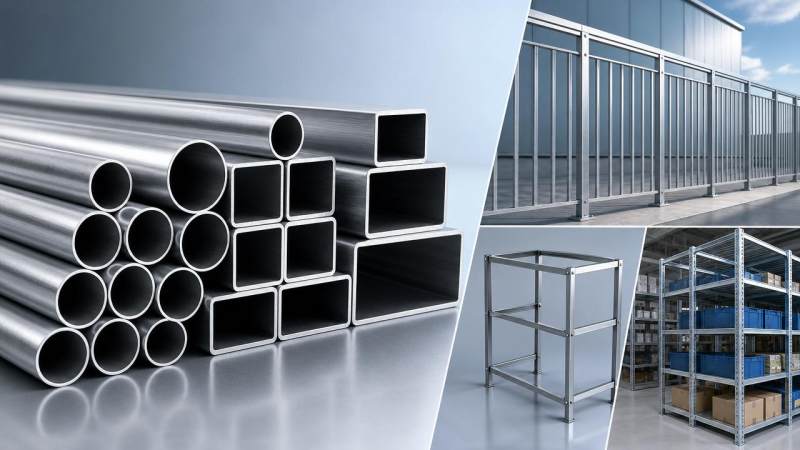
Quick judgment table: when is lightweight steel tube a good fit?
What are the main limits of lightweight steel tube?
The biggest limit is load capacity under demanding structural conditions. A lightweight steel tube may look efficient on paper, but if the wall thickness is too low for the span, connection detail, or dynamic load, deflection and local buckling can become real risks. This is especially important in platforms, multi-level systems, heavy equipment supports, and impact-prone structures. Lighter is not always better when safety margins are tight.
A second limit is corrosion allowance. In coastal, chemical, humid, or outdoor industrial environments, thin-wall tube has less material reserve once corrosion begins. Even when galvanized or painted, damage to the coating can shorten service life more quickly than buyers expect. For this reason, distributors should ask whether the project is indoor, covered outdoor, open outdoor, or chemically exposed before recommending a specification.
A third limit is fabrication tolerance in demanding assemblies. Very light sections can distort more easily during cutting, welding, punching, or hot-dip galvanizing if process control is weak. This does not mean lightweight steel tube is unreliable; it means the fabrication route must match the tube size, thickness, and end use. Poorly controlled production or overaggressive welding can create dimensional instability, which leads to costly rework.
There is also a market-side limit: buyer misunderstanding. Some end customers use the word “structural” loosely, assuming every tube can substitute for heavier beams or hot-rolled sections. Experienced suppliers know that section shape, grade, wall thickness, and project standard all affect the answer. Selling on price alone may win an order, but it can also create claims if the application was not properly reviewed.
How should distributors compare lightweight steel tube with heavier sections or other steel products?
The best comparison starts with function, not with unit price. Lightweight steel tube often wins when the job needs manageable weight, clean appearance, repetitive fabrication, and medium-duty structural performance. Heavier sections become more suitable when the project requires longer spans, high point loads, stronger weld zones, or higher resistance to impact and deformation.
Distributors should also compare total project cost rather than raw material cost alone. A slightly higher price per ton may still be the better option if the tube reduces transport expense, shortens installation time, and lowers labor input. This is one reason why global buyers often prefer optimized hollow sections over oversized profiles. The steel itself is only one part of the value equation.
In some sourcing discussions, buyers also consider companion materials for filtration, enclosure, architectural, or industrial systems. For example, projects involving frames and infill components may combine tube products with wire-based stainless items such as Stainless Steel Welded Mesh. Available in grades including SS 201, 304, 304L, 316, 316L, and 430, with mesh ranges from 2 to 635 mesh and wire diameters from 0.0008″ to 0.12″, it is used in filters, sieve systems, chemical processing, mining, architecture, and residential applications. For distributors, understanding adjacent products helps build more complete solutions instead of selling a single line in isolation.
This broader comparison is commercially useful because many customers prefer one supplier that can coordinate structural steel, cold formed profiles, and selected industrial metal products under consistent quality control. A manufacturer with export experience, modern production facilities, and compliance with standards such as ASTM, EN, JIS, and GB can reduce sourcing complexity for importers and channel partners.
What should buyers check before ordering lightweight steel tube?
Before placing an order, buyers should confirm five practical points: application, material grade, size and wall thickness, surface treatment, and compliance standard. These factors influence performance far more than a simple quotation comparison. If the use is structural, ask for the intended load condition and whether engineering approval is required. If the use is decorative or light industrial, appearance tolerance and coating quality may matter more.
Wall thickness deserves special attention. Many disputes in international trade come from nominal size assumptions or substitution without proper review. Two tubes may share the same outer dimensions but behave very differently because of thickness differences. The distributor should also verify whether the tube will be welded, bent, drilled, or exposed to outdoor weather, because each process changes the recommended specification.
Documentation is another key point. Reliable suppliers should be able to provide mill test data, dimensional tolerance information, coating details if applicable, and packing methods suitable for export. For channel partners, this is not just paperwork; it is part of risk control. Stable lead times, traceability, and responsive technical communication are often more valuable than chasing the lowest initial offer.
Buyer checklist for faster decision-making
What are the most common mistakes when selling or specifying lightweight steel tube?
One frequent mistake is treating lightweight steel tube as a universal substitute. It is versatile, but it is not the right answer for every load-bearing or long-span design. Another mistake is underestimating environmental exposure. A buyer may focus on section weight and forget the real operating conditions, such as rain, salt, heat, or chemical contact. That oversight can turn a cost-saving choice into a maintenance problem.
Some traders also overlook processing requirements. If the customer plans heavy welding, repeated bending, or precise frame assembly, the steel tube specification should reflect that. Thin-wall sections can work very well, but only when manufacturing methods are realistic. A third error is weak communication about standards and substitutions. If an order changes from one grade or thickness to another, the customer should approve it clearly and understand the effect on performance.
Finally, many suppliers sell on immediate price instead of lifecycle value. Professional buyers increasingly care about stable supply, consistent dimensions, fewer claims, and dependable delivery. A trusted structural steel manufacturer and exporter can support these priorities through controlled production, customized solutions, and better coordination across global projects.
How can wholesalers and agents reduce sourcing risk with lightweight steel tube?
The first step is supplier qualification. Choose partners with proven export capability, clear quality control, and familiarity with major standards. A manufacturer serving North America, Europe, the Middle East, and Southeast Asia usually has stronger experience with documentation, packing, and delivery expectations across different markets. This reduces the chance of mismatch between quotation, production, and end-use requirements.
The second step is sample-based verification or specification confirmation before mass production. For lightweight steel tube, small dimensional deviations can matter in large assembly programs. Confirming thickness, section size, coating, and weld quality early helps avoid expensive disputes later. It is also wise to discuss acceptable tolerances, marking, bundle packing, and lead times in advance.
The third step is commercial planning. Stocking popular sizes can improve responsiveness, but customized items should be aligned with realistic order volumes and shipment schedules. Experienced exporters can support OEM and standard supply models, helping distributors balance inventory risk with market demand. In competitive steel markets, speed matters, but controlled sourcing matters more.
What is the key takeaway for buyers evaluating lightweight steel tube?
Lightweight steel tube is a smart solution when the application rewards efficient weight, practical strength, easy fabrication, and lower total handling cost. It is especially valuable in light structural work, fabrication systems, and repeat distribution programs. Its limits appear when buyers ignore load conditions, corrosion exposure, processing demands, or code requirements. In other words, the product performs best when selected with discipline rather than with assumptions.
For distributors, agents, and wholesalers, the strongest approach is to ask better questions before quoting: What is the actual application? What standard is required? Is the environment indoor or outdoor? What wall thickness and surface finish are needed? Will the product be welded or heavily fabricated? If you need to confirm a suitable specification, lead time, OEM option, export packing method, or quotation strategy for your market, those are the first topics worth discussing with a reliable structural steel manufacturing partner.
Please give us a message


Please enter what you want to find