Understanding l angle steel dimensions is essential for technical evaluators comparing load requirements, fabrication compatibility, and cost efficiency. This guide explains standard sizes, leg configurations, thickness options, and common applications of L angle steel, helping buyers and engineers make informed sourcing decisions. As a structural steel manufacturer and exporter, Hongteng Fengda also supports global projects with reliable specifications, consistent quality, and customized solutions.
Why a checklist approach works best when reviewing l angle steel dimensions
For technical evaluation teams, the challenge is rarely just identifying a nominal angle size. The real task is checking whether specific l angle steel dimensions match structural loads, joining methods, corrosion environment, fabrication limits, and procurement standards. A checklist-based review helps prevent common sourcing errors such as selecting the right leg size with the wrong thickness, matching dimensions but missing tolerance requirements, or approving a section that is difficult to punch, weld, or galvanize.
In practical projects, angle steel may look simple, but performance depends on a combination of variables: equal or unequal leg geometry, thickness, length, edge condition, steel grade, and standard system such as ASTM, EN, JIS, or GB. That is why technical evaluators should review l angle steel dimensions as a decision package rather than a single number on a drawing.
Start with these priority checks before comparing sizes
Before requesting quotations or approving a supplier, confirm the following points in sequence. This is the fastest way to screen whether the proposed l angle steel dimensions are technically suitable and commercially efficient.
- Confirm whether the design requires equal angle or unequal angle sections. Equal angles simplify many framing and connection details, while unequal angles may better fit specific support or bracing layouts.
- Check leg size first, then thickness. Leg dimensions affect fit-up and envelope space, while thickness strongly affects strength, stiffness, weldability, and weight.
- Verify the applicable material standard and grade, such as A36, Q235, Q345, SS400, or S235JR, because identical geometric dimensions can perform differently depending on yield strength and chemistry.
- Review length requirements, including stock length and cutting plan, to reduce waste and avoid unnecessary secondary processing.
- Assess surface condition and corrosion protection early, especially for outdoor structures, marine exposure, or humid industrial environments.
- Request section tolerances and straightness data if the angle will be used in assemblies requiring precise bolting, punching, or robotic fabrication.
How to read l angle steel dimensions correctly
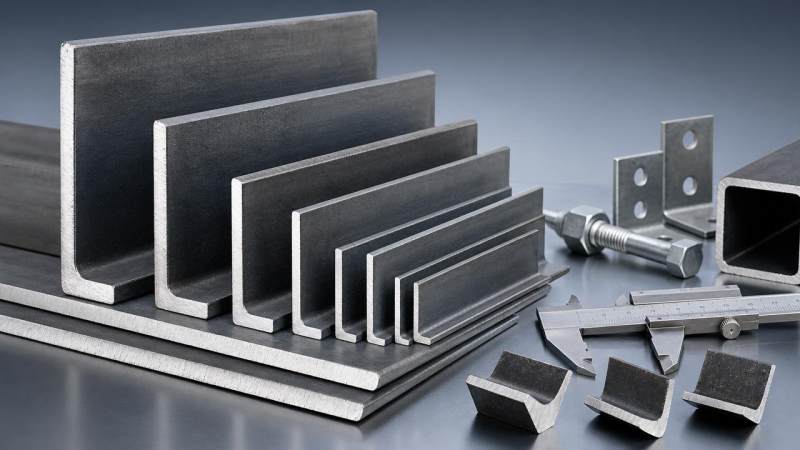
Most l angle steel dimensions are expressed by leg size and thickness. For equal angles, a common format is 50 × 50 × 5 mm, meaning both legs are 50 mm and the thickness is 5 mm. For unequal angles, the notation may appear as 75 × 50 × 6 mm, where one leg is 75 mm, the other is 50 mm, and thickness is 6 mm. In inch-based systems, dimensions may be shown in imperial format, often linked with ASTM specifications.
Technical evaluators should never treat two angle sections as interchangeable only because the longer leg is similar. Section properties such as area, moment of inertia, and radius of gyration can change significantly with thickness or with equal versus unequal geometry. Therefore, when comparing l angle steel dimensions, always review the dimensional notation together with section weight and structural calculations.
Key dimension elements that affect selection
- Leg length: Determines fit with gusset plates, base details, frames, supports, and edge clearances.
- Thickness: Influences bearing capacity, local stability, drilling feasibility, and coating behavior.
- Inside radius and edge profile: Important for mating parts, close contact surfaces, and some machine fabrication setups.
- Length: Impacts transportation, cutting efficiency, and installation sequence.
- Tolerance: Critical where assembly precision, punching alignment, or repeatable fabrication is required.
A practical checklist for choosing the right size and thickness
When reviewing l angle steel dimensions, use the following decision logic to narrow options quickly and reduce rework.
1. Match dimensions to load path
If the angle serves as a brace, lintel support, frame stiffener, shelf support, or secondary member, its load path must be clear. Tension members may prioritize net section and hole effects, while compression members require more attention to slenderness and buckling behavior. In many cases, increasing leg size without increasing thickness will not solve local stability concerns.
2. Check fabrication compatibility
The best l angle steel dimensions on paper can still create shop-floor issues. Confirm whether the section will be cut, punched, drilled, welded, slotted, bent, or hot-dip galvanized. Thicker angles may improve strength but increase processing cost. Very thin sections may distort during welding or coating. If the project includes repetitive assemblies, dimensional consistency becomes especially important.
3. Compare weight against total installed cost
Technical evaluators should not compare only unit price per ton. Larger l angle steel dimensions may reduce the number of members or simplify reinforcement, while smaller sections may save material weight but increase connection complexity. The right choice balances steel consumption, processing hours, transport efficiency, and installation labor.
4. Verify standard availability in the target market
Many projects specify dimensions according to regional habits, but supply may depend on the mill’s standard rolling range. For export procurement, always confirm whether the requested l angle steel dimensions are regular production items or special rolling requests. This directly affects lead time, minimum order quantity, and cost control.
Typical ranges and what they usually mean in practice
While exact size ranges vary by standard and manufacturer, technical buyers often see small, medium, and heavy angle sections used for different tasks. Small angles are common in frames, brackets, supports, and light industrial fabrication. Medium sizes are often used in secondary structural systems, equipment bases, and warehouse steelwork. Heavier angles are more suitable for transmission structures, industrial supports, reinforcement frames, and demanding load-bearing applications.
Thickness selection follows a similar logic. Thin sections may fit light-duty fabrication, but medium and heavier thicknesses are preferred when connection reliability, impact resistance, or long-term durability matters. When comparing l angle steel dimensions, always ask whether the goal is minimum weight, easiest fabrication, longest service life, or best all-around project value.
Scenario-based checks: what matters in different applications
Construction and structural framing
For buildings, towers, walkways, mezzanines, and support frames, l angle steel dimensions should be checked against connection design, bolt spacing, weld access, and corrosion exposure. Equal angles are often selected for ease of detailing, while unequal angles can help when one leg must connect to a plate and the other must support a different load line.
Equipment support and industrial fabrication
Machines, guards, support racks, and utility frames often require a balance between stiffness and manufacturability. Here, l angle steel dimensions should be reviewed with hole pattern requirements, edge distance, vibration behavior, and protective finish. A dimension that is structurally sufficient may still be unsuitable if punching deforms the leg or if coating thickness interferes with assembly tolerance.
Export procurement and mixed-standard projects
International sourcing often involves matching drawing dimensions from one standard with material grades from another. In these cases, technical teams should clearly define equivalent grades, tolerance acceptance, coating requirements, and inspection documents. This is especially important when the project spans ASTM, EN, JIS, and GB systems.
A useful mid-project comparison: angle steel versus channel sections
During evaluation, some buyers discover that the required function may be better served by a channel rather than an angle. For example, purlins, wall beams, lightweight roof trusses, brackets, and certain machine support members may benefit from a formed channel profile with easier integration into repetitive assemblies. In such cases, it is practical to review alternatives such as C Channel Beam, which is available for steel structure buildings and mechanical light industry manufacturing in materials including Q195, Q235, Q345, A36, SS400, and S235JR. With galvanized coated options, thickness from 1 mm to 12 mm, lengths of 6 m, 9 m, and 12 m, and processing services such as bending, welding, punching, decoiling, and cutting, this type of section can be a strong alternative when the original l angle steel dimensions create connection or production constraints.
This does not replace angle steel in all cases, but it reminds evaluators to compare section efficiency, fabrication speed, and installation logic before final approval. In value-engineering reviews, a shaped profile may reduce downstream complexity even if the initial section choice seems familiar.
Common oversights that can affect project performance
- Ignoring tolerances: Slight dimensional deviation can create assembly problems in bolted frames or automated welding lines.
- Specifying only nominal dimensions: Without grade, standard, and finish, the material may not meet real performance requirements.
- Overlooking coating buildup: Galvanizing or other finishes may affect fit at tight interfaces.
- Using the same angle size across all nodes: Different locations may need different l angle steel dimensions depending on force transfer and attachment details.
- Failing to review logistics: Stock length, bundle weight, and container loading can influence landed cost and delivery schedule.
- Missing documentation requirements: Mill test certificates, inspection reports, and compliance with ASTM, EN, JIS, or GB should be clarified before production.
Execution advice for technical evaluators and buyers
If your team is preparing to source angle steel internationally, build the inquiry package around decision-critical data rather than broad descriptions. The most effective RFQ or technical review set usually includes section dimensions, quantity by size, steel grade, standard, finish, tolerance expectations, application scenario, fabrication requirements, inspection level, and destination market. This allows the supplier to confirm whether the requested l angle steel dimensions are standard stock, rolling production, or custom processing items.
As a structural steel manufacturer and exporter from China, Hongteng Fengda supports buyers who need reliable structural steel products, customized solutions, and alignment with major international standards such as ASTM, EN, JIS, and GB. For technical evaluation teams, this matters because consistent production capability and quality control reduce sourcing risk, especially on projects that require stable lead times, material traceability, and repeated dimensional accuracy.
Final decision checklist before approval
- Are the l angle steel dimensions clearly defined as equal or unequal angle?
- Have leg size, thickness, and length been checked against structural and fabrication requirements?
- Is the material grade suitable for the required mechanical performance and standard system?
- Have coating, tolerance, and processing requirements been specified in the purchase documents?
- Is the selected size readily available, or will it require special production?
- Have alternative sections been reviewed where they may improve cost or fabrication efficiency?
If you need to move from comparison to procurement, the next step is to prepare exact dimensions, grade preference, standards, surface treatment, required certificates, processing details, target quantity, and delivery schedule. With that information, suppliers can give a more accurate recommendation on l angle steel dimensions, production feasibility, pricing, and export lead time, helping your team make a faster and lower-risk decision.
Please give us a message


Please enter what you want to find