When sourcing stainless steel coil—especially '304 SS coil'—many buyers unknowingly accept material substitutions that compromise corrosion resistance, weldability, and project safety. As a trusted stainless steel plate manufacturers and ss coil supplier from China, Hongteng Fengda helps procurement teams, technical evaluators, and project managers spot red flags on mill test reports (MTRs), such as mismatched chemistry for 304 vs. 201/202, or mislabeled hot rolled stainless coil and cold rolled stainless steel coil. Whether you’re comparing ss coil price, verifying 310s stainless steel strip specs, or evaluating how much does stainless steel coil cost per ton, this guide reveals critical MTR inconsistencies—and why your '304' might not be 304 at all.
What Does “304 SS Coil” Really Mean — And Why It’s Often Misrepresented
AISI 304 stainless steel is defined by its precise chemical composition: 18–20% chromium, 8–10.5% nickel, ≤0.08% carbon, and balanced iron with trace manganese, silicon, and phosphorus. Its corrosion resistance, formability, and weldability rely directly on this balance. Yet in global supply chains—especially in high-volume, cost-sensitive stainless coil exports from Asia—substitutions like 201 or 202 stainless are routinely labeled as “304” on MTRs, packaging, or invoices.
These substitutions cut nickel content by up to 60%, replacing it with manganese and nitrogen. While acceptable for low-risk indoor applications (e.g., kitchenware or decorative trim), they fail under chloride exposure, elevated temperatures, or structural stress. In construction or industrial projects, such mislabeling introduces long-term failure risk—particularly where welding, bending, or pressure cycling occurs over 5–15 years of service life.
Hongteng Fengda maintains full traceability across all stainless coil batches. Every MTR we issue is backed by in-house spectrometry verification and third-party lab cross-checks—ensuring the stated grade matches the actual chemistry within ASTM A240/A480 tolerances. This eliminates ambiguity before coil reaches your fabrication line.
5 Critical Red Flags to Spot on Mill Test Reports
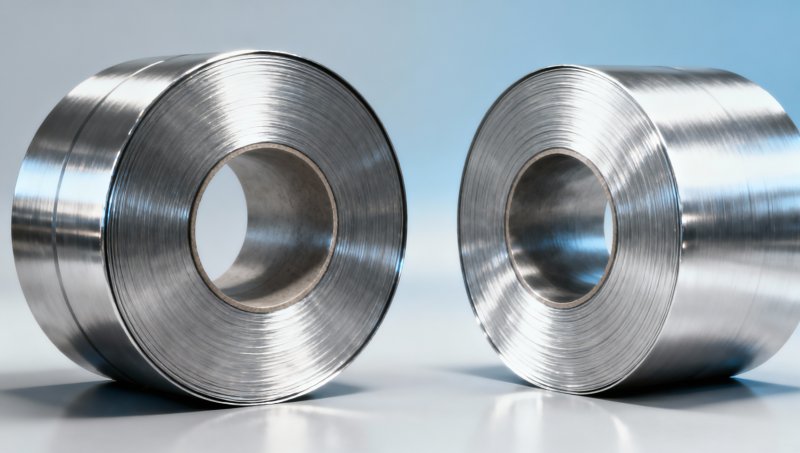
Mill test reports are your first line of defense—but only if you know what to verify. Below are five non-negotiable checks, each tied to real-world failure cases we’ve helped clients avoid:
- Chromium/Nickel Ratio Mismatch: True 304 requires Cr ≥18.0% and Ni ≥8.0%. If Ni reads 4.5–5.5% while Mn exceeds 7.5%, suspect 201-grade substitution.
- Carbon Content >0.08%: 304 must meet ≤0.08% C (ASTM A240). Readings above 0.10% often indicate 202 or re-melted scrap blends—not certified 304.
- Absence of Heat Number Traceability: Legitimate MTRs list a unique heat number linked to furnace batch records. Generic “N/A”, “LOT-XXXX”, or duplicated numbers signal documentation gaps.
- Mismatched Temper Designation: “304 HR” (hot rolled) and “304 CR” (cold rolled) have different yield strength ranges (205–310 MPa vs. 290–510 MPa). An MTR listing “304 CR” but reporting yield strength <270 MPa is physically inconsistent.
- No Reference to ASTM/EN Standard: Authentic 304 MTRs cite ASTM A240, EN 10088-2, or GB/T 20878 explicitly—not vague terms like “industrial grade” or “stainless type”.
How Substitution Impacts Real Applications
Material misrepresentation isn’t just paperwork—it alters mechanical behavior. For example, 201 stainless has ~25% lower pitting resistance equivalent number (PREN) than 304. In coastal infrastructure projects, this translates to premature perforation in cladding coils within 3–7 years versus the 15+ year design life expected from true 304.
Comparing 304, 201, and 316L — When Each Grade Fits Your Project
Choosing the right stainless coil isn’t about “best”—it’s about fit-for-purpose alignment. Below is a functional comparison of three widely sourced grades, based on verified production data from our ISO-certified rolling lines:
Note: The 316L Stainless Square steel rod offers superior resistance to chlorides and acids—making it ideal for marine hardware, chemical processing frames, and medical device components where 304 would degrade prematurely. Its higher molybdenum content (2–3%) delivers measurable lifecycle value in aggressive environments.
Why Hongteng Fengda’s MTR Verification Process Reduces Your Sourcing Risk
We don’t just ship stainless coil—we validate every claim. Our process includes:
- Pre-shipment Spectrographic Analysis: Each coil lot undergoes handheld XRF and lab-based OES testing against declared chemistry.
- Heat Number Cross-Reference: All MTRs are matched to furnace logs, rolling records, and annealing certificates.
- Third-Party Audit Access: Clients may request SGS or Bureau Veritas verification reports—available within 3–5 business days.
- Batch-Specific Documentation: No generic templates. Every MTR reflects actual test values—not averages or typographical placeholders.
This level of transparency supports compliance with ISO 9001, ASME BPVC Section II, and EU Construction Products Regulation (CPR) Annex ZA requirements—critical for public-sector tenders and regulated industries.
Get Verified Stainless Coil — With Full Traceability & Support
If you’re evaluating stainless steel coil suppliers for ongoing projects—or auditing recent deliveries for potential grade mismatches—Hongteng Fengda offers immediate support:
- Free MTR review service: Send us your current report—we’ll flag inconsistencies within 24 hours.
- Custom coil certification packages: Add EN 10204 3.2, ASTM E1866, or project-specific QA documentation.
- Lead time guarantee: Standard 304/316L coil orders shipped in 7–15 days from confirmed PO, with real-time logistics tracking.
- OEM coil slitting & edge conditioning: Available for precision width, thickness tolerance (±0.05 mm), and surface finish (No. 4, BA, or 2B).
Contact our technical sales team today to request a sample coil, verify your next MTR, or discuss custom solutions—including hybrid orders combining 316L Stainless Square steel rod with structural profiles for integrated fabrication.
Please give us a message


Please enter what you want to find