Selecting the right industrial wire for load-bearing and fatigue-critical applications requires more than a simple review of tensile strength. In structural and industrial steel use, wire grade influences deformation resistance, cycle life, weldability, corrosion behavior, standards compliance, and overall service reliability. When wire is exposed to repeated loading, vibration, bending, or environmental stress, the wrong grade can lead to premature failure, costly downtime, or safety risks. This guide explains how to evaluate industrial wire grades in a practical way, covering mechanical properties, common standards, fatigue factors, and sourcing checkpoints for demanding steel-related applications.
What does industrial wire grade mean in load and fatigue applications?
In technical terms, the grade of industrial wire refers to the material specification that defines its chemical composition, processing route, and expected mechanical performance. For steel wire, this may include carbon content, alloy additions, heat treatment condition, surface coating, and compliance with standards such as ASTM, EN, JIS, or GB. These factors determine whether the wire is suitable for static load, dynamic load, or repeated stress conditions.
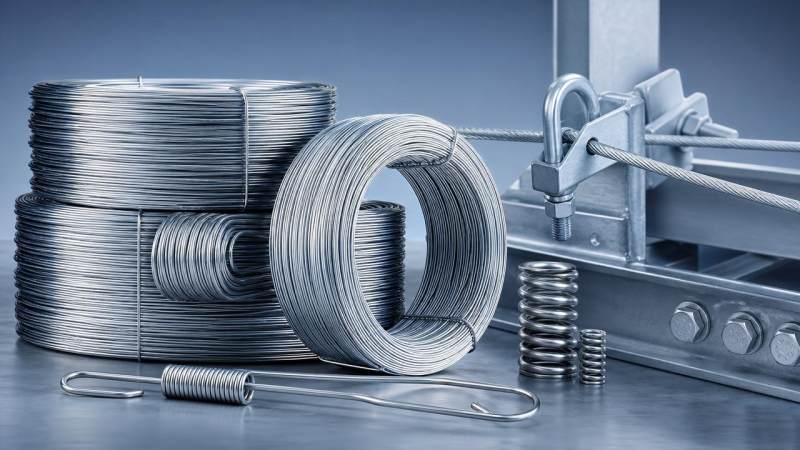
For load-bearing use, the main concern is whether the wire can carry a specified force without yielding, necking, or breaking. For fatigue use, the focus shifts to how the wire behaves under many stress cycles. A wire with high ultimate strength may still perform poorly if it has low ductility, poor surface quality, or stress concentrators that accelerate crack initiation. That is why grade selection should never rely on one number alone.
In steel industry practice, industrial wire is often used in reinforcement systems, spring elements, cable components, fastening systems, formed parts, welded assemblies, and support structures. The working condition matters as much as the nominal grade. If the application involves bending, vibration, impact, or cyclical loading, fatigue behavior becomes a critical selection criterion rather than an optional detail.
Which mechanical properties matter most when comparing industrial wire grades?
The most useful way to compare industrial wire grades is to evaluate a balanced property set instead of only strength. The first key metrics are tensile strength and yield strength. Tensile strength indicates the maximum stress the wire can withstand before fracture, while yield strength shows when permanent deformation begins. In structural or industrial systems, both values affect safety margin and dimensional stability.
Elongation and reduction of area are also important because they indicate ductility. A wire with adequate ductility can absorb localized stress and tolerate installation variation more effectively. In fatigue-sensitive applications, ductility can support crack resistance, especially where minor misalignment or shock loading is possible.
Hardness, impact toughness, and fatigue limit should also be reviewed. Harder wire may offer wear resistance, but excessive hardness can reduce bendability and increase crack sensitivity. Impact toughness becomes more relevant in low-temperature or variable-climate conditions. Surface condition is another major factor: decarburization, scale, scratches, or uneven coating can reduce fatigue life significantly even if the base material grade appears correct on paper.
When evaluating supporting steel members for assemblies that use wire-based fastening, bracing, or reinforcement, it is also useful to consider compatible structural components. For example, projects that combine wire systems with framed steel supports may specify Channel In Steel in grades such as Q195, Q235, Q345B, or stainless options like 304 and 316, depending on corrosion exposure and load demand. Matching wire performance with the surrounding steel system helps avoid uneven durability or fabrication issues.
How do fatigue conditions change the way industrial wire should be selected?
Fatigue loading changes the selection logic because failure can occur well below the wire’s ultimate tensile strength. Repeated stress cycles gradually initiate microcracks, often at the surface, at bends, or near contact points. Over time, these cracks grow until fracture occurs. This means industrial wire used in cyclic service should be chosen with attention to stress range, cycle count, bending radius, surface finish, and environmental exposure.
A practical assessment should include these questions:
- Is the wire under constant tension, fluctuating tension, or combined bending and tension?
- Will the wire experience vibration, shock, or resonance?
- Are there sharp bends, cut ends, weld zones, or clamping points?
- Is the service environment dry, humid, chemical, coastal, or high temperature?
- Does the design require galvanizing, stainless material, or post-forming treatment?
For fatigue-critical use, lower defect rates and tighter dimensional consistency often matter more than nominal strength alone. In many cases, a slightly lower-strength grade with better surface integrity and more stable processing will outperform a higher-strength wire that contains residual stresses or coating defects. This is especially true in steel assemblies exposed to movement, repeated load transfer, or seasonal expansion and contraction.
What standards, coatings, and material options should be checked?
Standards verification is essential when specifying industrial wire. Depending on the target market and application, buyers may need compliance with ASTM, EN, JIS, or GB requirements. The standard should match not only chemistry and strength, but also testing method, dimensional tolerance, and surface condition. If fatigue performance is critical, ask whether the inspection plan includes bend tests, torsion tests, coating adhesion checks, or metallographic review.
Coating choice also affects service life. Carbon steel wire may be suitable for indoor or protected use, while galvanized wire provides additional corrosion resistance for outdoor or humid conditions. Stainless wire may be preferred where chemical exposure, sanitation, or long life with minimal maintenance is required. However, stainless options do not automatically solve fatigue problems; alloy type, cold work level, and surface finish still matter.
In broader steel projects, supporting products such as U channel steel sections may also need matched standards and coating systems. For example, galvanized structural channels with thickness from 1.5mm to 25mm, height from 80mm to 160mm, and standards such as AISI, ASTM, DIN, JIS, BS, and GB/T are often selected to coordinate with corrosion-protected wire or fastening systems in construction and light manufacturing applications. This kind of material consistency improves overall project durability.
What are the most common mistakes when buying industrial wire for demanding steel applications?
One common mistake is specifying only diameter and strength without defining the service condition. Two wires with the same diameter and tensile value can behave very differently in fatigue, weldability, or corrosion resistance. Another mistake is overlooking tolerance and straightness. Dimensional inconsistency can create uneven stress, poor fitting, or process instability in fabrication.
A second major risk is ignoring surface quality. In fatigue use, small scratches or coating discontinuities can become crack initiation points. The third mistake is mixing incompatible materials within the same system. If the wire, brackets, channels, or connectors have very different corrosion behavior, galvanic or environmental degradation may reduce service life.
Lead time assumptions can also create problems. Some industrial wire grades are standard stock items, while others require custom drawing, heat treatment, coating, or testing. If the application is tied to a structural steel schedule, the wire delivery plan should be aligned with fabrication, inspection, and export timing. Reliable supply is often as important as the grade itself in global projects.
How can you compare industrial wire options quickly and make a safer decision?
A structured comparison table helps reduce selection errors. Instead of reviewing material certificates separately, compare each industrial wire option against the real operating demands.
A practical decision process starts with the load case, then checks fatigue exposure, environment, fabrication method, and standard requirements. After that, compare supplier documentation quality, test consistency, and ability to support custom or mixed steel packages. This is especially useful when wire products must integrate with structural sections, fabricated components, or corrosion-protected support systems.
How should sourcing strategy balance performance, cost, and delivery reliability?
The lowest unit price is rarely the best value in fatigue-sensitive steel applications. A cheaper industrial wire may increase inspection burden, replacement frequency, or installation loss. Instead, total value should include service life, reject rate, quality consistency, and lead-time reliability. Projects that involve export, fabrication coordination, or multiple steel product categories benefit from working with suppliers that understand both standard materials and customized structural solutions.
Hongteng Fengda, as a structural steel manufacturer and exporter from China, supports global construction, industrial, and manufacturing projects with stable production capacity, strict quality control, and compliance with major international standards. Beyond standard steel sections and customized structural components, this type of integrated supply capability can help align material grades, reduce sourcing risk, and improve schedule control when wire-related systems must perform alongside beams, channels, purlins, brackets, and other steel elements.
In summary, selecting industrial wire for load and fatigue use depends on more than nominal strength. The right decision requires a clear view of grade, ductility, fatigue resistance, coating, dimensional consistency, standards compliance, and supply stability. For demanding steel applications, start by defining the actual load cycle and environment, then compare wire options against a disciplined checklist rather than a single mechanical value. If your project also requires coordinated structural steel sections or customized support components, combining the evaluation of wire and related steel products early can improve reliability, cost control, and long-term performance.
Please give us a message


Please enter what you want to find