When specifying industrial I beam deflection limits, compliance with EN 1993-1-1 isn’t just best practice—it’s critical for structural integrity, safety, and project approval. As a trusted supplier I beam and structural steel manufacturer from China, Hongteng Fengda ensures every steel shelf angle, H shape steel, and cold formed steel profile meets stringent Eurocode requirements—alongside ASTM, GB, and JIS standards. Whether you're sourcing angle steel, galvanized metal mesh sheets, carbon plate steel, or thick steel wire for reinforcement, our engineered solutions support precise deflection control. For technical evaluation, procurement, or project execution, aligning your specs with EN 1993-1-1 starts with the right partner—and the right steel.
What Does EN 1993-1-1 Specify for I Beam Deflection?
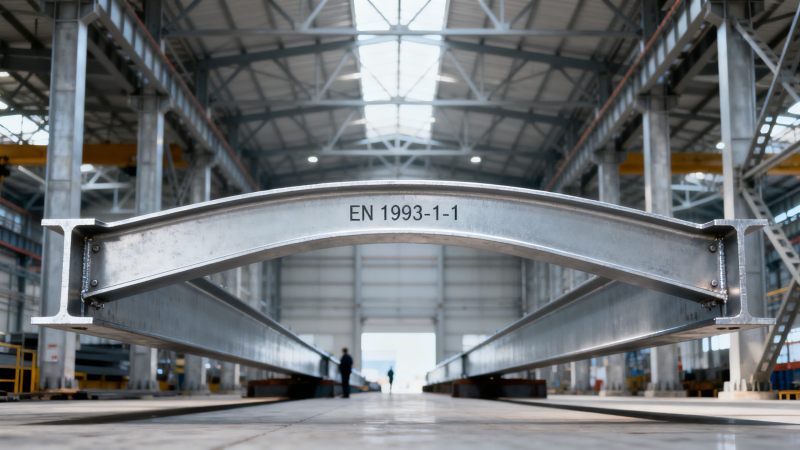
EN 1993-1-1 (Eurocode 3: Design of steel structures — Part 1-1: General rules and rules for buildings) defines serviceability limit state (SLS) criteria for deflection control in structural steel members. For simply supported I beams under uniform loading, the standard recommends a maximum allowable deflection of L/200 for total load and L/360 for live (imposed) load only—where L is the effective span length in millimeters.
These thresholds are not arbitrary. They prevent visible sagging, avoid damage to non-structural elements (e.g., cladding, ceilings, or partitions), and ensure occupant comfort—especially in long-span industrial floors or crane runway girders where dynamic loads apply. Exceeding L/360 may trigger rejection during third-party inspection across EU, UK, and Middle Eastern projects requiring CE marking or conformity assessment.
Crucially, EN 1993-1-1 does not prescribe fixed numerical values for all cases. It requires case-specific verification based on: (1) beam geometry (depth-to-span ratio ≥ 1/25 recommended), (2) connection stiffness, (3) loading pattern (point vs. distributed), and (4) secondary effects like camber compensation. That’s why generic “deflection calculators” often mislead—real-world validation demands full section property input and boundary condition modeling.
Key Deflection Thresholds per Application
This table reflects real-world design benchmarks used by structural engineers across Europe and GCC countries. Note that crane runway girders demand tighter tolerances due to dynamic wheel loads—requiring deeper sections or composite reinforcement. Our manufacturing team routinely validates such configurations using FEA-simulated load cases before production release.
How Do Your I Beam Specs Stack Up Against EN 1993-1-1?
Misalignment between procurement specs and EN 1993-1-1 typically stems from three gaps: (1) reliance on outdated national standards (e.g., BS 5950 without SLS updates), (2) omission of camber requirements in purchase orders, and (3) use of nominal section properties instead of actual mill test reports.
At Hongteng Fengda, every I beam batch undergoes certified dimensional verification—including depth, flange thickness, and web flatness—against EN 10034 and EN 10025-2. We supply full Mill Test Certificates (MTCs) showing measured second moment of area (Iy), elastic modulus (E = 210 GPa ± 5%), and yield strength variance (±12 MPa typical). This enables precise deflection calculation—not estimation.
For projects requiring pre-cambered beams (common in 12+ m spans), we offer controlled cold-bending per EN 1090-2 Execution Class EXC3—with deviation tolerance ≤ ±0.5 mm/m. This eliminates post-installation shimming and reduces on-site labor by up to 30% in high-rise industrial builds.
5 Critical Checks Before Finalizing Your I Beam Order
- Confirm whether your design uses gross or net section properties—especially if bolt holes or cutouts are present.
- Verify if the specified grade (e.g., S355JR vs. S355J2) includes guaranteed Charpy impact values at service temperature (−20°C minimum for outdoor cranes).
- Check if fire resistance rating (e.g., R30, R60) affects required section factor (A/V) and thus deflection under thermal load.
- Ensure weld procedure specifications (WPS) account for residual stress redistribution, which influences long-term creep deflection.
- Cross-reference anchorage details—base plate stiffness directly affects effective span length and thus calculated deflection.
Why Wire Rod Quality Matters in Supporting Deflection-Controlled Structures
While I beams bear primary loads, their performance depends on complementary components—including Wire Rod used in welded shear connectors, stud anchors, and reinforcement cages. Substandard wire rod introduces variability in bond strength, weld integrity, and ductility—compromising composite action between steel and concrete slabs, which directly impacts overall system stiffness and deflection behavior.
Our Wire Rod complies with multiple global standards—including GB1499.2 HRB400, ASTM A615 Grade 60, and AS/NZS 4671 500N—ensuring consistent tensile strength (≥500 MPa), elongation (>14%), and bendability (no cracks after 180° wrap around mandrel). Carbon content is tightly controlled at 0.06–0.22%, optimizing weldability without sacrificing yield point stability.
In petrochemical plants and wind-tower foundations—where cyclic loading induces fatigue-sensitive deflection—our wire rod’s low sulfur (<0.045%) and phosphorus (<0.045%) content minimizes embrittlement risk over 20+ years of service. Lead times average 7–15 days for standard diameters (6–16 mm), with traceable heat numbers and full chemical analysis per batch.
Why Partner with Hongteng Fengda for EN-Aligned Structural Steel?
You’re not just buying steel—you’re securing predictable engineering outcomes. With ISO 9001-certified production lines and in-house metallurgical labs, we deliver structural steel that performs as modeled—not just as specified.
We support your team through four phases: (1) Pre-order technical review (free deflection validation against EN 1993-1-1 within 48 hours), (2) Real-time production monitoring via shared portal (including MTC generation and dimensional QA logs), (3) Loading supervision with third-party witness (SGS/BV available), and (4) Post-delivery documentation package including EN 10204 3.2 certificates and weldability test reports.
Whether you need custom I beams for a logistics hub in Dubai, corrosion-resistant channel steel for an offshore platform in Norway, or precision-cut Wire Rod for seismic bracing in California—we align materials, testing, and delivery to your exact compliance roadmap. Contact us today for a no-obligation specification audit and timeline confirmation.
Please give us a message


Please enter what you want to find