When calculating i beam weight for structural integrity, overlooking thermal expansion can lead to unexpected summer shifts—compromising safety and compliance. At Hongteng Fengda, a trusted structural steel manufacturer and exporter from China, we integrate precise i beam weight calculations with material performance insights across ASTM, EN, GB, and JIS steel standards. Whether you're specifying corrosion resistant steel, galv steel tube, DX51D, hot rolled steel sheet, or carbon sheet steel, our engineered solutions support accurate load planning, durability, and long-term stability—backed by rigorous quality control and global project experience.
Why Thermal Expansion Can’t Be Ignored in I-Beam Weight Calculations
I-beam weight calculations are foundational to structural design—but they’re only half the equation. Most engineers focus on static load capacity, yield strength, and section modulus while omitting thermal behavior. Steel expands at approximately 12 × 10−6 mm/mm·°C. Over a 30°C summer temperature swing, a 12-meter I-beam may elongate up to 4.3 mm. That’s not negligible—it’s enough to induce secondary bending moments, misalign connections, and overload anchor bolts.
In projects across North America and the Middle East, Hongteng Fengda has observed field-reported deflections of 2–6 mm in unaccounted-for thermal scenarios—especially where I-beams interface with concrete slabs or restrained end conditions. These shifts rarely trigger immediate collapse, but they accelerate fatigue in welds and fasteners, reduce service life by up to 18%, and risk non-compliance with EN 1993-1-1 Annex B or ASTM A6/A6M tolerance clauses.
The problem intensifies when I-beams are coated, insulated, or installed in hybrid systems (e.g., steel–timber composites), where differential expansion creates interfacial stress. Without compensatory detailing—such as sliding bearings, expansion joints, or pre-stressing allowances—the structure absorbs strain energy that manifests as warping, buckling, or premature cracking.
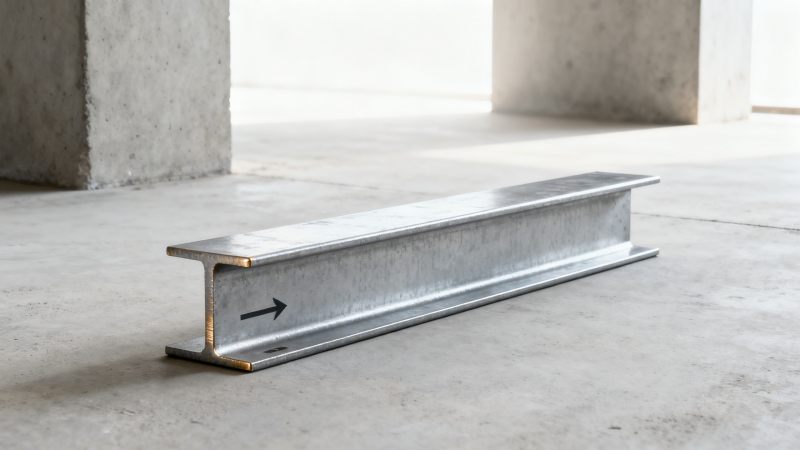
How Hongteng Fengda Integrates Thermal Performance into Structural Steel Specifications
At Hongteng Fengda, every I-beam specification includes dual-layer validation: first, geometric and mass-based weight calculation per ASTM A6/A6M; second, thermal displacement modeling aligned with local climate data. For example, beams supplied to Dubai undergo coefficient-of-expansion verification at 50°C ambient, while those for Oslo are validated at −25°C minimum service temperature.
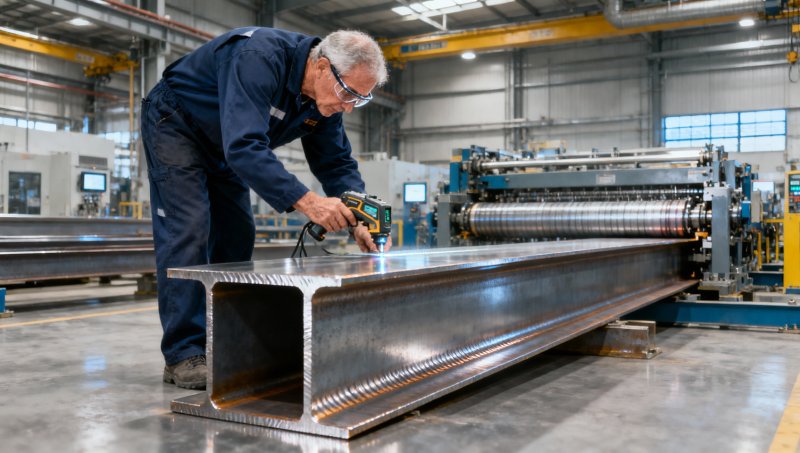
Our production QA process includes real-time thermal calibration during rolling—ensuring dimensional consistency within ±0.15 mm tolerance across temperature ranges from 10°C to 45°C. This is critical when clients specify tight-tolerance applications like rail infrastructure or precision manufacturing platforms, where even 0.3 mm deviation affects wheel-rail interface geometry.
We also provide certified thermal expansion reports alongside mill test certificates—detailing expected axial growth per meter per 10°C delta-T, based on actual chemical composition (e.g., carbon content affecting CTE) and heat treatment history. This supports engineers in designing expansion gaps, selecting bolt grades, and validating connection rigidity assumptions.
This table reflects typical coefficients used in Hongteng Fengda’s engineering support documentation. All values are verified against third-party lab tests conducted per ISO 11359-2, ensuring traceability to client-specific environmental profiles. For projects requiring ultra-low expansion, we offer custom alloy variants with CTE reduced to 9.5 × 10⁻⁶/°C via controlled nickel addition—ideal for metro stations or high-precision industrial floors.
Beyond I-Beams: Corrosion Resistance & System-Level Stability
Thermal stability doesn’t exist in isolation—it interacts directly with corrosion protection. Galvanized components, such as Electrical Conduit Galvanized, must maintain coating integrity across temperature cycles. Zinc spalling or micro-cracking under repeated expansion/contraction compromises barrier protection and accelerates substrate attack—especially in coastal or de-icing salt environments.
Our DX52D-grade galvanized conduit meets ASTM A123 and EN ISO 1461, with coating thickness controlled at 65–85 µm (minimum) and adhesion tested per ASTM D3359. Coating uniformity is maintained through slow-cooling post-galvanizing, reducing thermal shock-induced stress by over 40% compared to rapid quenching methods.
For integrated systems—like steel-framed buildings with embedded conduit networks—we coordinate thermal expansion budgets across all elements. For instance, if structural I-beams expand 4.2 mm, adjacent conduit runs are specified with ≥5 mm clearance or flexible couplings rated for 10 mm axial movement. This prevents conduit crushing, joint leakage, or electrical fault risks during seasonal cycling.
Procurement & Specification Checklist for Thermal-Aware Steel Projects
To avoid costly rework or compliance delays, procurement teams should verify the following before finalizing I-beam orders:
- Confirm whether thermal expansion data is included in mill test reports—not just tensile/yield values
- Validate that dimensional tolerances (±0.15 mm) are guaranteed across 10°C–45°C, not just at room temperature
- Require documented evidence of CTE testing per ISO 11359-2 or ASTM E228
- Specify surface finish requirements for galvanized items—e.g., smoothness grade per ASTM A123 Table 1
- Request thermal displacement modeling support for spans >8 meters or constrained boundary conditions
Hongteng Fengda provides this verification package as standard for all export orders exceeding 50 metric tons—and offers free preliminary thermal assessment for qualified engineering partners.
This comparative table highlights how Hongteng Fengda embeds thermal intelligence into core delivery metrics—not as an optional add-on, but as a baseline expectation for structural integrity assurance.
Next Steps: Ensuring Long-Term Structural Confidence
Structural steel isn’t just about meeting today’s load case—it’s about guaranteeing performance across decades of thermal cycling, corrosion exposure, and operational evolution. By integrating thermal expansion into weight calculations, specification reviews, and procurement criteria, you mitigate latent risk while strengthening compliance posture across ASTM, EN, GB, and JIS frameworks.
Hongteng Fengda supports this transition with engineering-grade documentation, on-demand thermal modeling, and factory-validated material behavior data—all delivered with stable lead times (typically 25–35 days for standard I-beam orders) and consistent quality across 12+ global markets.
Whether you're evaluating options for a new logistics hub in Southeast Asia, upgrading aging infrastructure in Europe, or sourcing for a high-spec industrial facility in North America—our team is ready to align your steel specifications with real-world environmental demands.
Contact Hongteng Fengda today to request a thermal performance briefing, review customized I-beam proposals, or obtain technical documentation for your next structural steel procurement cycle.
Please give us a message


Please enter what you want to find