Steel C channel beam is widely used in construction, framing, support systems, and industrial structures thanks to its strength, versatility, and cost efficiency. For buyers comparing steel c channel beam options with broader structural steel solutions, understanding its common applications, load performance, and material standards helps improve project planning, sourcing decisions, and long-term value.
In practical purchasing and engineering work, the question is not only where a C channel can be used, but also how to match section size, steel grade, coating, fabrication method, and delivery requirements to the actual load case. This is especially important for contractors, technical evaluators, project managers, distributors, and procurement teams working across different markets and standards.
As a structural steel manufacturer and exporter from China, Hongteng Fengda supplies channel steel, steel beams, angle steel, cold formed profiles, and custom steel components for global projects. With production aligned to ASTM, EN, JIS, and GB requirements, the company supports buyers who need stable quality, OEM processing, and dependable lead times for construction, industrial, and manufacturing applications.
Where Steel C Channel Beam Is Commonly Used
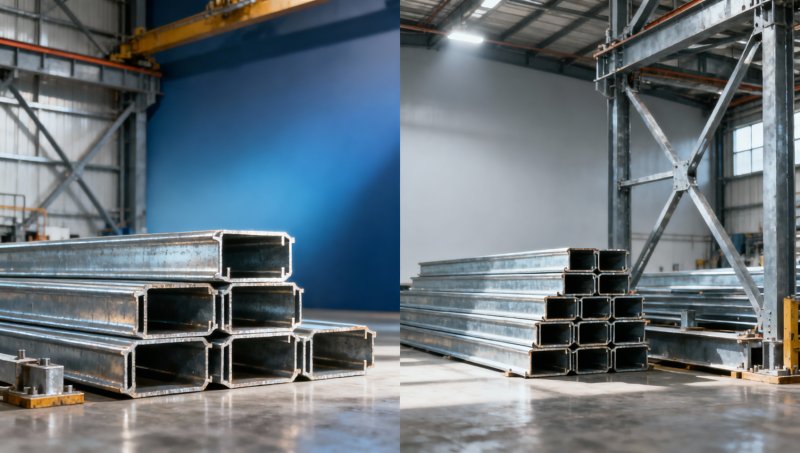
A steel C channel beam is a structural section with a web and two flanges, forming a “C” profile. Because of this geometry, it is frequently selected for framing, bracing, support rails, platform structures, equipment bases, trailer bodies, warehouse systems, and secondary building members. In many projects, it offers a practical balance between strength, weight, and ease of fabrication.
In building construction, steel C channel beam sections are widely used for purlins, girts, wall studs, lintel supports, stair framing, and roof support members. Typical light-to-medium applications may use thicknesses from 3 mm to 8 mm, while heavier structural or industrial uses may require larger hot rolled sections with higher load capacity and better resistance to local deformation.
In industrial environments, C channels are often used for conveyor frames, equipment skids, machine guards, pipe racks, cable trays, and maintenance walkways. Operators and plant engineers prefer them because the open section allows relatively simple drilling, bolting, and welding. This can reduce fabrication steps from 5 or 6 operations to 3 or 4 in some standardized assemblies.
For transport and manufacturing, C channels are also common in vehicle chassis substructures, storage rack frames, agricultural equipment, and modular steel assemblies. Compared with more complex fabricated sections, a standard channel can shorten sourcing and machining time by 7–15 days when standard stock sizes are available from the supplier.
Typical application categories
- Building structures: roof framing, wall supports, door frames, mezzanine members, and bracing systems.
- Industrial facilities: machinery supports, cable support systems, maintenance platforms, and utility frames.
- Infrastructure and civil works: guard structures, access frames, light retaining support members, and temporary works.
- Fabricated products: trailers, container reinforcement, storage systems, and OEM structural assemblies.
The following table shows how steel C channel beam sections are typically matched to application needs. Final sizing should always be checked against span, point load, connection method, and local code requirements.
For most buyers, the key conclusion is simple: steel C channel beam sections are not limited to one sector. Their value comes from cross-industry flexibility. When dimensions, material, and processing are chosen correctly, the same basic profile can support building, industrial, OEM, and export-oriented fabrication needs with lower complexity than many built-up sections.
How Load Performance, Material Grade, and Standards Affect Selection
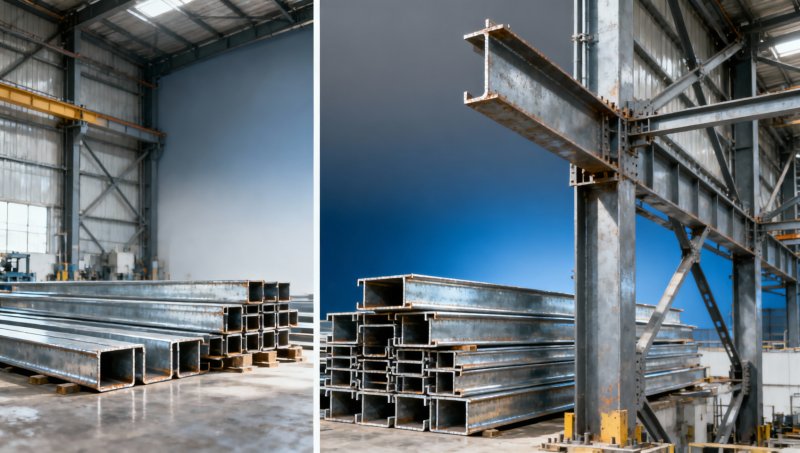
The real performance of a steel C channel beam depends on more than its shape. Load behavior is influenced by web height, flange width, thickness, steel grade, unsupported span, connection type, and whether the load is uniformly distributed or concentrated at one point. A section that works well over a 1.5 m span may not be suitable at 4 m without reinforcement or redesign.
Material grade matters because yield strength directly affects structural capacity. In international projects, buyers often compare ASTM, EN, JIS, or GB specifications. While equivalents are not always exact, common structural grades are generally selected based on yield strength, weldability, impact requirements, and corrosion environment. Technical evaluation should also include mill test certificates and tolerance compliance.
Hot rolled channel steel is usually preferred for heavier structural loads and larger dimensions, while cold formed channels may be chosen for light framing, modular systems, and thinner-wall sections. In practice, hot rolled sections often offer better robustness under demanding site conditions, especially where repeated loading, vibration, or connection stress concentration may occur.
For quality and procurement teams, standards are equally important. Products supplied to different regions may need to align with ASTM for North America, EN for Europe, JIS for Japan-related projects, or GB for domestic and export manufacturing. A supplier that can work across 3 or 4 major standards reduces sourcing risk and simplifies cross-border project coordination.
Key technical checks before ordering
- Confirm design load, including static load, dynamic load, and any impact or vibration condition.
- Check span length, support spacing, and deflection limit, especially for platform or rack structures.
- Match steel grade and standard to the project specification, such as ASTM, EN, JIS, or GB.
- Review fabrication needs such as punching, cutting, welding, galvanizing, or pre-assembly.
- Verify dimensional tolerances, straightness, and certificate requirements before production release.
Why procurement should not rely on size alone
Two channel sections with similar outer dimensions may perform differently if thickness, steel grade, or manufacturing method changes. A 150 mm section in one grade may not be interchangeable with another if the wall thickness differs by 1.5 mm to 3 mm or if the connection hole layout changes. This is a common source of procurement error in multi-supplier purchasing.
The table below summarizes practical selection factors for different buyer roles, from engineers to finance and safety teams.
The main takeaway is that channel selection should be engineering-led but purchasing-aware. A lower unit price does not always reduce total project cost if rework, delayed installation, or non-compliance adds 2–4 weeks to the schedule. Good sourcing decisions combine structural performance, standard alignment, and reliable delivery.
Comparing Steel C Channel Beam with Other Structural Steel Solutions
Buyers rarely evaluate steel C channel beam sections in isolation. In real projects, they are compared with I beams, angle steel, rectangular hollow sections, cold formed profiles, and sometimes sheet pile or fabricated assemblies. The right choice depends on function. A channel is efficient for support framing and secondary members, but not always the best solution for deep retaining or high moment main beams.
For example, in wall support or foundation-related work where continuous earth or water retention is required, a dedicated retaining profile is more suitable than a standard channel. In such cases, products such as Hot Rolled Steel Sheet Pile may be considered for retaining wall and water retaining wall projects. U Sheet Pile options can be freely combined to form a continuous and tight barrier, with material choices including S275, S355, S390, S430, SY295, SY390, and ASTM A690.
This contrast is useful for decision-makers. A steel C channel beam performs well where open-section framing, bolted support systems, and fabrication flexibility are priorities. A sheet pile system is typically selected when interlock performance, soil retention, or water control is the main requirement. Choosing the wrong product category can increase both material waste and site labor.
From a sourcing perspective, comparing alternatives also means reviewing standards, customization range, and delivery form. For instance, sheet piles may be supplied under EN10248, EN10249, JIS5528, JIS5523, or ASTM, with interlock types such as Larssen locks, cold rolled interlock, and hot rolled interlock. Single lengths can exceed 80 m in special projects, which is very different from typical channel supply logistics.
When to choose a C channel and when to choose another section
- Choose steel C channel beam sections when the project needs framing efficiency, easy drilling or welding, and moderate structural demand.
- Choose I or H beams when major load-bearing capacity and bending resistance are primary design drivers.
- Choose angle steel for bracing, edge reinforcement, and simple connector-based structures with lower complexity.
- Choose specialized sheet pile systems for permanent or temporary retaining walls, marine work, and water-sealing structures.
The following comparison table helps procurement and engineering teams distinguish where each steel product type creates the most value.
The conclusion from this comparison is practical: a C channel should be chosen for what it does best, not forced into applications that require a different profile system. For project managers and buyers, this approach reduces specification mismatch, avoids site delays, and supports more predictable cost control.
Procurement, Quality Control, and Delivery Considerations
For global buyers, the performance of a steel C channel beam is only one part of the decision. Supply reliability, manufacturing consistency, export packaging, and document control are equally important. A technically correct section can still create project risk if dimensional variation causes fit-up problems or if the shipment arrives 10–20 days later than the construction sequence requires.
A structured procurement process usually includes 4 stages: technical confirmation, quotation comparison, production inspection, and shipping approval. This process helps align engineering and commercial teams. For distributors and contractors, it also improves inventory planning because repeat orders can be based on confirmed section data, not only on past supplier habits or informal drawings.
Quality control should cover dimensional tolerance, straightness, surface condition, material certificate review, and fabrication accuracy if the channels are cut, punched, or welded. On large projects, sampling from each batch is common. Even a tolerance drift of ±1 mm to ±2 mm may affect bolted assembly when there are multiple connection points across repeated modules.
Lead time depends on whether the order is for standard stock sizes or custom processing. Standard channel sections may move faster, while OEM orders with punching, special lengths, galvanizing, or bundled assemblies usually need additional production scheduling. In many export cases, buyers should allow 2–4 weeks for production and further time for packing, port handling, and sea freight.
A practical supplier evaluation checklist
- Can the supplier produce to ASTM, EN, JIS, or GB according to the project requirement?
- Can the factory provide standard sizes and custom processing in the same order?
- Are MTCs, inspection records, and packing details clear before shipment?
- Is there stable capacity for repeat orders across several batches or project phases?
- Does the supplier understand export handling for North America, Europe, the Middle East, or Southeast Asia?
Why a manufacturer-exporter model helps B2B buyers
Working with a manufacturer that also handles export coordination can reduce communication layers. It often improves response speed on drawing changes, quantity adjustments, and inspection issues. For procurement teams managing budget approval and project schedule at the same time, this can simplify the entire chain from inquiry to delivery.
Hongteng Fengda focuses on structural steel manufacturing and export, including angle steel, channel steel, steel beams, cold formed profiles, and customized steel components. With modern production facilities and quality control aligned to major international standards, the company supports global buyers that need stable production capacity, consistent quality, and dependable lead times rather than one-time spot supply only.
Common Mistakes, FAQs, and Practical Buying Advice
One of the most common mistakes is assuming all channel sections are interchangeable. In reality, small differences in web thickness, flange geometry, steel grade, or hole location can change both structural performance and installation efficiency. Another mistake is selecting only by unit price without reviewing coating, certification, or fabrication scope, which may increase total cost later.
A second risk is underestimating service environment. Indoor dry applications may accept black steel or basic priming, while outdoor or humid environments may require galvanizing or a more robust coating system. If corrosion protection is overlooked at the purchasing stage, maintenance cost can rise significantly within the first 12–24 months of service.
Buyers should also avoid vague RFQs. A complete request should include section size, grade, standard, quantity, length range, surface treatment, fabrication requirements, destination port, and certificate needs. This reduces quotation gaps and makes supplier comparison more accurate from both technical and commercial angles.
Below are several frequently asked questions that often influence final selection and approval decisions.
How do I choose the right steel C channel beam size?
Start with the design load, span, and support condition. Then check whether the member will face static load only or vibration and repeated loading. In many projects, engineers review 3 factors first: section modulus, deflection limit, and connection layout. If the member is part of a larger assembly, fabrication tolerances should be checked at the same time.
Is hot rolled or cold formed channel better?
It depends on the duty level. Hot rolled channels are generally preferred for heavier structural use and more demanding site conditions. Cold formed channels are often suitable for lighter framing, modular building systems, and applications where lower weight and easier forming are priorities. The right choice should match the load case and fabrication process, not preference alone.
What should procurement teams request from suppliers?
At minimum, request the grade and standard confirmation, section drawing or dimensions, surface condition, length tolerance, packing method, delivery time, and inspection documents. For export orders, ask whether the supplier can support marking, palletization or bundling, and port documentation. These details often affect both customs clearance and on-site handling efficiency.
How long does delivery usually take?
For standard channel steel, lead time may be relatively short if stock or regular rolling schedules are available. For customized processing, many projects should allow around 2–4 weeks for production, plus shipping time based on destination. Bulk orders, mixed specifications, and coating processes can extend schedules, so timeline confirmation should be part of contract review.
Steel C channel beam sections remain one of the most practical structural steel choices for framing, supports, industrial assemblies, and OEM fabrication because they combine versatility, cost efficiency, and straightforward processing. The best results come from matching the section to actual load conditions, standards, environment, and fabrication needs rather than purchasing on size or price alone.
For buyers, engineers, distributors, and project teams seeking reliable structural steel supply, Hongteng Fengda provides standard and customized channel steel, beams, angle steel, and related structural products for international projects. If you need help comparing specifications, confirming standards, or building a cost-effective sourcing plan, contact us now to get a tailored solution, technical support, and detailed product information.
Please give us a message


Please enter what you want to find