In load-critical applications, choosing between a high tensile steel rod and standard grades directly affects strength, safety, and lifecycle cost. For technical evaluators, understanding the differences in mechanical performance, compliance standards, and sourcing reliability is essential before specification. This article compares key properties, application fit, and procurement considerations to support more accurate structural steel decisions.
Why a checklist-based review is necessary before selecting a high tensile steel rod
For technical evaluation teams, the fastest way to avoid mis-specification is to review load-critical steel through a structured checklist instead of a purely price-led comparison. A high tensile steel rod may deliver higher yield strength, better stress resistance, and lower section demand, but these advantages only matter when the rod grade, welding suitability, forming method, and compliance documents all match the project conditions.
In practical procurement, the difference between high tensile and standard grades is not just a mechanical number. It affects at least 5 core decision points: design load, safety margin, fabrication method, corrosion protection, and delivery consistency. On projects with repeated dynamic loading, long spans, anchoring demand, or concentrated force transfer, a wrong material choice can create higher maintenance exposure within 12 to 36 months, even when initial installation appears acceptable.
A checklist method also helps evaluators compare suppliers on equal terms. Many quotations look similar until you verify mill standard, tolerance range, heat traceability, surface condition, and test certificate format. In structural steel sourcing, especially across export markets, consistent compliance with ASTM, EN, JIS, or GB often matters as much as the nominal strength rating itself.
First-pass review: the 6 items to confirm before comparing offers
- Confirm the required load case: static, cyclic, impact, or fatigue-sensitive service.
- Check the minimum yield and tensile strength required by the design code, not only the supplier description.
- Verify whether diameter tolerance, straightness, and length tolerance affect assembly or anchoring accuracy.
- Review fabrication steps such as bending, threading, welding, or galvanizing before final grade selection.
- Match the rod to environmental exposure, including humidity, chlorides, temperature swing, and outdoor storage duration.
- Request traceable documents: chemical composition, mechanical properties, standard reference, and batch inspection records.
When these 6 items are checked early, the comparison between a high tensile steel rod and standard grades becomes more objective. It also reduces the common issue of approving a stronger grade that later creates fabrication difficulty, or approving a cheaper standard grade that requires a larger diameter, more pieces, or tighter inspection control to achieve the same design intent.
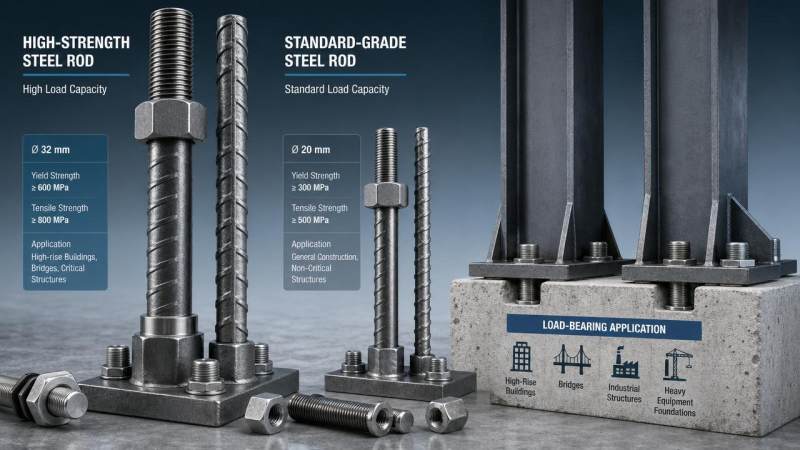
Core comparison checklist: high tensile steel rod vs standard grades
The most useful technical comparison starts with performance categories that directly influence structural behavior. Evaluators should review yield strength, ultimate tensile strength, ductility, elongation, fatigue suitability, and dimensional availability. In many industrial and construction applications, the actual decision is a balance between strength reserve and fabrication practicality rather than strength alone.
As a general guide, standard structural rod grades often serve where loading is moderate, dimensions are not tightly constrained, and cost sensitivity is high. A high tensile steel rod becomes more relevant where design loads increase, member count must be reduced, or where diameter limits are fixed by connection geometry, sleeves, anchors, or confined installation zones.
The table below provides a practical checklist for side-by-side evaluation. Values vary by standard and grade family, so they should be used as a screening reference, then confirmed against the actual mill specification and project code.
This comparison shows why a high tensile steel rod is not automatically the better choice in every case. If the design allows a larger bar size, the connection details are simple, and the loading is mainly static, a standard grade may provide sufficient performance at lower fabrication risk. On the other hand, where every 1 mm to 4 mm of diameter reduction helps fit the assembly, higher strength can create measurable design flexibility.
Checklist for mechanical and compliance review
- Check minimum yield strength and tensile strength against the design basis, not just marketing terminology.
- Review elongation and ductility values where seismic performance, deformation demand, or impact loading may occur.
- Confirm whether the grade is supplied under ASTM, EN, JIS, or GB, and whether the project accepts equivalent standards.
- Verify if the product is hot rolled, cold formed, heat treated, or otherwise processed, because this affects performance consistency.
- Request mill test certificates with batch-level data if the application is safety-sensitive or inspection-led.
A technical evaluator should also note that two products with similar nominal strength may perform differently in bending, threading, or welding because of chemistry, rolling process, and tolerance control. That is why compliance review should include both mechanical values and manufacturing route.
How to judge application fit in construction and industrial load paths
Application fit should be judged by load path, connection type, and service environment. In construction projects, a high tensile steel rod is frequently considered where tensile demand is concentrated, where reinforcement density must be optimized, or where long-term load performance matters. In industrial settings, the same logic applies to tie systems, anchoring assemblies, support members, and components exposed to repetitive force transfer.
A useful middle-stage check is to determine whether the material is acting as a primary load-bearing element or only as an auxiliary part. When the rod is part of the primary structural resistance system, technical teams should evaluate code acceptance, inspection requirements, and replacement difficulty over a design horizon that may run 10 years, 20 years, or longer. This is where conservative grade verification becomes more valuable than short-term material savings.
For reinforced concrete and mainstream construction work, evaluators may also compare rod-grade decisions with rebar options that are already standardized for major load-bearing use. One practical reference is HRB400 Rebar, a widely used hot-rolled ribbed bar for construction projects. Its standard yield strength is no less than 400 MPa, and common sizes range from 6 mm to 50 mm with lengths such as 5 m to 14 m, 5.8 m, 6 m, and 12 m. It is typically supplied under standards including ASTM, JIS, AISI, DIN, BS, EN, and GB, which helps technical teams compare grade suitability, certification expectations, and dimensional availability in a more structured way.
Application checklist by scenario
- For congested reinforcement zones, prioritize higher strength only if anchorage, bend radius, and code acceptance are confirmed.
- For exposed outdoor structures, assess corrosion protection together with grade selection, because coating quality may determine service life more than nominal strength.
- For threaded or machined rod ends, verify dimensional tolerance and machinability before finalizing a higher-strength option.
- For fabricated assemblies requiring site welding, confirm weld procedure compatibility and heat input control.
- For export projects, make sure the specified grade language aligns with the receiving market’s accepted standard system.
When standard grades may still be the better technical choice
Standard grades can remain the better option when there is enough design space for larger diameters, when field adjustment is likely, or when the fabrication chain is distributed across multiple subcontractors with varying process control levels. In these cases, a slightly lower strength but easier-to-handle material may reduce the risk of improper bending, overheating, or installation deviation.
This is especially true on medium-load projects where the total steel tonnage difference is limited. A 3% to 8% material saving from strength optimization can be offset if the project needs extra threading, stricter inspection, or slower fabrication. Technical evaluators should therefore assess total execution impact, not only theoretical material reduction.
In short, application fit is a systems decision. The right answer depends on whether the stronger rod solves a real constraint in the structure, connection, installation sequence, or lifecycle maintenance plan.
Risk checks that are often missed during evaluation and sourcing
Several recurring risks appear when buyers compare a high tensile steel rod with standard grades only by nominal specification. The first is assuming that higher strength automatically improves safety. In reality, if the design, detailing, or fabrication procedure does not support the grade, the result may be lower installation reliability rather than better structural performance.
The second missed issue is document inconsistency. Some offers list broad standard families but do not clearly state the exact grade, test method, or delivery condition. For technical evaluation, this gap matters. A batch with acceptable tensile strength but unclear elongation, chemistry, or surface treatment may still be unsuitable for the intended application, especially where field threading, welding, or coating adhesion is required.
The third issue is lead time variability. Higher-strength products, nonstandard diameters, and custom surface treatments can add 2 to 6 weeks compared with regular stock dimensions. That affects not only procurement timing but also approval sequencing, sample testing, and logistics planning for international projects.
The following table highlights common risk points and the corresponding checks that should be built into technical review and supplier qualification.
These risk checks are particularly important for import procurement. A supplier may be technically capable, but if documentation flow, packaging protection, or dimensional control are inconsistent, the downstream impact can include customs delay, on-site rejection, or costly rework. That is why sourcing reliability should be evaluated alongside material performance.
Practical warning signs during supplier review
- Quoted grade name is clear, but no matching standard edition or test scope is provided.
- Mechanical values are shown as generic ranges without batch traceability.
- Diameter availability does not match the exact required schedule, such as 12 m fixed lengths or special cut lengths.
- Surface finish is offered without clarification on storage period, anti-rust treatment, or export packing method.
- Lead time is unusually short for a custom grade, which may indicate substitution risk or incomplete production planning.
A disciplined review of these warning signs can prevent specification drift and protect both engineering quality and project schedule. For technical evaluators, this is often where the real difference between a dependable supplier and a low-visibility source becomes visible.
Execution guide: what technical evaluators should prepare before final approval
Before approving a high tensile steel rod for load-critical work, technical teams should prepare a concise decision package. This package normally includes the target standard, minimum mechanical properties, diameter and length schedule, fabrication method, surface treatment, inspection expectations, and delivery timeline. A complete package improves quotation quality and reduces the risk of receiving technically incomplete offers.
For global procurement, it is also useful to define acceptable equivalent standards in advance. If a project references ASTM but can accept EN or GB equivalents under controlled review, buyers can widen the sourcing pool while keeping technical control. This can matter when required sizes range from 6 mm to 50 mm or when staged deliveries are needed across several shipment windows.
A disciplined approval process should cover at least 4 stages: specification confirmation, supplier document review, sample or batch verification where needed, and logistics coordination. On larger projects, this sequence can save several rounds of clarification and reduce the chance of re-issuing procurement documents after fabrication has already started.
Recommended approval checklist
- Define whether the rod is a primary load-bearing element, a reinforcement component, or a connection-related part.
- List the required mechanical thresholds, including yield strength and any ductility-related criteria.
- Confirm size schedule, tolerances, and preferred lengths such as 5.8 m, 6 m, 12 m, or project-specific cut lengths.
- State the required finish: galvanized, painted, transparent oil, anti-rust oil, or other protective condition.
- Specify document needs, such as standard reference, inspection records, and traceability format.
- Ask suppliers to clarify production lead time, packaging method, and export support before award.
Why work with a structural steel manufacturer and exporter with broad standard coverage
When projects involve multiple steel categories, technical evaluators benefit from working with a supplier that understands both product specification and export execution. Hongteng Fengda, as a structural steel manufacturer and exporter from China, supports global construction, industrial, and manufacturing projects with angle steel, channel steel, steel beams, cold formed steel profiles, and customized structural steel components. This kind of supply scope is useful when rod selection is part of a larger structural package rather than an isolated purchase.
Broad familiarity with ASTM, EN, JIS, and GB standards also helps technical teams compare alternatives more efficiently. Instead of evaluating each steel item in isolation, buyers can coordinate material grade, documentation, production planning, and delivery lead time across the full package. That approach often improves schedule predictability and lowers sourcing risk for cross-border projects.
In load-critical work, the best decision is rarely the lowest unit price or the highest nominal strength in isolation. The better choice is the one that matches design demand, fabrication reality, compliance expectations, and supply reliability at the same time. That is the core principle behind effective evaluation of a high tensile steel rod versus standard grades.
Contact us for technical confirmation and sourcing support
If you are comparing a high tensile steel rod with standard grades for a structural or industrial application, we can help you review the key technical points before ordering. Our team can support parameter confirmation, grade selection, size matching, standard comparison, coating options, and delivery planning based on your project requirements.
You can contact us to discuss material strength targets, diameter and length availability, OEM or customized structural steel solutions, certification expectations, sample support, production lead time, and export packing details. This is especially useful when your evaluation must align design needs with procurement efficiency and documentation control.
Why choose us: Hongteng Fengda provides stable production capacity, consistent quality control, and practical export support for global buyers. If you need a clearer recommendation on whether a high tensile steel rod or a standard grade is the better fit, send us your drawings, required standards, quantity range, and target delivery schedule for a focused quotation and technical review.
Please give us a message


Please enter what you want to find