High strength steel tubing makes thinner walls and lighter structures possible, but the real decision goes beyond material strength alone. For technical evaluators, the key is balancing load performance, weldability, fabrication limits, cost, and compliance with project standards. Understanding this tradeoff helps buyers choose tubing that delivers both structural efficiency and long-term reliability.
Why is high strength steel tubing getting so much attention in structural projects?
The growing interest in high strength steel tubing comes from a simple engineering objective: reduce dead weight while maintaining required load capacity. In many building frames, support members, equipment bases, transport structures, and fabricated assemblies, wall thickness can sometimes be reduced by 10% to 30% when a higher strength grade is selected. That reduction can lower total steel tonnage, ease handling, and improve logistics efficiency across long-distance supply chains.
For technical evaluation teams, however, the material decision is rarely based on yield strength alone. Tubing performs as part of a system that includes welding procedure, joint geometry, hole making, galvanizing or coating, tolerances, and service environment. A stronger tube may look better on paper, but if it increases forming difficulty or requires tighter process control, the total project benefit may narrow quickly.
This is especially relevant in export-oriented sourcing, where steel products may need to align with ASTM, EN, JIS, or GB specifications depending on the destination market. Structural steel buyers in North America, Europe, the Middle East, and Southeast Asia often compare not only section properties, but also mill consistency, lead time stability, and documentation readiness. In practice, high strength steel tubing becomes attractive when the entire procurement and fabrication chain can support it, not just when the tensile numbers look higher.
What are buyers usually trying to improve?
- Lower structural weight for easier transport, lifting, and installation.
- Reduce wall thickness while preserving section performance in specific load cases.
- Improve material efficiency in repetitive fabricated components.
- Meet project standards without overdesigning every member.
- Control cost through optimized tonnage rather than only lower unit price.
In other words, the keyword high strength steel tubing is often linked to a broader technical and commercial question: can the project achieve lower weight and acceptable cost without creating new fabrication risks? That is the real evaluation framework.
What does “thinner walls” actually mean, and where is the tradeoff?
Thinner walls do not automatically mean weaker structures. If the tube grade has higher yield strength, engineers may be able to specify a lower wall thickness and still achieve required design resistance in axial, bending, or combined loading. But section behavior depends on more than material strength. Local buckling sensitivity increases as wall thickness decreases, and that can limit how much practical benefit the designer gains from a stronger steel grade.
This is why technical evaluators must distinguish between material strength and member efficiency. A tube with 20% higher yield strength does not always translate into 20% thinner walls. Depending on width-to-thickness ratio, connection design, welding heat input, and service conditions, the usable reduction may be much smaller. For some rectangular and square hollow sections, local stability and fabrication tolerance become the governing factors before the steel’s nominal strength is fully utilized.
The tradeoff becomes sharper in projects involving repeated welded nodes, slotted holes, or field modifications. A lighter tube can reduce shipping mass over hundreds of pieces, yet a thin wall may be less forgiving during fit-up, drilling, or on-site handling. This is why experienced sourcing teams review not just structural calculations, but also process windows, reject risk, and the expected skill level of the fabrication shop.
A practical comparison table for evaluation
The table below summarizes how technical teams typically compare conventional tubing with high strength steel tubing when thinner walls are being considered for structural use.
The key reading is that high strength steel tubing improves the design toolbox, but not every member benefits equally. Compression elements, welded frames, and thin-walled sections need closer review than a simple strength comparison would suggest.
Where do projects gain the most value?
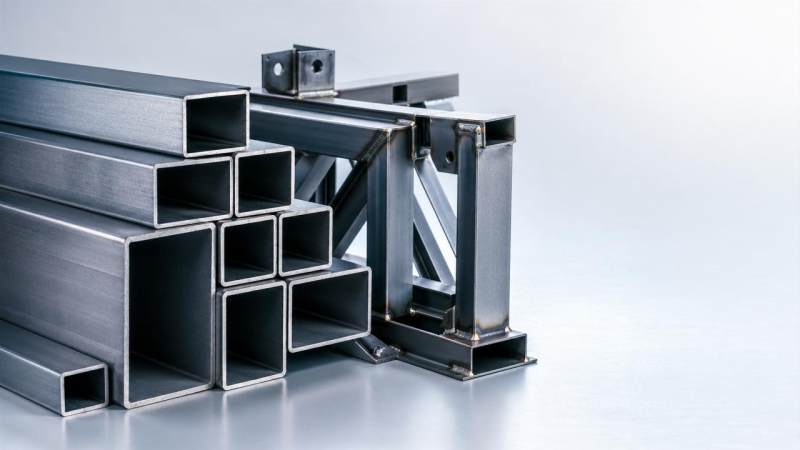
Value is often strongest in transport-sensitive projects, modular construction, pre-engineered structures, equipment skids, and assemblies shipped in large quantities. When freight, erection time, or crane capacity matters, even a 5% to 15% mass reduction can improve total project economics. When fabrication complexity is high, the benefit must be reviewed more carefully.
How should technical evaluators judge whether high strength steel tubing is the right choice?
A sound evaluation starts with the actual governing requirement. Is the design controlled by yield, deflection, local buckling, fatigue, weld detail, or corrosion allowance? If the structure is deflection-controlled, changing to a higher strength grade may deliver little improvement unless section geometry also changes. If local buckling governs, reducing wall thickness too far may cancel the theoretical gain of stronger steel.
The second step is to map fabrication realities. Technical teams should ask whether the tube will be laser cut, saw cut, cold formed, bent, punched, coped, or heavily welded. In many factories, moving from a standard wall to a thinner high strength wall changes setup tolerance, distortion behavior, and rework rate. A material that saves 8% in mass but causes 3% to 5% more fabrication loss may not be the better decision.
The third step is standards compliance. International projects often require mill test documentation, chemical composition review, mechanical property verification, and traceability matching to destination specifications. A supplier with experience across ASTM, EN, JIS, and GB frameworks can help align these expectations early, which reduces technical approval delays that may otherwise add 1 to 3 weeks to procurement cycles.
A practical checklist before approval
- Confirm whether yield strength or local buckling is the real governing limit.
- Review weldability, including procedure qualification and expected heat input range.
- Check dimensional tolerance requirements for thin-wall sections.
- Verify corrosion strategy, especially if wall reduction leaves less thickness reserve.
- Confirm applicable standards and document package before order release.
- Compare total installed cost, not only steel price per ton.
A balanced sourcing approach may also include complementary material options for non-primary parts. For example, in some mixed-material assemblies, buyers evaluating structural tubing may also review stainless components for wear, appearance, or corrosion-related functions. A relevant example is 310 Stainless Square steel rod, which can be supplied in square bar ranges such as 18mm to 47mm, with standards including ASTM, AISI, JIS, GB, DIN, and EN. Although it serves different applications than structural tubing, it illustrates how technical procurement often combines strength, forming behavior, surface condition, and specification matching within one project workflow.
For technical evaluators, the point is not to treat every steel item as interchangeable. High strength steel tubing should be selected for structural efficiency, while bar and rod products are assessed on their own performance requirements, such as machining, surface finish, or corrosion exposure. Good procurement decisions come from matching each product form to its service role.
What are the most common mistakes when specifying high strength steel tubing?
The most common mistake is assuming higher strength always reduces total cost. In reality, cost performance depends on at least five linked variables: material premium, weight saving, fabrication yield, welding complexity, and inspection requirements. If the wall reduction is small, or if the structure includes many welded connections, the cost advantage may disappear.
Another frequent error is ignoring service conditions. Thinner walls can be more sensitive to corrosion allowance, abrasion, denting, or impact during transportation and installation. In harsh environments, losing 1 mm of wall thickness to corrosion over time has a bigger percentage effect on a thin section than on a heavier one. That does not rule out high strength steel tubing, but it means protective systems and maintenance assumptions must be reviewed early.
A third mistake is relying on nominal strength values without checking actual manufacturability. If the project involves extensive cutting, hole patterns near edges, field welding, or repetitive fitting, thin-walled high strength sections may require stricter process discipline. This is where supplier capability matters. Stable production, consistent tolerances, and dependable lead times often influence project success as much as the steel grade itself.
Common misunderstanding versus better practice
The following table highlights frequent specification mistakes and the more reliable evaluation approach for high strength steel tubing.
The pattern is clear: high strength steel tubing is best assessed as a full process decision. Engineering, fabrication, protection, and supply documentation all need to align before the thinner-wall concept creates real value.
What questions should be asked internally?
- Is this member actually strength-controlled, or are stiffness and stability more important?
- What wall loss allowance is needed for the expected service life?
- Will our fabricator need revised weld procedures or trial pieces?
- Can the supplier support the required test certificates and standard matching?
Answering these questions early often prevents expensive late-stage redesigns, especially when projects have shipping windows, inspection milestones, or site erection deadlines within 6 to 12 weeks.
How do cost, lead time, and compliance affect the final decision?
In procurement practice, high strength steel tubing must pass three tests at the same time: technical suitability, commercial logic, and delivery reliability. A technically attractive section can still fail the business case if the grade premium is too high, if mill rolling availability is limited, or if approval documentation slows the release process. These factors matter more in export projects with fixed construction schedules.
Lead time can vary depending on size range, order quantity, finishing requirements, and whether the section is standard or customized. For many structural steel items, a normal production cycle may fall within roughly 3 to 8 weeks, while customized profiles or more complex fabricated components may take longer. Technical evaluators should therefore compare not only the ideal material choice, but also the realistic supply window that supports project sequencing.
Compliance is another major decision driver. Projects serving multiple regions may require different acceptance logic around mechanical properties, dimensions, and documentation. A structural steel manufacturer and exporter with modern facilities and established quality control can reduce sourcing risk by helping buyers align the tubing selection with ASTM, EN, JIS, or GB expectations before order confirmation. That kind of early coordination often saves more time than trying to solve compliance gaps after production.
Quick FAQ summary for decision makers
For fast internal review, the table below condenses the most common questions technical teams raise when comparing high strength steel tubing options.
A disciplined buyer will normally request section data, applicable standards, chemical and mechanical property confirmation, tolerance expectations, and estimated production timing before making a final approval. This turns the discussion from a theoretical material upgrade into a controlled engineering decision.
When should you move forward, and what should you confirm with the supplier first?
You should move forward with high strength steel tubing when the project can clearly benefit from lower weight, when the governing design checks support wall reduction, and when the fabrication route can handle the thinner section without excessive quality risk. In many cases, the best outcome comes from early coordination among engineering, procurement, and fabrication teams rather than from choosing the strongest grade available.
For structural steel buyers working internationally, supplier capability is a major part of the answer. A manufacturer that can provide angle steel, channel steel, steel beams, cold formed steel profiles, and customized structural steel components offers practical advantages when projects involve multiple product categories. Stable capacity, consistent quality control, and support for standard matching reduce the sourcing uncertainty that often affects timelines and approval flow.
At this stage, the most useful discussion is not a generic sales inquiry. It should focus on the exact decision points that technical evaluators need to close: required section size, expected load case, standard preference, coating or surface condition, fabrication method, quantity range, documentation package, and delivery schedule. That is how high strength steel tubing becomes a reliable project choice rather than a specification gamble.
Why choose us for structural steel sourcing?
Hongteng Fengda is a professional structural steel manufacturer and exporter from China, supporting global construction, industrial, and manufacturing projects with reliable steel products and customized solutions. We work across standard and OEM requirements, with product categories that include angle steel, channel steel, steel beams, cold formed profiles, and customized structural steel components. Our production and quality control approach is built to support consistent supply and practical specification matching.
If you are evaluating high strength steel tubing for a current project, we can help you review key points before procurement: parameter confirmation, section selection, standard alignment, fabrication suitability, delivery cycle, certification requirements, customized solutions, sample support, and quotation planning. This is especially useful when your team needs to balance structural efficiency with lead time and compliance across export markets.
Contact us to discuss your drawings, target specifications, quantity range, and delivery schedule. We can support you in comparing options, clarifying technical details, and building a sourcing plan that reduces risk while keeping the project moving efficiently.
Please give us a message


Please enter what you want to find