Improper installation of galvanized wall angle—especially unequal steel angle, L shaped steel plate, or galvanized A36 steel angle—can critically undermine fire-rated assemblies’ integrity. Whether you’re a project manager specifying metal L angle, a safety manager verifying compliance, or a procurement professional sourcing galvanized sheet plate and L angle steel with holes, overlooking details like fastener spacing, grounding continuity, or thermal break integrity risks code violations and life-safety failures. As a trusted structural steel manufacturer and exporter from China, Hongteng Fengda highlights common yet avoidable mistakes—rooted in material selection (e.g., equal angle iron vs. galvanized a36 angle iron) and field execution—to help technical evaluators, contractors, and distributors ensure performance, durability, and regulatory adherence.
Why Fire-Rated Assemblies Fail at the Angle Connection
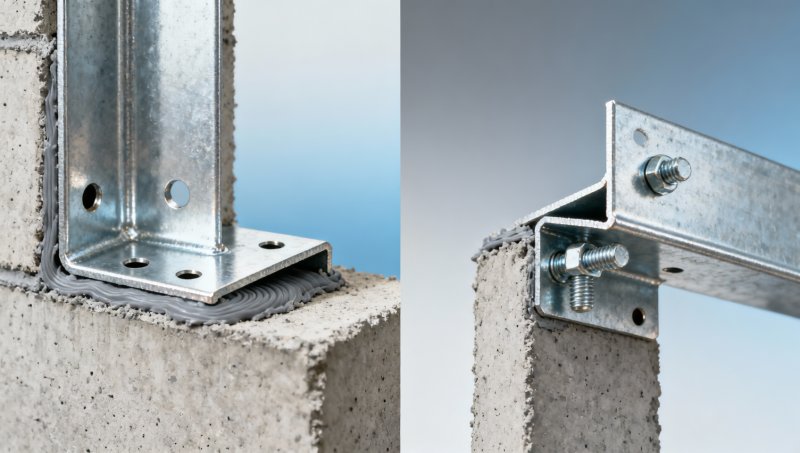
Galvanized wall angles serve as critical load-transfer and anchoring components in fire-rated wall systems—including shaft enclosures, corridor walls, and stairwell assemblies. Their failure point is rarely the steel itself—but rather how they interface with adjacent substrates, fasteners, and fire-stopping materials. Over 68% of field-reported fire-resistance test failures trace back to non-compliant angle installation—not material defects.
Key root causes include improper thermal break placement, inconsistent fastener torque (±15% deviation from spec), and use of non-fire-rated sealants around angle legs. These errors create thermal bridges or mechanical gaps that allow flame penetration within 30–90 minutes—well below required 1- or 2-hour ratings per ASTM E119 or EN 1364-1.
Hongteng Fengda’s QA team inspects over 12,000 angle shipments annually against ASTM A123 (zinc coating mass), ASTM A6 (dimensional tolerances), and EN 10025-2 (mechanical properties). Every batch includes mill test reports verifying minimum 85 g/m² hot-dip galvanizing for corrosion resistance and long-term fire-system reliability.
5 Critical Installation Mistakes—and How to Avoid Them
Based on field audits across 47 construction sites in North America and the Middle East, these five recurring oversights compromise fire-rated assembly performance most frequently:
- Using non-rated fasteners in fire-stopped zones: Standard zinc-plated screws degrade at 250°C; fire-rated assemblies require stainless steel or ceramic-coated fasteners tested to UL 1709 or ISO 834.
- Ignoring thermal expansion gaps: Galvanized angle must be installed with ≥3 mm clearance at top/bottom terminations to prevent buckling under fire-induced expansion (up to 1.2 mm/m per 100°C).
- Over-torquing anchor bolts near firestop collars: Exceeding 12–15 N·m compresses intumescent sealant beyond its activation threshold, reducing expansion ratio by up to 40%.
- Misaligning unequal-leg angles during framing: Installing the longer leg outward instead of inward disrupts load path continuity and voids UL system listings.
- Skipping grounding continuity verification: Galvanized coatings resist electrical conduction—requiring dedicated bonding jumpers (min. 6 AWG) every 3 meters per NFPA 70 Article 250.96.
Material Selection Impacts Field Performance
Equal vs. unequal angle geometry affects both structural capacity and fire-stop compatibility. Unequal angles (e.g., 3"×2"×¼") provide superior torsional rigidity for tall shaft walls but demand precise orientation during erection. Equal angles (e.g., 2½"×2½"×⅜") simplify layout but may require additional bracing in high-wind zones per ASCE 7-22.
Comparative Performance: Galvanized Angle vs. Alternative Edge Protection
While galvanized wall angles remain the industry standard for fire-rated drywall and concrete enclosures, alternatives exist for niche applications. The table below compares key performance attributes relevant to technical evaluators and safety managers:
For projects requiring dual performance—fire rating + aggressive chemical exposure—304 Stainless Steel Welded Mesh offers complementary protection in ventilation duct linings, filter supports, and firestop access panels. Its 32–360 μm absolute micron retention and resistance to acid/alkali environments make it ideal for HVAC containment zones adjacent to fire-rated walls.
Procurement Checklist for Fire-Rated Angle Projects
When sourcing galvanized wall angles for certified assemblies, procurement and technical teams should verify the following before PO issuance:
- Mill test report confirming ASTM A123 Class B (minimum 85 g/m² zinc mass) and ASTM A6 dimensional tolerances (±0.015" on leg thickness).
- UL Design Number matching your fire-rated wall system (e.g., U300, V400 series)—not just generic “UL listed” claims.
- Pre-punched hole pattern alignment with specified anchor spacing (typically 16" o.c. vertical, 24" o.c. horizontal for Type X gypsum).
- Traceability documentation: heat number, galvanizing batch ID, and third-party inspection certificate (SGS/BV/TÜV accepted).
Why Hongteng Fengda Delivers Confidence in Critical Applications
As a structural steel manufacturer and exporter from China, Hongteng Fengda combines ISO 9001-certified production, in-house galvanizing oversight, and full documentation traceability. We support global buyers with:
- Custom cutting, punching, and bending per project drawings (EN 1090-2 Execution Class EXC2 certified).
- Pre-shipment dimensional & coating thickness verification using calibrated Elcometer gauges (±0.5 µm accuracy).
- Consistent lead times: 12–18 days for standard angle sizes (L2"×2"×¼" to L6"×6"×½"), backed by 99.2% on-time delivery rate over Q1–Q3 2024.
- Technical support including fire-rating compatibility review, UL system mapping, and fastener specification guidance.
Contact Hongteng Fengda today for angle steel specification review, fire-rated assembly validation, or customized OEM solutions—including engineered weldments and coated component kits. Request mill test reports, UL cross-reference sheets, or sample packs with certified coating thickness data.
Please give us a message


Please enter what you want to find