When specifying galvanized steel sheet for cladding, thickness isn’t just a number—it directly impacts durability, corrosion resistance, structural integrity, and long-term steel roofing cost. As a trusted structural steel manufacturer and exporter from China, Hongteng Fengda supplies premium galvanized steel sheet, hot dip galvanized steel, and ASTM standards-compliant structural steel beams to global projects. Whether you’re a procurement professional evaluating steel suppliers, a project manager planning installation, or a technical assessor verifying compliance with EN/ASTM standards, understanding how thickness influences performance—especially alongside stainless steel pipe, carbon steel pipe, and galvanized steel pipe alternatives—is critical. Let’s break down why it matters—and how to get it right.
Why Galvanized Steel Sheet Thickness Directly Affects Cladding Performance
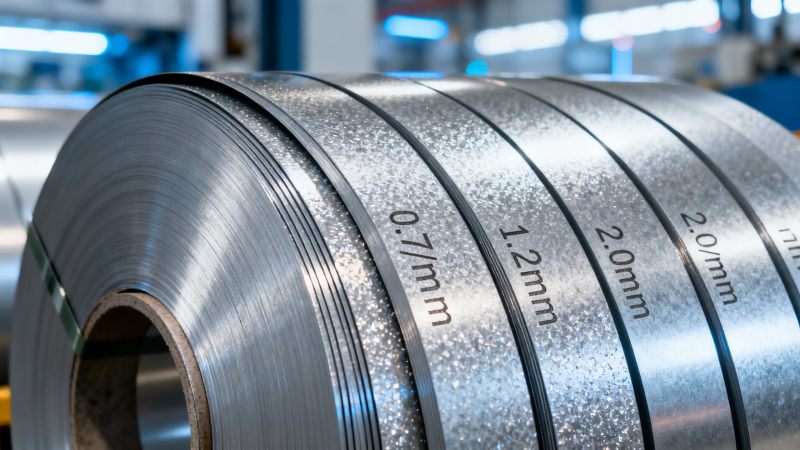
Galvanized steel sheet used in architectural cladding is rarely selected based on aesthetics alone. Its thickness—typically ranging from 0.4mm to 2.5mm for standard applications—determines load-bearing capacity, wind uplift resistance, and service life under environmental stress. For example, a 0.5mm sheet may suffice for interior partitions but fails to meet EN 14782 minimum requirements for external façades in high-wind zones (e.g., coastal Middle East or typhoon-prone Southeast Asia).
Thinner gauges (<0.6mm) increase risk of denting during transport and installation—especially when handled manually across scaffolding or lifted by cranes without proper edge protection. In contrast, sheets ≥1.2mm offer superior rigidity for large panel systems (up to 6m spans), reducing intermediate framing needs by up to 30% and cutting labor time by 2–4 weeks per 10,000 m² project.
Corrosion resistance also scales non-linearly with thickness. While the zinc coating (typically 275 g/m² for hot-dip galvanizing) provides initial barrier protection, substrate thickness governs how long the base steel remains intact once zinc depletes. A 1.0mm sheet with Z275 coating delivers ~45 years of service life in C3 industrial environments (per ISO 12944-2), whereas a 0.6mm sheet drops to ~28 years—impacting lifecycle cost calculations for financial approval.
How Thickness Interacts With Other Critical Cladding Parameters
Thickness doesn’t operate in isolation. It interacts dynamically with zinc coating mass, substrate grade (e.g., DX51D+Z vs. S350GD+Z), and forming complexity. For instance, cold-formed profiles like trapezoidal roof sheets require higher ductility—so even at 1.2mm thickness, using G300-grade steel instead of G500 avoids cracking during roll-forming at bending radii <15× thickness.
Thermal expansion behavior also shifts: thinner sheets expand more per degree Celsius, increasing stress at fixings over large façade areas (>500 m²). This demands precise fastener spacing—typically ≤300mm for 0.7mm sheets versus ≤450mm for 1.5mm sheets—to prevent oil-canning or buckling.
For hybrid systems combining galvanized steel with stainless components, thickness consistency becomes essential. When integrating 304 Stainless Steel Coil for flashing or trim (common in food processing plants or pharmaceutical cleanrooms), matching thermal movement between 1.0mm galvanized cladding and 2.0mm stainless edges prevents gap formation and water ingress.
Key Interaction Metrics Across Common Thickness Ranges
This table reflects real-world engineering constraints—not theoretical limits. At Hongteng Fengda, we validate all thickness-coating combinations against ASTM A653/A792 and EN 10346 through third-party salt-spray testing (1,000+ hours at 5% NaCl, 35°C) before release. Our production line supports tight tolerances: ±0.03mm on thickness for sheets ≥1.0mm, ensuring predictable structural behavior across batches.
Procurement Checklist: 5 Non-Negotiable Thickness Verification Steps
For procurement professionals and project managers, skipping thickness verification invites rework, delays, and warranty disputes. Here’s what to verify—before PO issuance:
- Mill test reports (MTRs): Confirm actual measured thickness—not nominal—against ASTM A924 Table 2 or EN 10143 Annex B. Tolerances vary: ±0.05mm for 0.6mm sheets vs. ±0.12mm for 2.0mm sheets.
- Coating adhesion test results: Per ASTM D3359 (cross-hatch) or EN ISO 2409, especially critical for sheets <0.8mm where poor zinc bonding increases spalling risk during bending.
- Edge condition inspection protocol: Sheared edges on thin sheets (<0.7mm) must be deburred to prevent accelerated corrosion—require supplier to document edge finish (Ra ≤3.2μm).
- Batch traceability: Each coil must carry laser-etched ID linking thickness, coating mass, and heat number to raw material certificates (GB/T 2518, JIS G3302).
- Dimensional stability report: Thermal cycling data (−40°C to +80°C, 5 cycles) showing thickness variation ≤±0.02mm—critical for precision façade systems.
At Hongteng Fengda, every export shipment includes digital MTRs accessible via QR code on packaging, plus physical copies certified by BV and SGS. Lead times remain stable at 25–35 days for standard thicknesses (0.7–1.5mm), with expedited options (18–22 days) available for urgent projects across North America and EU markets.
Why Partner With Hongteng Fengda for Precision-Thick Galvanized Steel
Selecting cladding steel isn’t just about meeting spec sheets—it’s about mitigating risk across your supply chain. Hongteng Fengda combines deep metallurgical expertise with agile manufacturing: our 120,000-ton annual capacity allows us to hold buffer stock on high-demand thicknesses (e.g., 0.8mm, 1.0mm, 1.2mm), reducing lead-time volatility by up to 40% versus spot-market sourcing.
We support full project lifecycle collaboration—from early-stage parametric modeling (with Revit-compatible BIM families) to on-site technical supervision during installation. For complex integrations—like pairing galvanized cladding with 304 Stainless Steel Coil in food-grade facilities—we co-develop joint detailing protocols validated by independent corrosion engineers.
Ready to optimize your next cladding specification? Contact us for: thickness-specific load-test data, EN/ASTM compliance documentation, sample kits with certified MTRs, or customized OEM solutions—including dual-certified (GB + ASTM) beams for mixed-standard projects. Let’s engineer resilience—layer by layer.
Please give us a message


Please enter what you want to find