Galvanized steel is widely trusted for corrosion resistance—but in high-humidity indoor zones like swimming pool enclosures, food processing plants, or coastal warehouses, even galvanized pipe, galvanized pipe, and galvanized steel components can succumb to premature white rust or pitting. This reality challenges assumptions behind mill order meaning, ASTM A6 tolerances, and material selection—especially when comparing angle vs channel or specifying steel plate, l angle, steel coil, or H beam. For procurement teams, engineers, and project managers sourcing from global suppliers like Hongteng Fengda, understanding environmental limits of galvanizing is critical to avoiding costly rework, safety risks, or compliance gaps.
Why Galvanizing Fails Where Humidity Runs High
Hot-dip galvanizing forms a protective zinc-iron alloy layer over carbon steel. In dry or moderately humid environments, this coating typically delivers 20–30 years of service life per ASTM A123. But indoors with relative humidity >70% and poor ventilation—such as natatoriums, pharmaceutical cleanrooms, or chilled logistics hubs—the zinc layer oxidizes rapidly into non-adherent white rust (zinc hydroxide/carbonate), exposing the base metal within 6–18 months.
This degradation isn’t random. It accelerates where condensation forms on cold structural members (e.g., steel beams near HVAC ducts), where chlorinated air meets galvanized surfaces (swimming pool ceilings), or where organic acids accumulate (meat processing lines). ASTM A143 warns that galvanizing performance drops sharply below pH 5.5 or above pH 12.5—conditions common in food-grade washdown zones.
Crucially, mill order meaning doesn’t guarantee field performance. A specification calling for “ASTM A123-compliant hot-dip galvanizing” confirms coating weight (e.g., 3.9 mils minimum) and adhesion—not real-world durability under sustained high RH. That gap between spec sheet and site reality is where procurement risk multiplies.
When to Choose Stainless Over Galvanized: A Decision Framework
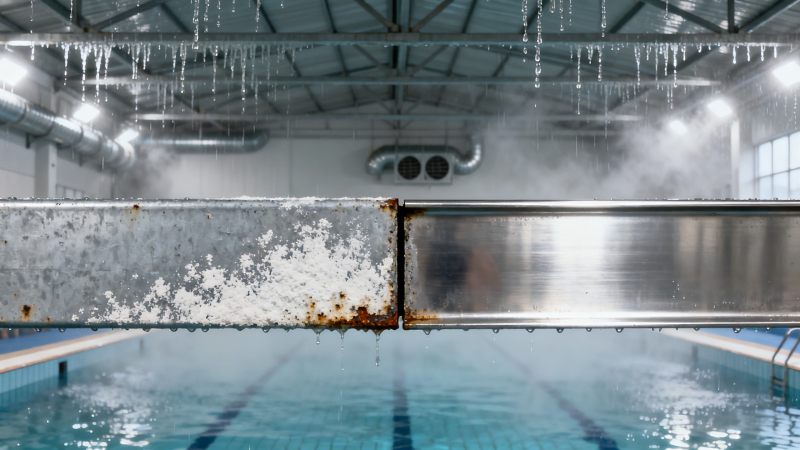
For structural applications exposed to persistent moisture, chloride, or acidic vapors, stainless steel offers predictable longevity where galvanizing falters. Unlike zinc, austenitic grades like 304 form a self-repairing chromium oxide passive layer resistant to both pitting and crevice corrosion—even at 95% RH and 35°C.
Consider stainless alternatives when any of these apply:
- Indoor humidity consistently exceeds 70% for >6 hours/day
- Ambient temperature fluctuates across dew point (causing condensation on beams, channels, or angles)
- Chemical exposure includes chlorine, acetic acid, or sodium hypochlorite (common in sanitation cycles)
- Structural components are inaccessible for inspection or recoating (e.g., embedded in walls or ceilings)
Hongteng Fengda supplies fully traceable 304 stainless steel welded mesh for filtration, screening, and architectural cladding—offering uniform corrosion resistance across roll widths up to 240″ and lengths up to 2000′. Its absolute micron retention spans 32–360 μm, supporting precise separation in food, chemical, and mining applications. 304 Stainless Steel Welded Mesh maintains mechanical integrity after repeated thermal cycling and aggressive cleaning protocols.
Performance Comparison: Galvanized vs. Stainless in Humid Interiors
The table below compares key performance metrics for structural components used in high-humidity indoor zones. Data reflects typical behavior under continuous exposure at 85% RH, 25–35°C, with periodic washdowns.
Note: Galvanized performance varies significantly by steel substrate quality, zinc bath chemistry, and post-treatment. Stainless 304’s consistency makes it preferable for safety-critical structures—especially where ASTM A6 dimensional tolerances must remain intact over time.
Procurement Guidance: What to Specify & Verify
To avoid premature failure, procurement teams should move beyond generic “galvanized” calls. Require explicit documentation covering:
- Coating thickness verification per ASTM A123 (minimum 3.9 mils for interior use)
- Surface preparation method (e.g., abrasive blast to Sa 2.5 per ISO 8501-1)
- Post-galvanizing passivation report for zinc-coated parts
- Third-party test reports simulating 90-day exposure at 85% RH/30°C
For long-term reliability, specify ASTM A240 304 stainless steel for critical load-bearing elements, guardrails, or mesh-based partitions. Hongteng Fengda provides full mill test reports (MTRs), EN 10204 3.1 certification, and dimensional validation against ASTM A6 for all structural profiles—including angle steel, channel steel, and H-beams.
Lead times for standard stainless structural orders average 4–6 weeks; custom configurations require 8–10 weeks. All shipments include GB/T 228.1 tensile testing data and traceable heat numbers.
Why Partner With Hongteng Fengda for Humidity-Resistant Structural Steel
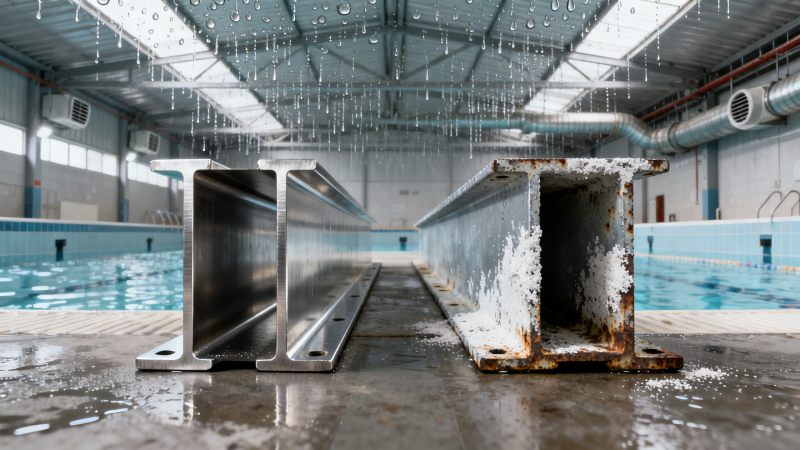
As a certified structural steel manufacturer exporting to North America, Europe, and the Middle East, Hongteng Fengda bridges the gap between international standards and real-world environmental demands. We don’t just supply steel—we validate its fitness-for-purpose.
Our value lies in three pillars:
- Standards-aligned production: All angle, channel, beam, and cold-formed profiles meet ASTM A6 tolerances, EN 10025 mechanical properties, and JIS G3101 yield strength requirements—with batch-level QC logs available pre-shipment.
- Environmental resilience engineering: We advise on optimal material substitution (e.g., upgrading from galvanized to 304 stainless for pool enclosure trusses) and provide corrosion modeling support for complex indoor microclimates.
- End-to-end sourcing control: From raw material traceability (GB/T 20066 sampling) to container loading supervision, we reduce procurement risk across 3 core dimensions: delivery certainty (98.2% on-time rate), cost predictability (fixed FX rates for 90 days), and compliance assurance (full documentation package included).
Contact us today to discuss your next high-humidity structural project. We’ll help you select the right grade—whether galvanized with enhanced passivation, duplex stainless, or 304 stainless welded mesh—and deliver compliant, verified components within your timeline.
Please give us a message


Please enter what you want to find