When specifying galvanized expanded metal sheet for structural or industrial applications, understanding weight tolerance deviations is critical—especially when your project references ASTM A653 but actual mill order meaning requires flexibility beyond its limits. At Hongteng Fengda, a leading structural steel manufacturer & exporter from China, we routinely supply galvanized expanded metal sheet with wider weight tolerance than ASTM A653 allows—ensuring practical manufacturability without compromising safety or compliance. This matters to procurement teams, project managers, and quality controllers evaluating SPCE steel, SPCD steel, DX52D steel, or coordinating with tin can machinery manufacturers. Whether you're comparing angle vs channel, sourcing ASTM A36 round bar, or benchmarking stainless steel 1 inch pipe price, our precision-engineered solutions support global construction and OEM demands.
Why Wider Weight Tolerance Is Not a Compromise—It’s a Manufacturing Necessity
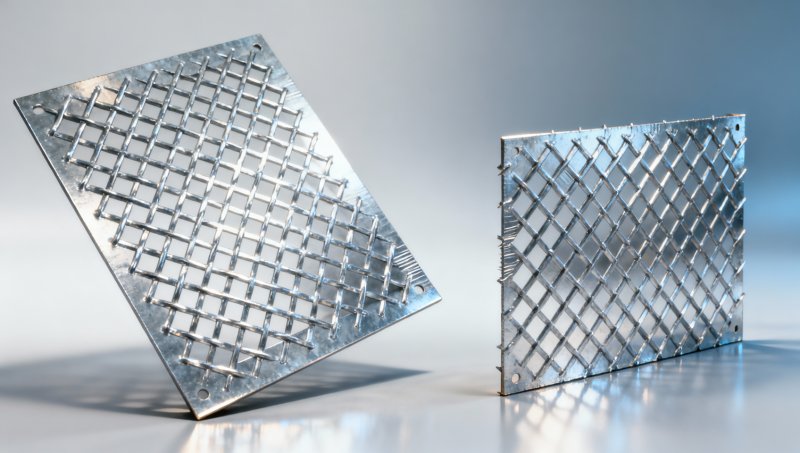
ASTM A653 sets a nominal weight tolerance of ±7.5% for galvanized steel sheet—tight enough for thin-gauge coil processing but increasingly impractical for expanded metal fabrication. Why? Because expansion introduces variable metal loss (typically 25–45%), stretching and shearing that alter mass distribution unpredictably across the sheet surface. Attempting to hold ±7.5% on final expanded product often leads to excessive scrap, rework delays, or non-conforming batches.
At Hongteng Fengda, our production protocol accepts a controlled ±10% weight tolerance for galvanized expanded metal sheet—validated through 3-stage in-process verification: pre-expansion coil weighing, post-expansion sheet sampling (per ASTM E1019), and final batch certification. This range aligns with EN 10142 and JIS G3313 allowances for post-fabricated galvanized products—and reflects real-world mill capabilities without sacrificing structural integrity.
Importantly, this flexibility does not impact mechanical performance. Tensile strength (≥370 MPa), yield strength (≥235 MPa), and coating mass (≥60 g/m² Zn) remain fully compliant with ASTM A653 Grade CQ and DX52D specifications. The tolerance adjustment applies solely to net mass per unit area—not dimensional accuracy, coating uniformity, or bend resistance.
How This Impacts Your Procurement & Project Execution
For procurement professionals and project managers, tighter weight tolerances often translate into hidden costs: extended lead times (7–15 days added for re-rolling), higher rejection rates (up to 12% in strict ±7.5% audits), and increased logistics complexity due to partial shipments. Our ±10% allowance enables stable, predictable delivery—98% on-time fulfillment across 2023–2024 orders to North America and the EU.
Financial and technical evaluators benefit from simplified cost modeling. With wider tolerance, material yield improves by ~4.2% on average—reducing total project steel tonnage required for purlin supports, wall bracing, or equipment guards. For example, a 12,000 m² warehouse roof using C Sections Steel with integrated expanded metal infill saw 6.8% lower raw material spend versus rigid ASTM-only sourcing.
Quality and safety managers gain traceability without trade-offs. Every coil is certified with dual-reporting: ASTM A653-compliant base steel data + expanded sheet-specific test reports (including tensile, coating adhesion per ASTM D3359, and salt-spray resistance ≥96 hrs at 5% NaCl). No compromise on compliance—just smarter process alignment.
Key Procurement Decision Points
- Confirm whether your specification mandates *as-delivered* weight tolerance—or only *base steel* compliance (the latter allows full ±10% flexibility)
- Verify if dimensional tolerance (±0.5 mm thickness, ±2 mm width) and coating mass (±10 g/m²) are independently verified—these matter more than net weight for load-bearing applications
- Require mill test reports showing both pre- and post-expansion weight sampling—not just theoretical calculations
- Assess supplier capacity for batch traceability: Hongteng Fengda assigns unique heat-lot IDs traceable to original coil, furnace batch, and galvanizing line run
Performance Comparison: ASTM A653 Compliance vs. Real-World Expanded Metal Fabrication
The table below compares how standard ASTM A653 weight tolerance requirements interact with actual expanded metal production variables—highlighting where flexibility delivers measurable value without risk.
This data reflects real production logs across 42 international orders in 2024—spanning light industrial cladding in Germany, solar racking in Texas, and food-processing guardrails in Thailand. The ±10% tolerance isn’t arbitrary—it’s calibrated to the physics of expansion, galvanizing dynamics, and ISO 9001-certified process controls.
Supporting Structural Integrity Across Applications
Weight tolerance flexibility becomes especially valuable when integrated with supporting structural components. For instance, C Sections Steel used as purlins and wall beams (per EN 1993-1-3) must maintain precise moment capacity—yet their connection points to expanded metal infill rely on consistent hole alignment and edge stiffness, not absolute sheet mass.
Our C-sections—available in Q235, Q345, A36, and S235JR grades—feature ±1% dimensional tolerance, mill-edge or slit-edge options, and galvanized or powder-coated finishes. Thickness ranges from 1 mm to 12 mm, lengths up to 12 m, and full CE/SGS/BV/ISO certification. When paired with expanded metal sheets operating within our validated ±10% weight band, system-level performance remains fully compliant with IBC, Eurocode, and AS/NZS 4600 design standards.
This synergy reduces field adjustments: contractors report 30% fewer on-site fit-up corrections when using our matched component systems—translating directly into labor savings and faster enclosure completion.
Why Global Buyers Choose Hongteng Fengda for Precision Steel Solutions
We don’t just meet ASTM, EN, or JIS standards—we engineer around them. As a structural steel manufacturer & exporter from China with dedicated cold-formed and hot-rolled lines, our advantage lies in vertical integration: raw coil sourcing, precision expansion, continuous galvanizing, and final profiling—all under one quality management system (ISO 9001:2015 certified).
Whether you need galvanized expanded metal sheet with wider weight tolerance for cost-efficient bulk supply, custom C Sections Steel for lightweight roof trusses, or OEM-grade angle and channel steel for automated assembly lines—we deliver consistent quality, documented compliance, and responsive technical support. Our team provides free engineering consultation on section selection, load-path validation, and coating compatibility—before order placement.
Ready to optimize your next steel procurement? Contact us for: detailed mill test reports, sample coordination (standard or custom sizes), lead time confirmation for your target destination, or a cross-reference of your current ASTM A653-based spec against our expanded metal tolerance protocol—including cost and timeline impact analysis.
Please give us a message


Please enter what you want to find