Edge rust on flat plate stainless steel after delivery can raise immediate concerns for distributors and project buyers. Is it a sign of poor material quality, handling damage, or storage issues during transit? Understanding the real causes helps you respond to customers confidently, reduce claims, and make better sourcing decisions for future steel orders.
Why distributors should use a checklist first, not assumptions
When edge discoloration appears on flat plate stainless steel, the fastest mistake is to blame the mill immediately. In practice, edge rust can come from several stages: slitting, cutting, packaging, sea transport, warehouse storage, or cross-contact with carbon steel. For distributors, agents, and stockists, a checklist approach is more useful than a general discussion because customer complaints usually require quick evidence, not theory.
A structured review helps you answer five critical questions: whether the rust is superficial or deep, whether it is limited to the cut edge or spread to the surface, whether contamination occurred before or after shipment, whether the grade and finish were correct for the intended environment, and what preventive action should be built into the next order. This is especially important for flat plate stainless steel supplied into fabrication, construction, coastal infrastructure, and industrial processing chains.
First-response checklist: what to confirm within 24 hours
Before making a claim or promising compensation to your customer, collect the following information. This first-response checklist gives you a practical basis for judging whether the issue is material-related, logistics-related, or storage-related.
- Confirm the rust location: only on the edge, on corners, near straps, or across the full sheet surface.
- Check the edge condition: mill edge, slit edge, sheared edge, laser-cut edge, or plasma-cut edge.
- Identify the stainless grade and finish: for example 201, 304, 316, hot rolled, No.1, 2B, or brushed finish.
- Review packaging condition on arrival: wet wrapping, torn film, damaged pallets, missing separators, or direct contact with carbon steel.
- Ask for transport details: container shipment, break bulk, local trucking, rain exposure, or long port dwell time.
- Check storage conditions after delivery: outdoor placement, humidity, condensation, saline air, or stacking near reactive metals.
- Take timestamped photos from multiple angles before cleaning or reworking the material.
- Request the mill test certificate, packing list, and if possible the loading photos from the supplier.
This checklist prevents a common commercial problem: assuming all rust means poor stainless steel quality. In many cases, edge rust on flat plate stainless steel is not proof of a wrong grade but proof that the passive layer at the cut edge was damaged or contaminated.
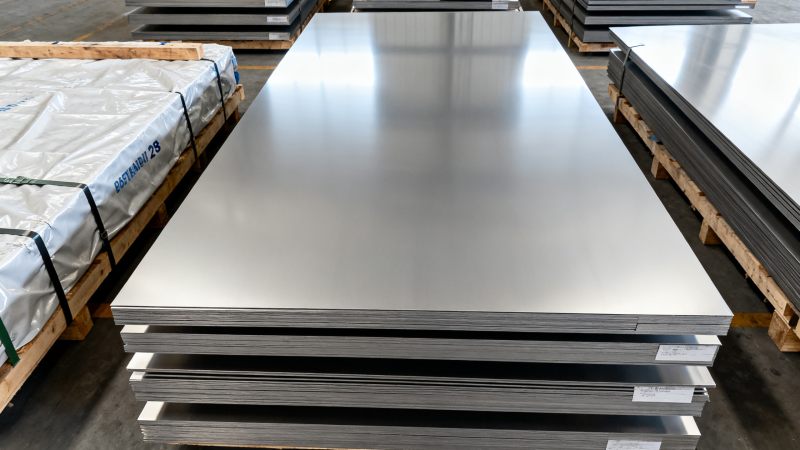
The main causes of edge rust on flat plate stainless steel
1. Free iron contamination during processing
One of the most frequent causes is carbon steel contamination. If the stainless plate was cut on shared equipment, handled with carbon steel tools, or placed on contaminated tables, tiny iron particles can embed in the edge. These particles rust quickly, especially after exposure to moisture. The stainless itself may still meet specification, but the contamination creates visible rust spots or a brown line along the edge.
2. Damaged passive layer at cut edges
Stainless steel resists corrosion because of its chromium-rich passive film. However, shearing, slitting, flame cutting, or rough grinding can break that layer. If the fresh edge is left unpassivated and then exposed to humidity, it becomes more vulnerable than the flat surface. This is why edge rust can appear even when the face of the flat plate stainless steel still looks clean.
3. Wrong grade selection for the service environment
Not all stainless grades perform the same way. In chloride-rich or marine conditions, 201 or even 304 may show tea staining or edge corrosion faster than 316. If the steel is intended for coastal projects, food processing washdown zones, or chemically aggressive environments, apparent “delivery rust” may actually be an early suitability problem. Distributors should always connect customer use conditions to grade selection before closing the claim file.
4. Moisture trapped during packing and transport
Sea freight often causes condensation. When bundles are wrapped too tightly without moisture control, water can remain trapped around cut edges. Long transit times, day-night temperature differences, and port delays make this worse. Edge-first rusting is common because water accumulates at exposed sides, especially if pallets tilt or packing film is damaged.
5. Improper warehouse handling after arrival
Sometimes the material arrives in acceptable condition but deteriorates quickly after unloading. A damp warehouse floor, open-sided storage, contact with rusty racks, forklift scratches, or stacking stainless next to carbon steel can all trigger edge corrosion. For flat plate stainless steel, last-mile handling matters almost as much as production quality.
How to judge whether the issue is minor, moderate, or serious
Distributors need a practical judgment standard before deciding on replacement, discount, or local rework. Use the following guide.
This type of grading is useful because many edge issues on flat plate stainless steel are recoverable. A small amount of superficial rust does not always justify rejection, but ignoring early signs can create larger quality disputes later in fabrication.
Mid-project sourcing reminder: related steel items also need transport and storage control
For distributors serving broader construction and industrial customers, corrosion control should not stop with stainless sheet and plate. Other steel products in the same shipment may need equally clear storage planning. For example, Rail products supplied for railway rail, bridge railings, or deck handrails are available in grades such as U74, U71Mn, PD2, PD3, BNbRE, Q235, 55Q, 50Q, U71, and 45Mn, with common lengths from 12m to 30m, thickness from 3mm to 24mm, rail height of 134-170mm, head width of 68-73mm, bottom width of 114-150mm, and tolerance of ±1%.
These products may be supplied in oil, black, galvanized, or painted appearance, and can comply with ISO9001-2008 and ISO14001:2004. For stockists, the lesson is the same: match packaging, loading, and storage to the material type and final use. A supplier with abundant stock, prompt delivery, and export experience can help reduce preventable damage claims across multiple steel categories.
Checklist by scenario: what changes your diagnosis
If the customer is a fabricator
Ask whether the rust appeared before or after cutting, welding, or grinding. Fabricators often use shared tools. If only processed areas show rust, contamination at the workshop may be the real cause. Request details on grinding discs, brush type, and whether pickling or passivation was performed.
If the customer is a construction contractor
Check the site environment. Open-air storage, concrete splash, chloride exposure, and prolonged wet-dry cycles can cause fast staining at the edges. In this case, the issue may be site management rather than the flat plate stainless steel supply itself.
If the order was for coastal or chemical use
Recheck the material grade against service conditions. This is where distributors can add the most value. A customer buying on price alone may choose a lower grade that performs poorly. Early edge rust can become a warning sign that the original specification was under-selected.
Commonly overlooked factors that trigger claims
- Mixed loading with carbon steel products without proper separators.
- Packaging film that traps condensation instead of releasing it.
- No edge protection on cut plates during long-distance shipping.
- No incoming inspection photos taken immediately upon unloading.
- Confusing tea staining, transferred iron rust, and actual stainless corrosion.
- Using the same forklifts, chains, or slings for stainless and carbon steel.
These points matter commercially because claim responsibility often depends on timing and evidence. Without records, it becomes difficult to prove whether the rust originated at the mill, in transit, or at the customer warehouse.
Execution advice: how to reduce repeat issues in future orders
- Specify the stainless grade based on real environment, not only target price.
- Clarify whether edges are mill edge, slit edge, or processed edge before shipment.
- Require clean handling procedures to avoid free iron contamination.
- Request export packaging with moisture control for long transit routes.
- Ask suppliers for loading photos, package labels, and MTC documentation in advance.
- Train warehouse teams to isolate stainless from carbon steel tools and racks.
- Create a standard arrival inspection form for all flat plate stainless steel orders.
FAQ for distributors handling flat plate stainless steel complaints
Does edge rust always mean the material is fake stainless steel?
No. Very often it indicates contamination or passive film damage at the edge. Verification should include grade documents, visual inspection, and if needed chemical analysis.
Can superficial edge rust be cleaned?
In many cases, yes. Light contamination can often be removed through appropriate cleaning and passivation methods. However, pitting or widespread corrosion needs deeper technical review.
What is the best evidence to collect for a supplier discussion?
Arrival photos, close-up edge images, package condition, shipment dates, storage details, the MTC, and a clear record of when the rust was first observed.
What to prepare before your next purchase discussion
If you want to reduce future claims on flat plate stainless steel, prepare the following points before placing the next order: end-use environment, required grade, finish type, edge condition, packaging expectations, transit route, local storage conditions, and inspection requirements on arrival. This information helps a reliable supplier recommend the right specification instead of only quoting the lowest price.
Hongteng Fengda, as a structural steel manufacturer and exporter from China, supports global buyers with stable production capacity, strict quality control, and customized steel solutions aligned with ASTM, EN, JIS, and GB standards. For distributors and agents, the most productive next step is to discuss application conditions, corrosion risk, packaging method, lead time, and documentation requirements early. That is how you turn an edge-rust complaint into a better sourcing standard for every future shipment.
Please give us a message


Please enter what you want to find