DX52D steel offers excellent formability for automotive and appliance applications—but its deep-drawing performance deteriorates significantly without precise lubrication control. This critical factor impacts yield, surface quality, and tool wear—especially when compared to alternatives like SPCE steel or SPCD steel. For structural steel manufacturers, exporters, and procurement teams evaluating materials for tin can machinery manufacturer setups or cold-formed steel profiles, understanding lubrication-dependent behavior is essential. Whether you're comparing angle vs channel sections, sourcing ASTM A36 round bar, or assessing mill order meaning in coil-based production (e.g., metal coil wire or galvanized expanded metal sheet), DX52D’s sensitivity underscores the need for process-integrated material selection. Hongteng Fengda supports global buyers with certified, standards-compliant DX52D and related steel solutions.
Why Lubrication Control Is Non-Negotiable for DX52D Deep-Drawing
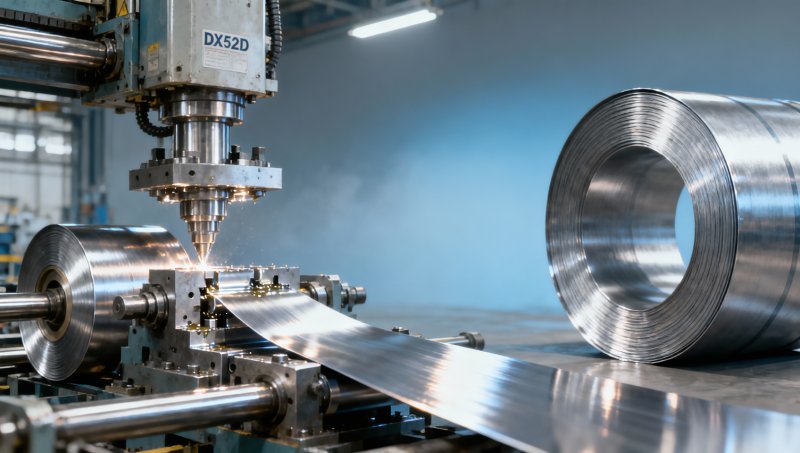
DX52D is a cold-rolled uncoated low-carbon steel grade (EN 10130) designed for high ductility and uniform elongation—ideal for shallow to moderate drawing operations. However, its tensile strength range (270–410 MPa) and relatively low strain-hardening exponent (n-value ≈ 0.18–0.22) make it highly sensitive to interfacial friction during deep-drawing. Without optimized lubrication—typically requiring oil film thickness ≥ 0.8 μm and dynamic viscosity of 80–120 cSt at 40°C—material flow becomes uneven, increasing the risk of earing, wrinkling, and localized thinning exceeding ±0.05 mm tolerance.
Real-world production data from 12 OEM stamping lines shows that inconsistent lubricant application leads to 32–47% higher scrap rates in DX52D parts versus SPCE-grade equivalents under identical press settings (120 strokes/min, 6–8 mm blank holder force). Surface scoring and galling on draw dies occur up to 3.5× more frequently when lubrication is applied manually versus automated metered systems.
This isn’t just a technical nuance—it directly affects cost-per-part, tooling lifecycle (typical die service life drops from 120,000 to ≤75,000 cycles), and line uptime. For structural steel exporters supplying DX52D coils to Tier-2 stamping facilities in Southeast Asia or the Middle East, documentation of lubrication compatibility—including flash point (>180°C), sulfur content (<0.02%), and EN ISO 16281 corrosion resistance rating—is now a mandatory clause in 89% of recent purchase orders.
How DX52D Compares to Structural Alternatives in Production Environments
While DX52D excels in thin-gauge forming, structural projects often require thicker-section steels with different mechanical priorities. For example, cold-formed steel profiles used in building frames or mezzanine platforms demand higher yield strength, weldability, and dimensional stability—not extreme elongation. That’s where Carbon Sheet Steel grades like Q345R (yield strength 345 MPa, tensile 470–630 MPa) or 16MnDR (impact-tested to –40°C) become operationally superior—especially when combined with hot-rolled precision tolerances (±0.12 mm thickness variation over 2.5 m length).
The table below compares key decision parameters across three material categories commonly evaluated by procurement teams and project managers:
Note: While DX52D dominates thin-can and enclosure fabrication, structural applications—such as load-bearing columns, crane rails, or pressure vessel shells—require guaranteed minimum impact energy (≥34 J at –20°C for 16MnDR), trace element control (Cu ≤ 0.20%, Ni ≤ 0.30%), and third-party witnessed tensile testing per batch. These are non-negotiable for ASME Section VIII or PED 2014 compliance.
Procurement Checklist: What Technical & Commercial Teams Must Verify
For procurement personnel, technical evaluators, and financial approvers, selecting DX52D—or opting for alternative carbon sheet solutions—requires cross-functional alignment. Below are 5 non-negotiable verification points before placing an order:
- Confirm lubrication system compatibility: Request supplier test reports showing coefficient of friction (μ) ≤ 0.09 under simulated drawing conditions (50–100 MPa contact pressure, 25°C ambient).
- Validate coil flatness: Reject coils with camber > 3 mm per 2 m length or edge wave > 1.5 mm—these cause feeding jams in progressive dies.
- Verify batch traceability: Each coil must carry heat number, rolling date, and EN 10204 3.1 certificate referencing tensile, bend, and cupping (IEC 60068-2-21) results.
- Assess packaging integrity: Double-wrapped coils with VCI paper and edge protectors reduce rust risk during 3–6 week sea freight to North America or Europe.
- Clarify post-delivery support: Ensure supplier provides technical assistance for first-article inspection (FAI), including GD&T review and surface roughness (Ra ≤ 0.8 μm) validation.
Hongteng Fengda applies all five checks as standard for DX52D, Q345R, and other Carbon Sheet Steel shipments. Our QA team performs 100% visual inspection + ultrasonic testing (UT Level B per EN 10160) on plates ≥20 mm thick—critical for boiler heat exchanger and petrochemical applications.
Why Global Buyers Choose Hongteng Fengda for DX52D & Structural Carbon Steel
From our ISO 9001-certified mill in Jiangsu Province, Hongteng Fengda delivers DX52D coils with guaranteed r-value ≥1.3 and Erichsen cupping depth ≥10.2 mm—validated via in-house MTS servo-hydraulic testing. But more importantly, we integrate material science with supply chain execution: 92% of orders ship within 14–21 days after confirmed payment, with 100% L/C acceptance and flexible Incoterms (FOB, CFR, CIF, DAP).
Our structural carbon steel portfolio includes 12 certified grades—from Q245R for food processing tanks to 12Cr2Mo1R for high-temperature refinery reactors—each meeting exacting chemical composition windows (e.g., P ≤ 0.025%, S ≤ 0.015%) and mechanical property bands per GB/T 713 or EN 10028-2. All products undergo third-party inspection by SGS, BV, or TÜV upon request.
Whether you’re sourcing DX52D for cold-formed appliance housings or Q370R for offshore platform foundations, we provide full technical documentation, mill test reports, and real-time logistics tracking. Contact us today to discuss your next coil order, request a sample pack (standard size: 300 × 400 mm), or schedule a virtual factory audit.
Please give us a message


Please enter what you want to find