DIN 17456 Stainless Tube vs Generic Tube: What Really Changes?
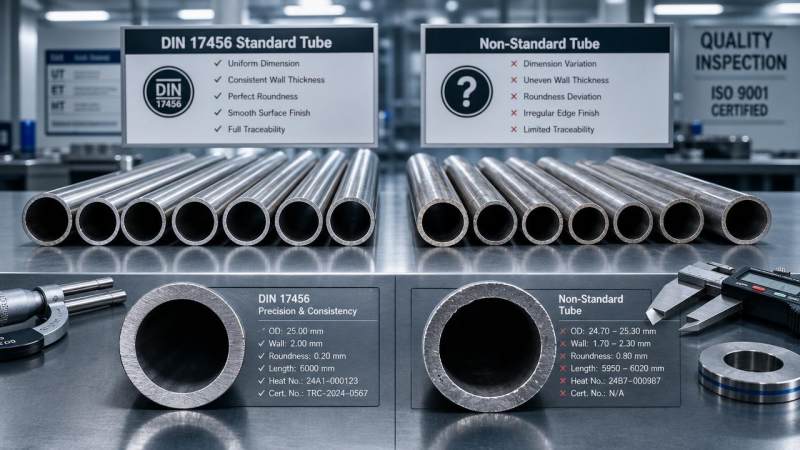
When comparing DIN 17456 stainless tube with generic tube options, the gap is more than a label.
It affects dimensional precision, material traceability, pressure behavior, weld quality, and long-term service reliability in steel-related applications.
A lower-priced generic tube may seem acceptable at first.
However, inconsistent chemistry or loose tolerances can increase installation problems, maintenance costs, and safety risks.
This article explains the key differences in a practical way, helping buyers compare DIN 17456 stainless tube with non-standard alternatives before ordering.
Why a Structured Comparison Matters
In steel sourcing, not every stainless tube sold on the market follows a recognized standard.
Some generic products only provide approximate dimensions or broad material descriptions without complete testing records.
That creates uncertainty in fabrication, pressure service, corrosion performance, and inspection acceptance.
A structured review helps separate standard-compliant tube from commercial-grade substitutes.
It also supports better cost control because the cheapest tube is not always the lowest total-cost option.
Core Points to Check Before Choosing DIN 17456 Stainless Tube
- Confirm whether the tube follows DIN 17456 requirements for dimensions, tolerances, surface condition, testing, and documentation instead of only using a stainless steel description.
- Check the material grade and chemical composition report to ensure chromium, nickel, and other alloying elements meet the required corrosion and strength targets.
- Review wall thickness consistency because irregular thickness in generic tube can weaken pressure resistance and create uneven performance during bending, welding, or expansion.
- Ask for mill test certificates, heat numbers, and inspection data so each batch of DIN 17456 stainless tube remains traceable from production to delivery.
- Inspect the surface finish for cracks, pits, scale, and excessive roughness, since these defects often reduce corrosion resistance and shorten service life.
- Verify straightness, roundness, and cut-end quality because poor shape control can increase fit-up problems during assembly and slow down site installation.
- Match the tube with the operating environment, including temperature, pressure, humidity, and media type, rather than selecting only by price or stock availability.
- Compare total project cost, including rejection risk, rework, maintenance, and downtime, not just the initial quotation from a generic tube supplier.
Key Differences Between DIN 17456 Stainless Tube and Generic Tube
1. Standard Compliance
DIN 17456 stainless tube is produced to a defined industrial standard.
That means dimensions, test methods, mechanical properties, and acceptance criteria are not left to interpretation.
Generic tube often varies by supplier.
It may be sold as stainless tube without complete reference to the exact standard, delivery condition, or inspection level.
2. Dimensional Accuracy
Tighter tolerances are one of the most practical advantages of DIN 17456 stainless tube.
Precise outside diameter, wall thickness, and straightness improve installation speed and reduce mismatch at joints.
Generic tube may still be usable in simple applications.
But dimensional variation can become costly when assemblies require repeatability or close fit-up.
3. Material Consistency
DIN 17456 stainless tube is expected to provide controlled chemistry and repeatable mechanical performance across batches.
This matters in fabrication and in corrosive or pressure-bearing environments.
Generic tube may show wider variation in alloy content.
Even small differences can influence weldability, hardness, corrosion resistance, and service life.
4. Testing and Documentation
A major benefit of DIN 17456 stainless tube is documentation.
Standardized certificates make quality verification easier during purchasing, customs clearance, project approval, and final inspection.
With generic tube, paperwork can be incomplete or inconsistent.
That may delay acceptance or require extra third-party testing.
5. Pressure and Service Reliability
If the tube will handle fluids, pressure, vibration, or heat, reliability becomes critical.
DIN 17456 stainless tube offers more predictable behavior because manufacturing controls are clearer.
Generic tube may perform well in light-duty use.
Still, performance uncertainty increases when operating conditions become more demanding.
Application Notes for Different Use Cases
Construction and Structural Support Systems
For visible structures or support assemblies, appearance and dimensional consistency both matter.
DIN 17456 stainless tube helps maintain uniform installation quality and cleaner finishing results.
In broader steel supply projects, other materials may also be selected by function.
For example, anti-slip platform areas may use 235JR Patterned steel plate because of its patterned surface and bending resistance.
Industrial Piping and Equipment Frames
Industrial environments usually require stronger control over dimensions, weldability, and traceability.
Here, DIN 17456 stainless tube is often the safer choice, especially when shutdown costs are high.
If a generic tube is considered, verify pressure rating, wall tolerance, and actual grade through independent inspection.
Decorative and Light-Duty Fabrication
For handrails, trims, or simple frames, some generic tube products may meet basic needs.
The decision depends on finish quality, corrosion exposure, and whether consistent appearance is important.
Even in decorative work, poor surface quality can increase polishing labor and waste.
Export and Cross-Border Projects
International projects usually favor standardized products because compliance proof is easier to review.
DIN 17456 stainless tube can simplify technical approval when documentation is complete and batch traceability is clear.
This is especially useful when several steel items must align with ASTM, EN, JIS, DIN, or GB-based requirements.
Commonly Overlooked Risks
One frequent mistake is assuming all stainless tubes with a similar appearance offer the same corrosion performance.
Visual similarity does not confirm alloy composition or processing quality.
Another overlooked issue is mixed batches.
Without proper traceability, replacement pieces may not match the original tube in chemistry or dimensional tolerance.
Surface defects are also underestimated.
Minor pitting or roughness can become initiation points for corrosion in humid or chemical environments.
Finally, low entry price can hide downstream costs.
Extra machining, failed inspections, delays, and replacement work often erase the early savings of generic tube.
Practical Steps Before Placing an Order
- Define the real service conditions, including media, pressure, temperature, and required service life.
- Request full technical documents for DIN 17456 stainless tube, including grade, dimensions, tolerances, and test reports.
- Ask for sample photos or inspection records showing surface finish, end condition, and packaging.
- Compare at least two supply options based on total value, not only quoted unit price.
- If the project includes other steel products, confirm whether the supplier can support coordinated standards and delivery schedules.
Conclusion
DIN 17456 stainless tube differs from generic tube in ways that directly affect fit, safety, durability, and verification.
The most important differences are standard compliance, dimensional precision, material consistency, and dependable documentation.
For demanding steel applications, DIN 17456 stainless tube usually offers lower long-term risk and better project control.
Before buying, review the checklist above, confirm technical records, and match the tube to the real service environment.
A careful comparison now can prevent expensive quality issues later.
Please give us a message


Please enter what you want to find