Custom steel profile orders often fail long before production starts—because one critical drawing detail is missing. For technical evaluation in structural steel projects, that missing detail is usually the complete Profile definition: not just overall size, but the exact sectional geometry, reference dimensions, tolerances, hole positions, radii, edge conditions, and orientation marks required for fabrication. When a Profile drawing is incomplete, the result is rarely a small inconvenience. It can trigger dimensional mismatch, poor fit-up on site, repeated clarification, scrap, and avoidable delays across the supply chain. In steel sourcing, a clear Profile drawing is the foundation of reliable manufacturing, inspection consistency, and delivery confidence.
Why Profile drawing failures happen before the steel ever reaches production
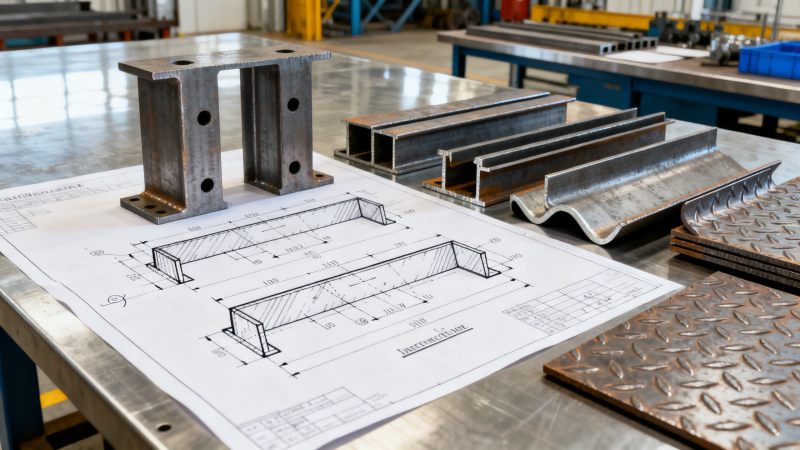
In structural steel, many orders begin with a seemingly usable sketch, PDF, or marked-up section view. However, a usable commercial drawing is not always a manufacturable Profile drawing. A steel mill or fabrication line can quote faster from a simplified file, but production accuracy depends on whether the drawing defines the section completely. If one side radius is omitted, if the bend direction is unclear, or if the datum for slot spacing is missing, the Profile may still look understandable while remaining technically unsafe to produce.
This problem becomes more serious in export supply, where standards, measurement habits, and fabrication assumptions may differ. A Profile designed around ASTM thinking may be reviewed by a team used to EN or JIS tolerancing logic. If the drawing does not explicitly state what matters, each side may fill gaps with different assumptions. That is why many custom steel profile disputes are not caused by poor manufacturing, but by incomplete inputs at the order stage.
Which project scenarios are most sensitive to missing Profile details
Building frames and connection-heavy structures
In structural building frames, the Profile must align with base plates, splice connections, gussets, and bolt patterns. A small error in flange thickness, web depth, hole center distance, or camber note can cause assembly interference. In this scenario, the most important judgment point is not only whether the section matches the design intent, but whether every connected steel component uses the same dimensional reference system.
For welded built-up sections, the Profile drawing should also define weld preparation edges, root gaps where needed, and orientation for installation. Without these details, the finished steel member may pass basic measurement but still fail field fit-up.
Cold formed Profile applications with tight repeatability needs
Cold formed steel Profile orders are highly sensitive to bend sequence, inside radius, springback expectation, and thickness tolerance. In roofing supports, framing channels, cable tray members, or machine supports, repeated parts must install quickly and consistently. If the drawing only shows nominal width and height but does not define corner radius or leg angle tolerance, production may vary from batch to batch even when the raw material is correct.
This is where a complete Profile specification protects both quality and lead time. It helps confirm roll forming feasibility, tooling setup, and final inspection criteria before material is committed.
Industrial flooring, platforms, and anti-slip surfaces
Not every steel order is a beam or channel. In transportation decks, equipment platforms, walkways, and factory flooring, surface performance is often the real function of the Profile. For these applications, patterned plate selection must match load, slip resistance, forming needs, and fabrication dimensions. A practical option for such projects is SS440 Patterned steel plate, which is used in transportation, construction, decoration, floor around equipment, machinery, and shipbuilding.
Its typical thickness range is 2-8mm, width 600mm-1800mm, and length 2m-12m, with patterned surface performance designed for anti-skid and decorative use. In this scenario, the drawing should not only specify plate size. It should also state pattern direction, required flatness after cutting, edge condition, and whether forming or welding will affect the visible or functional surface. When these Profile-related details are omitted, a plate can meet material grade requirements yet still fail in practical installation.
OEM steel components for equipment or machinery
Custom OEM steel components often combine multiple operations such as cutting, punching, bending, welding, and coating. Here, the Profile is not just a section; it is the production route. If the drawing misses slot orientation, burr side requirement, or bend deduction logic, downstream operations become unstable. The core judgment point is whether the drawing can be transferred directly into process planning without guesswork.
How different application scenarios change the Profile information required
The same steel grade can serve different uses, but the required Profile detail changes by application. The table below shows how demand shifts across common structural steel scenarios.
What a complete Profile package should include before order confirmation
A strong steel drawing package reduces uncertainty before pricing, production scheduling, and inspection planning. For custom structural steel, the Profile should include more than the visible outline. It should define how the part will be interpreted at each manufacturing stage.
- Section geometry with all critical dimensions, not just overall width and height
- Material grade, standard reference, and required mechanical or chemical compliance
- Thickness tolerance, straightness, twist, flatness, and other acceptance limits
- Hole, slot, notch, and cut-out positions defined from a clear datum
- Bend radii, open side orientation, left-right hand identification where relevant
- Surface requirement such as mill finish, patterned face direction, coating allowance, or visible side
- Part length, bundle logic, marking method, and packing expectation for export delivery
When these details are available, the supplier can verify feasibility earlier, propose material-saving alternatives, and reduce technical back-and-forth. For a structural steel manufacturer and exporter with global compliance capability, this also supports alignment with ASTM, EN, JIS, and GB-based project requirements.
Practical Profile selection and drawing advice for high-risk applications
If the application involves repeated installation, exposed interfaces, or safety-related support, the Profile should be reviewed as both a design item and a manufacturing instruction. A few practical checks can prevent expensive mistakes.
- Compare drawing dimensions with installation dimensions and do not assume they are the same control points.
- Ask whether the Profile depends on formed shape accuracy, welded build-up accuracy, or machined accuracy, because each has different tolerance behavior.
- For floor, deck, or anti-slip steel, define functional face direction early, especially if using patterned plate.
- For long members, confirm whether camber, sweep, or straightness limits affect assembly or visual quality.
- Request sample cross-section confirmation or shop drawing review for first-time custom Profile orders.
This is especially useful when the steel solution includes standard products plus custom fabrication. Experienced suppliers can often suggest a more production-friendly Profile while keeping the same structural or functional result.
Common Profile mistakes that are often ignored until delivery is at risk
Several drawing omissions appear minor during sourcing but become critical later. One is missing orientation. Another is relying on a screenshot or marked-up catalog page instead of a dimensioned Profile drawing. Some orders specify material and length accurately but leave corner radius or punching reference undefined. Others show the section well but never state the applicable tolerance or inspection standard.
Another common error is mixing product logic. For example, a project may treat patterned plate like plain plate, even though surface geometry affects forming, measurement, and final use. If the application is anti-slip flooring, the Profile discussion must include function-related surface details, not only nominal thickness and width.
The cost of these omissions is not limited to manufacturing. They can delay document approval, packing, site sequencing, and even customs communication if product descriptions are inconsistent with the final steel Profile supplied.
How to move from unclear Profile drawings to reliable steel delivery
A successful custom steel order starts with a Profile package that is clear enough to quote, produce, inspect, and ship without assumption. Before releasing the order, review the drawing against the real application scenario: connection-heavy structure, cold formed framing, industrial flooring, or OEM assembly component. Then confirm that the Profile defines geometry, tolerances, orientation, and function-related surface requirements.
For projects that require structural steel products, standard sections, or custom fabricated members from China, early technical review can reduce sourcing risk and shorten total lead time. If your current drawing leaves any room for interpretation, refine the Profile before production starts. That one step can protect dimensional accuracy, installation efficiency, and the reliability of the entire steel supply plan.
Please give us a message


Please enter what you want to find