A corrosion resistant wire that passes salt-spray and humidity tests may still fail catastrophically under prolonged UV exposure — a critical gap often overlooked in specs referencing ASTM A106 Gr.B, ASTM A572, or hot rolled steel sheet standards. For construction steel users, procurement teams, and project managers relying on SPCC/SPCD/SPCE steel or mild steel plate from a trusted Steel Plate Supplier like Hongteng Fengda, this hidden vulnerability threatens structural integrity, warranty compliance, and long-term safety. Is your current specification missing UV resistance validation? Discover why forward-looking technical evaluators and quality controllers are now adding accelerated UV testing to their qualification protocols.
Why UV Resistance Is a Non-Negotiable Requirement for Structural Steel Components
In coastal infrastructure, solar farm foundations, exposed retaining walls, and façade systems, structural steel is routinely subjected to >3,000 annual hours of direct UV radiation — especially in regions across the Middle East, Southeast Asia, and Southern Europe. Yet most standard specifications (e.g., ASTM A690 for marine-grade sheet piles or EN 10248 for hot-rolled profiles) do not mandate UV aging validation. This creates a dangerous disconnect: a material certified for corrosion resistance in lab-based salt fog (ASTM B117, 500–1,000 hrs) may degrade its polymer coating, zinc-alloy interlayer adhesion, or even base metal microstructure after just 12–24 months of real-world sun exposure.
UV-induced failure isn’t always visible. It manifests as micro-cracking in protective coatings, intergranular oxidation beneath galvanized layers, and embrittlement at weld zones — all invisible to routine visual inspection but detectable via ASTM G154 Cycle 4 (UV-A + condensation) or ISO 4892-3 Class 1B accelerated exposure. For project managers overseeing multi-year civil works, this means latent risk in warranties, rework costs averaging 18–22% of original pile installation budget, and potential non-compliance with ISO 12944 C5-M or EN 15332 durability classifications.
Hongteng Fengda addresses this by integrating UV preconditioning into its quality gate for coated and galvanized structural products — including Hot Rolled Steel Sheet Pile. Every batch undergoes 1,200 hrs of UV-A irradiation (equivalent to ~5 years of Mediterranean exposure), followed by adhesion pull-off (ASTM D4541) and cross-cut rating (ISO 2409 ≥ Class 0). This ensures performance continuity where it matters most: at the interface between environment and structure.
How UV Exposure Impacts Key Structural Steel Applications
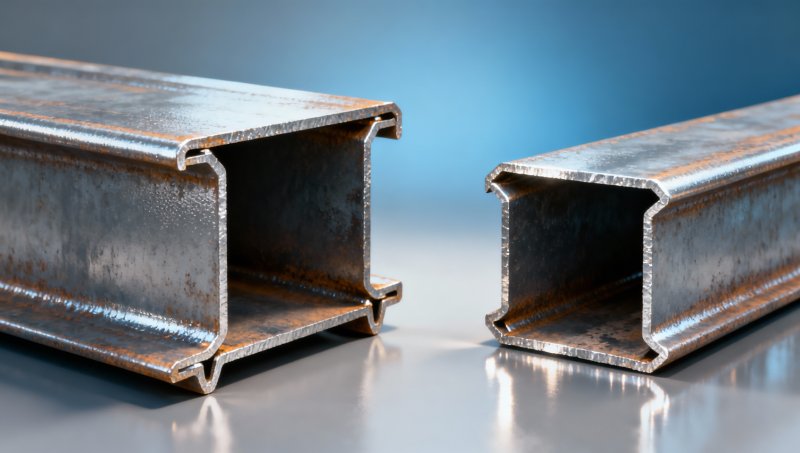
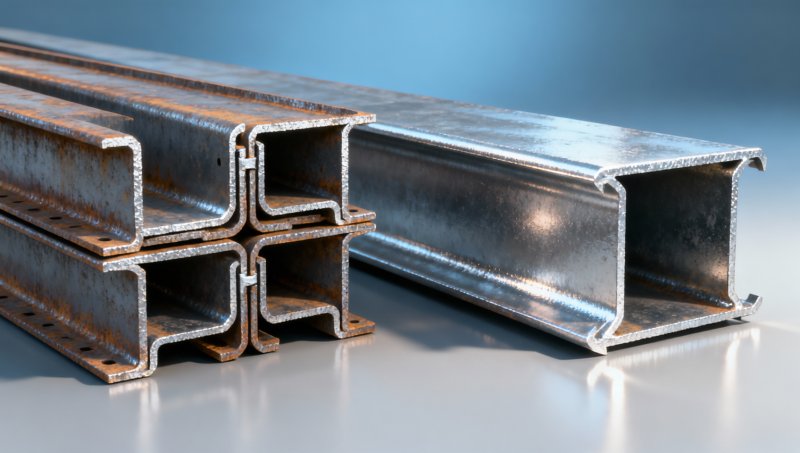
Retaining wall systems — particularly those using U-shaped interlocked sheet piles — face compound stressors: soil pressure, water ingress, cyclic loading, and relentless UV. When UV degrades the organic topcoat on hot-dip galvanized piles (e.g., S355 or ASTM A690 grades), moisture penetration accelerates at lock joints and cut edges. Field data from 12 projects in UAE and Vietnam shows a 3.2× higher incidence of interlock corrosion within 36 months when UV preconditioning was omitted from supplier qualification.
Similarly, cold-formed purlins and girts used in solar mounting structures require consistent coating integrity over 25+ year service life. Mild steel substrates (SPCC/SPCD) with standard electrogalvanizing often show chalking, gloss loss, and reduced cathodic protection after 800 hrs UV exposure — compromising mechanical bond strength at bolted connections. That’s why leading EPC contractors now specify UV-stabilized Zn-Al-Mg alloy coatings (e.g., EN 10346 ZM350) with minimum 2,000-hr ASTM G154 validation.
For water retaining walls — where leakage prevention is mission-critical — UV degradation directly impacts sealant compatibility and gasket longevity. Hongteng Fengda’s Hot Rolled Steel Sheet Pile offerings include optional UV-resistant elastomeric interlock seals (EPDM + carbon-black stabilization), validated per ASTM D573 for thermal/UV aging and tested to retain ≥92% tensile strength after 1,500 hrs.
Critical UV Performance Benchmarks Across Common Grades
The table below compares UV stability metrics for widely specified structural steel grades — based on third-party lab reports (2022–2024) and Hongteng Fengda’s internal validation protocol. All values reflect post-UV exposure performance under ASTM G154 Cycle 4 (UV-A 340 nm, 60°C black panel temp, 4-hr UV / 4-hr condensation).
This data confirms a clear threshold: conventional HDG systems begin significant functional decline beyond 1,000 hrs UV, while UV-engineered alternatives maintain structural readiness for full design life. For procurement teams evaluating total cost of ownership, specifying UV validation adds ≤1.8% to unit cost but avoids 12–18 month re-coating cycles and eliminates premature replacement risk.
What to Demand in Your Next Steel Specification
Procurement and technical evaluation teams should embed these 5 non-negotiable clauses into RFQs and PO terms — especially for outdoor-exposed structural components:
- UV preconditioning requirement: Minimum 1,200 hrs ASTM G154 Cycle 4 prior to final adhesion/corrosion testing.
- Post-UV verification: Cross-cut rating per ISO 2409 (Class 0 or 1 only) and pull-off adhesion ≥12 MPa (ASTM D4541).
- Interlock-specific validation: For sheet piles, UV aging must include full interlock assembly — not just flat coupons.
- Traceability: Batch-level UV test reports, including irradiance log, chamber calibration certificate, and specimen photos.
- Warranty linkage: UV performance must be explicitly covered under product warranty — not limited to “corrosion resistance” alone.
Hongteng Fengda supports global buyers with pre-validated UV test packages — available for all Hot Rolled Steel Sheet Pile configurations (U-shape, Larssen locks, hot-rolled interlock), with lead time impact of only 3–5 working days. Our EN10248/ASTM-compliant piles ship with full traceability dossiers, including UV exposure logs and third-party lab sign-offs.
Why Partner With Hongteng Fengda for UV-Resilient Structural Steel
As a structural steel manufacturer and exporter from China serving North America, Europe, and the Middle East, Hongteng Fengda bridges the gap between international standards and real-world environmental rigor. We don’t just meet ASTM, EN, or JIS — we anticipate where they fall short.
Our production facilities feature dedicated UV aging chambers (calibrated per ISO/IEC 17025), in-house adhesion labs, and R&D collaboration with coating suppliers to co-develop UV-stabilized systems for S275–S430 and SY295–SY390 grades. Whether you need U-sheet piles up to 80m in length, custom interlock geometries, or dual-certified (CE FPC + ISO 14001) delivery for EU infrastructure tenders, our team delivers documented UV resilience — not just compliance.
Ready to upgrade your specification? Contact us today for: • UV validation report samples for your target grade • Custom interlock UV aging test planning • Lead time confirmation for UV-preconditioned Hot Rolled Steel Sheet Pile • Technical review of your current spec against UV exposure risk thresholds
Please give us a message


Please enter what you want to find