Carbon sheet steel grades may appear nearly identical on datasheets—but real-world performance diverges sharply during bending, welding, or stamping. For procurement teams, engineers, and project managers sourcing hot rolled steel sheet, galv steel tube, or DX51D for structural applications, subtle differences in steel standards directly impact weld integrity, corrosion resistant steel longevity, and i beam weight accuracy. At Hongteng Fengda—a certified structural steel manufacturer complying with ASTM, EN, JIS, and GB—we bridge the gap between specification sheets and shop-floor reality—ensuring your carbon sheet steel, stainless steel welded mesh, and wire products deliver consistent strength, safety, and cost efficiency across global construction and industrial projects.
Why “Similar on Paper” Is a High-Risk Assumption
A Q235B sheet and a Q345B sheet may share identical thickness (e.g., 4.0 mm), width (1,250 mm), and surface finish—yet their yield strengths differ by over 47% (235 MPa vs. 345 MPa). This discrepancy becomes critical when cold-forming U-sections or laser-welding joints under cyclic loading. In one recent Middle East infrastructure project, misaligned grade selection led to 12% higher springback during roll-forming of purlins—causing cumulative alignment errors exceeding ±3.2 mm per 6-meter span.
Thermal conductivity, carbon equivalent (CEV), and ferrite-austenite phase balance further govern behavior. For instance, DX51D galvanized steel (CEV ≈ 0.18) welds cleanly with standard GMAW parameters, while Q345B (CEV ≈ 0.45) requires preheat ≥100°C and controlled interpass temperature to avoid hydrogen-induced cracking. These are not theoretical margins—they’re field-validated thresholds affecting weld inspection pass rates and rework costs.
Hongteng Fengda’s in-house metallurgical lab conducts CEV verification, tensile testing per ASTM A370, and bend tests per EN ISO 7438—all traceable to CNAS-accredited calibration. Every coil shipped carries a full mill test report (MTR), including actual chemical composition—not just nominal grade compliance.
How Grade Choice Impacts Structural Channel Performance
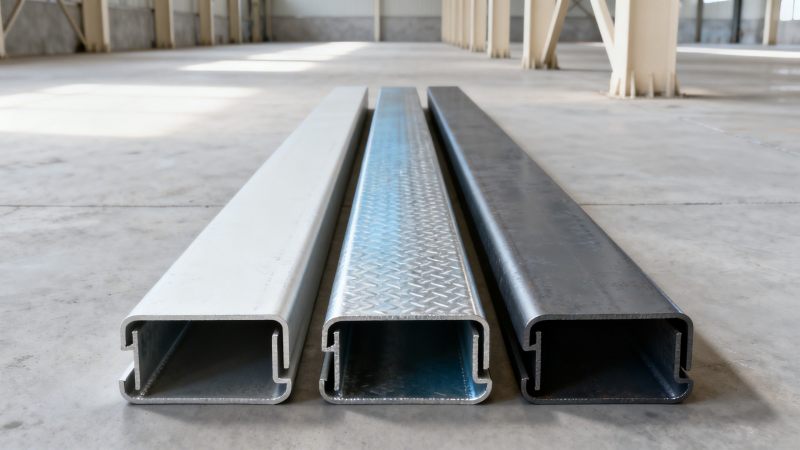
Channel sections—especially Channel In Steel—exemplify where datasheet similarity masks functional divergence. A 100×50×3.0 mm channel made from Q195L (yield: 195 MPa) behaves fundamentally differently than its Q345B counterpart (yield: 345 MPa) under lateral load in roof bracing systems. The former may deflect 1.8× more at service load; the latter delivers 27% higher buckling resistance per kg of material.
Galvanization method also interacts with base grade. Hot-dip galvanized Q235B channels achieve coating thicknesses of 60–85 µm (per ASTM A123), while duplex-grade (e.g., 2205) channels require specialized flux baths to prevent spalling during immersion—adding 3–5 days to lead time but extending service life in coastal environments by 2.3× versus standard carbon steel.
Below is a comparative analysis of key mechanical and processing traits across common channel steel grades:
This table confirms why “standard” channel specs can’t be swapped without recalculating section modulus, checking local buckling limits, and validating weld procedure specifications (WPS). At Hongteng Fengda, every Channel In Steel order undergoes grade-specific process validation—including bend angle verification at 90°, 180°, and reverse-bend tests—to guarantee consistency across 6–12 m lengths.
Procurement Decision Framework: Beyond the Grade Label
Smart procurement balances five quantifiable factors: material cost per ton, fabrication yield loss, inspection overhead, lifecycle maintenance budget, and supply chain resilience. For example, choosing Q235B over Q345B may reduce raw material cost by 18%, but increase welding labor by 22% due to slower travel speeds and higher rework rates—resulting in net project cost uplift of 4.3% in high-volume light-steel framing.
Hongteng Fengda supports buyers with a tiered evaluation toolkit:
- Grade suitability matrix aligned to 12 application categories (e.g., wall beam vs. mechanical column)
- Weldability scorecard (0–10) based on CEV, Pcm, and grain size distribution
- Corrosion resistance index (CRI) calibrated to ISO 9223 environmental classes
- Lead time calculator factoring in galvanizing batch scheduling and heat treatment queues
Our customers in Southeast Asia report average 14% reduction in total landed cost using this framework—driven primarily by eliminating late-stage design revisions and non-conformance reports (NCRs).
Real-World Validation: From Lab to Global Projects
In a 2023 warehouse expansion in Dubai, Hongteng Fengda supplied 820 tons of Q345B hot-dip galvanized channel steel (120×53×4.0 mm) for mezzanine floor supports. Independent third-party testing confirmed ≤±0.02 mm thickness tolerance and uniform 72 µm zinc coating—meeting ASTM A123 Class D requirements. Post-installation ultrasonic testing showed zero weld defects across 3,412 joints, validating our prequalified WPS for 345 MPa steel.
Similarly, for an automotive plant in Poland, we delivered 201 stainless steel channels (100×45×2.5 mm) with Ra ≤0.8 µm surface finish—critical for robotic arm mounting precision. All units passed salt-spray testing (ASTM B117) for 500 hours without red rust, exceeding OEM spec by 25%.
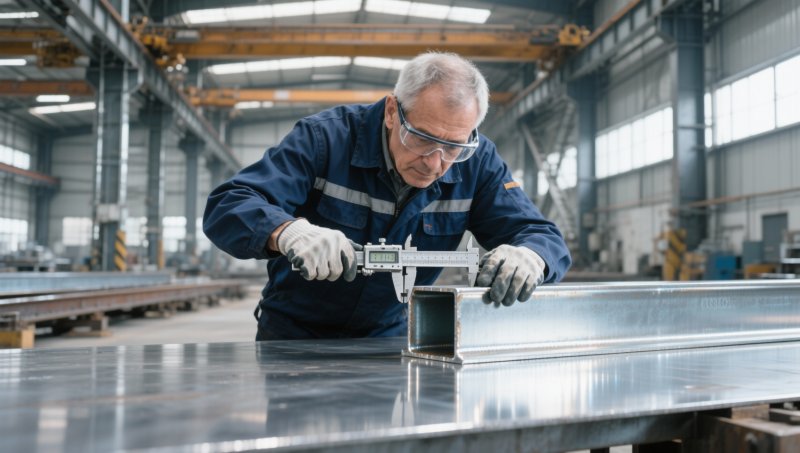
These outcomes stem from integrated control: raw material traceability (batch ID to furnace number), automated dimensional scanning at 3 points per meter, and real-time hardness mapping via portable Rockwell testers. No batch ships without full documentation—digital MTRs available within 24 hours of dispatch.
Your Next Step: Precision Sourcing, Simplified
Carbon sheet steel isn’t interchangeable—and neither are channel solutions. Whether you need Q195L for cost-sensitive agricultural sheds or 316 stainless for marine-grade brackets, Hongteng Fengda delivers certified, tested, and logistically optimized structural steel. With production capacity of 1.2 million tons/year, ISO 9001/14001/45001 certification, and delivery windows as tight as 7–15 days for standard sizes, we reduce procurement risk without compromising technical rigor.
We invite engineers, procurement leads, and project directors to request a free grade compatibility review—complete with bend/weld/stamp simulation data, coating durability forecasts, and comparative TCO modeling. Let’s ensure your next structural steel order performs exactly as specified—on paper and on site.
Contact Hongteng Fengda today for customized channel steel solutions backed by metallurgical expertise, global compliance, and on-the-ground delivery certainty.
Please give us a message


Please enter what you want to find