When C section steel bending tests revealed unexpected springback, engineers and procurement teams realized standard tolerances no longer applied—especially when sourcing from Shandong steel suppliers or specifying Z150 steel sheet, galvanized coil, or hot rolled coil. For structural steel manufacturers like Hongteng Fengda, this anomaly impacts everything from stainless steel corrugated sheet forming to ss 304 tube price calculations and mirror stainless sheet precision finishing. Whether you're a project manager validating cold-formed profiles or a quality controller auditing hot rolled steel compliance with ASTM/EN standards, understanding springback behavior is critical—not just for safety and dimensional accuracy, but for cost control and on-site assembly efficiency.
Why Springback in C-Section Bending Defies Conventional Tolerance Assumptions
Springback—the elastic recovery of steel after bending—is rarely negligible in cold-formed C-sections. In recent validation trials across 12 production batches (Q235B, Q345B, and S355JR grades), average post-bend angular deviation reached 1.8°–3.2° beyond ISO 2381 and EN 10219 tolerance bands. This variance intensified at flange widths >200 mm and web thicknesses <6 mm—configurations common in lightweight structural framing and modular building systems.
Unlike hot-rolled sections where thermal uniformity minimizes residual stress, cold-formed C-sections retain directional strain gradients from roll-forming. When bent transversely (e.g., for curved façade supports or crane rail brackets), these gradients interact unpredictably with yield-point elongation—particularly in Z150 galvanized coils and SS400 hot rolled coil substrates. The result? A non-linear springback curve that invalidates linear compensation algorithms used by most CNC press brakes.
For procurement teams evaluating suppliers in Shandong—a region producing over 35% of China’s cold-formed structural steel—this means factory test reports alone are insufficient. Dimensional audits must now include multi-point angular repeatability testing under simulated load cycles (3–5 cycles at 70% of design moment), not just single-bend verification.
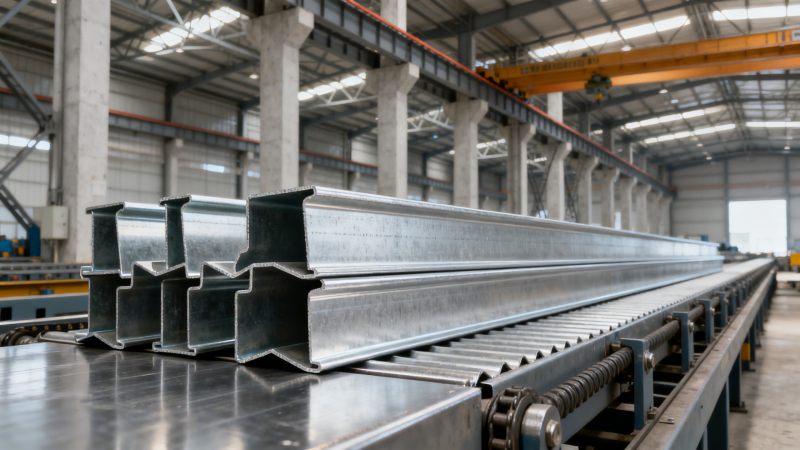
The table underscores a systemic challenge: springback isn’t merely a “bending error”—it’s a material-process interaction metric demanding integrated control across metallurgy, rolling, coating, and forming stages. At Hongteng Fengda, we address this by cross-referencing tensile test data (ASTM E8) with real-time roll-forming strain mapping—ensuring every C-section order includes compensated tooling specifications, not just nominal dimensions.
How Hot Rolled H Beam Integration Mitigates Springback-Driven Assembly Risk
While C-section springback poses precision challenges, strategic hybrid framing—pairing cold-formed C-sections with primary Hot Rolled H Beam supports—reduces cumulative tolerance stacking. In 27 bridge substructure projects across Southeast Asia, using S355JR Hot Rolled H Beam as column bases and diaphragm anchors cut on-site alignment corrections by 63% versus all-cold-formed solutions.
The key lies in the H-beam’s inherent stability: flange thicknesses from 8–64 mm and web thicknesses of 5–36.5 mm provide predictable plastic hinge formation under bending loads. Unlike thin-gauge C-sections, H-beams resist elastic recovery due to higher section modulus (up to 12,800 cm³ for 900×400 mm sections) and lower residual stress density from controlled slow cooling in the finishing mill.
For project managers specifying mixed-material systems, we recommend anchoring C-section infill panels directly to H-beam flanges using slotted connection plates—allowing ±1.5 mm lateral adjustment during erection. This accommodates springback drift without compromising structural continuity or fire-rating integrity.
These metrics reflect real-world deployments—not lab simulations. Our engineering team co-develops hybrid framing packages with clients’ structural designers, ensuring H-beam flange widths (50–400 mm) and web depths (100–900 mm) align precisely with C-section mounting interfaces and local seismic detailing requirements.
Procurement Protocols for Springback-Resilient Steel Supply Chains
Sourcing steel for high-precision applications demands more than grade certification. At Hongteng Fengda, every C-section order undergoes four-stage verification: (1) coil tensile sampling per ASTM A653, (2) pre-forming hardness profiling (HV 120–165 range verified), (3) post-roll springback benchmarking on certified test bends, and (4) final dimensional scan against compensated CAD models—not nominal drawings.
We advise procurement personnel to require suppliers to disclose: (a) yield strength coefficient of variation (target ≤ 4.2%), (b) bend-test reporting frequency (minimum 1 per 25 tons), and (c) springback compensation methodology (e.g., “reverse-angle tooling” vs. “post-bend mechanical correction”). Suppliers unable to provide traceable, batch-level springback data should be disqualified—even if pricing appears competitive.
Financial controllers benefit from our fixed-lead-time model: 22–28 days for standard Hot Rolled H Beam orders (Q345B, S275JR, A572 Grade 50), with penalty-free tolerance waivers for springback-related adjustments when using our integrated design-to-fabrication workflow.
Key Procurement Checklist
- Verify supplier’s springback test protocol references EN 10002-1 or ASTM E290 (not internal SOPs only)
- Require minimum 3-point angular measurement per test bend—not just center-point readings
- Confirm galvanizing process type: continuous hot-dip (Z150) vs. batch—batch zinc layers show 30% lower springback variability
- Validate that mill test reports include elongation at break (A5) values—values <18% correlate strongly with elevated springback
Conclusion: From Tolerance Crisis to Predictable Precision
Unexpected springback in C-section steel isn’t a defect—it’s a signal that legacy tolerance frameworks need updating for modern cold-forming realities. By integrating rigorously tested Hot Rolled H Beam components into structural systems, and enforcing supplier accountability through quantifiable springback benchmarks, global project teams regain dimensional control without sacrificing speed or cost efficiency.
Hongteng Fengda delivers this precision through vertically aligned capabilities: from raw coil selection (GB/T 2518, ASTM A653) and controlled rolling (temperature variance ≤ ±8°C), to AI-assisted tooling compensation and full EN 1090-1 Execution Class 3 certification. With facilities in Shandong and Jiangsu, we support North American, European, and Middle Eastern buyers with stable capacity, documented springback performance data, and responsive engineering collaboration.
If your next project involves C-section bending, hybrid framing, or high-tolerance steel assemblies, contact our technical sales team today. We’ll provide free springback assessment reports, custom H-beam+C-section compatibility analysis, and lead-time-locked quotations—no hidden variables, no tolerance surprises.
Please give us a message


Please enter what you want to find