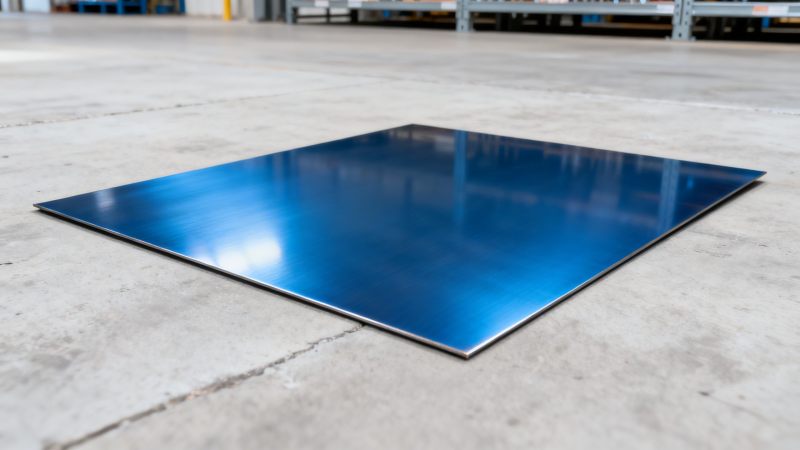
Blue stainless steel plate—striking in appearance, but what does that distinctive hue truly signify? Is it a visual indicator of a stable, protective chromium oxide layer, or merely the result of controlled surface treatment like heat coloring or passivation? For procurement managers, engineers, and project stakeholders evaluating structural steel products—including ASTM A36 angle steel price per ton in Philippines or MOQ requirements for structural steel orders—understanding this distinction is critical to performance, longevity, and compliance with international standards for structural steel products. As a trusted stainless steel supplier in Europe and global structural steel manufacturer, Hongteng Fengda integrates metallurgical insight with real-world application expertise.
What Does the Blue Hue Actually Indicate?
The blue tint on stainless steel surfaces is not an inherent property of the base alloy—it’s a surface phenomenon driven by precise thermal oxidation. When 304 stainless steel is heated to 290–350°C in air for 5–15 minutes, a thin, interference-based chromium oxide (Cr₂O₃) layer forms, ranging from 80–150 nm thick. This thickness causes visible light to reflect with constructive interference in the blue spectrum—hence the color.
Crucially, this oxide layer is *not* equivalent to the naturally forming passive film (2–5 nm thick) that provides baseline corrosion resistance. The blue layer is thicker, more brittle, and less adherent—making it unsuitable as a primary corrosion barrier in aggressive environments like marine or chemical processing settings.
However, its presence *does* confirm uniform surface chemistry and absence of iron contamination—key prerequisites for effective passivation. That’s why many quality-focused fabricators use controlled blue coloring as a visual process checkpoint before final passivation and packaging.
How It Differs From Standard Surface Finishes
Unlike mill finishes such as BA (bright annealed), 2B (cold-rolled), or NO.4 (brushed), blue coloring is a post-production thermal treatment—not a mechanical or chemical finishing step. It adds no dimensional tolerance variation but alters surface energy and wettability, impacting subsequent coating adhesion or cleaning efficiency.
This table clarifies why blue coloring should never be mistaken for enhanced corrosion performance. Its value lies in process verification—not functional enhancement. For applications demanding long-term atmospheric or mild chemical resistance, standard 304 stainless steel—properly finished and passivated—remains the validated choice.
When Is Blue Coloring Technically Justified?
Blue coloring serves three validated industrial purposes: (1) visual confirmation of oxide uniformity prior to electropolishing, (2) temporary identification marking for traceability during multi-stage fabrication (e.g., pre-weld vs. post-weld components), and (3) aesthetic differentiation in architectural cladding where color consistency matters more than corrosion load.
It is *not recommended* for food-contact surfaces (risk of flaking), high-vibration assemblies (thermal cycling induces delamination), or welded joints (heat-affected zones show inconsistent coloring, masking defects). In those cases, certified passivation per ASTM A967 or ISO 16048 remains mandatory.
For buyers sourcing structural steel components globally, verifying whether blue coloring is specified as a *process control step*—not a *performance specification*—is essential. Misinterpretation can lead to costly rework or premature field failure.
Procurement Checklist: What to Confirm Before Ordering
When evaluating blue-finished stainless steel plates for structural or industrial use, procurement teams must validate five technical checkpoints:
- Whether blue coloring is applied *before* or *after* final passivation—and if post-coloring passivation is performed
- Maximum allowable oxide thickness deviation (±15 nm typical for batch consistency)
- Adhesion test method used (ASTM D3359 cross-hatch rating ≥4B required)
- Surface roughness (Ra) tolerance—blue layers amplify underlying texture variations
- Documentation of thermal cycle parameters (time/temperature/atmosphere logs)
At Hongteng Fengda, all 304 Stainless Steel Plate shipments include full traceability reports covering finish type, heat treatment history, and third-party verification against EN 10088-2 and ASTM A240. Our production lines support custom finish requests—including NO.4, HL, and 2B—with 7–15 day lead times for standard sizes (thickness 0.3mm–200mm, width up to 3500mm, length up to 12000mm).
Why Partner With Hongteng Fengda for Structural Steel Sourcing?
As a certified structural steel manufacturer serving North America, Europe, the Middle East, and Southeast Asia, Hongteng Fengda delivers more than product specs—we provide procurement certainty. Our ISO 9001-certified facility maintains strict control over raw material sourcing (all 304 grades verified via PMI spectroscopy), cold-rolling parameters, and passivation chemistry (nitric acid concentration ±0.5%, temperature ±2°C).
We support global buyers with: (1) MOQ flexibility—from 1-ton trial orders to 500+ ton monthly commitments; (2) dual-standard compliance (ASTM + GB or EN + JIS); (3) pre-shipment SGS/BV inspection coordination; and (4) engineering consultation on finish selection for specific environmental loads (e.g., coastal humidity vs. indoor HVAC ducting).
Whether you’re comparing ASTM A36 angle steel price per ton in Philippines or validating surface treatment protocols for food-grade conveyors, our technical team provides rapid response—typically within 4 business hours—to requests for dimensional validation, mill test reports, or OEM-specific certification packages.
Please give us a message


Please enter what you want to find