Understanding beams weight is essential for accurate material planning, safe installation, and cost control in steel projects. Whether you work with Q235 steel, S235JR steel, Z-beam sections, or API pipe systems, fast calculation methods help buyers, engineers, and project managers make better decisions. This guide explains practical tips to estimate beam weight quickly and improve sourcing efficiency.
Why Beam Weight Calculation Matters in Real Steel Projects
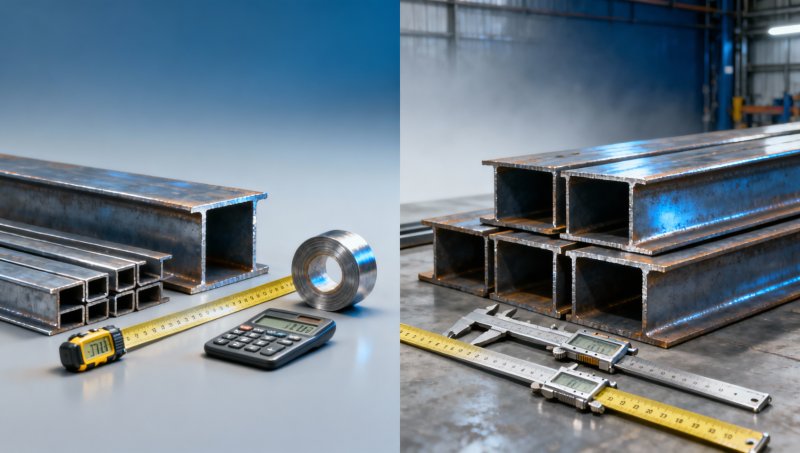
In structural steel work, beam weight affects far more than freight cost. It directly influences crane selection, loading plans, welding preparation, support design, and final procurement budgets. For project managers and purchasing teams, a weight error of even 3%–5% across medium or large orders can create avoidable cost gaps, delivery disputes, or site handling problems.
For operators and technical evaluators, fast estimation is often needed before full shop drawings are available. During early-stage quoting, teams usually compare 2–4 section options, check available stock lengths such as 6 m, 9 m, or 12 m, and estimate total tonnage for transport booking. This is why simple and reliable beam weight calculation methods remain highly practical.
Beam weight also matters for compliance and safety control. Quality personnel need to confirm whether actual material dimensions match the mill test documentation and order specifications. If thickness, flange width, or web size deviates beyond the allowed tolerance range, the final unit weight per meter changes, and that can affect structural assumptions, logistics planning, and cost accounting.
For global buyers sourcing from China, weight calculation supports faster RFQ evaluation and clearer supplier communication. Hongteng Fengda, as a structural steel manufacturer and exporter, supports customers with standard steel beams, angle steel, channel steel, cold formed profiles, and customized structural components. That combination is useful when a project needs both standard tonnage estimation and OEM-based fabrication planning under ASTM, EN, JIS, or GB requirements.
What decisions depend on beam weight?
- Budget approval: finance and procurement teams often convert unit weight into per-ton and per-piece cost for 3 key checks—material value, freight, and processing.
- Equipment planning: site teams must match beam weight to lifting capacity, especially for lengths between 6 m and 12 m.
- Supplier comparison: distributors and contractors frequently compare nominal weight, tolerance control, and lead time across 2–3 candidate sources.
- Installation safety: heavier sections may require different temporary supports, crew planning, and handling methods during the 1st to 3rd installation stages.
How to Calculate Beam Weight Fast Without Slowing Down Procurement
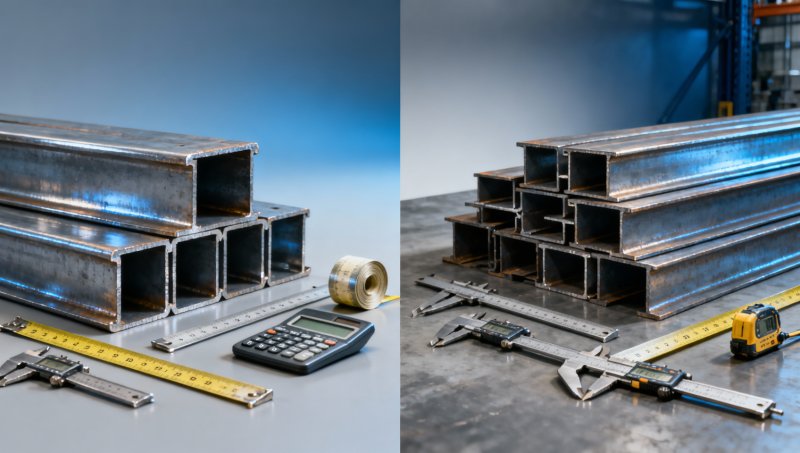
The most common quick formula for steel beam weight is based on volume multiplied by density. For carbon steel, the typical density used in practical estimation is 7.85 g/cm3, which is equal to about 7850 kg/m3. When dimensions are in millimeters, buyers and engineers often convert section area into square millimeters, then multiply by length and density to get kilograms.
A practical shortcut is this: beam weight per meter equals section area in square centimeters multiplied by 0.785. This method is widely used for early estimates because it is fast, easy to verify, and suitable for standard beams, channels, and many custom profiles. For example, if a section area is 50 cm2, the estimated unit weight is about 39.25 kg/m.
When working from drawings instead of standard tables, divide the section into rectangles, subtract voids where necessary, then sum the area. This approach is useful for welded beams, built-up sections, and special Z-beam configurations. In bidding or technical review, it helps teams produce a reasonable tonnage estimate within 10–20 minutes before a final engineering check is completed.
The key is to distinguish between nominal weight and actual delivered weight. Nominal weight uses theoretical dimensions. Actual delivered weight may vary due to rolling tolerances, coating, cut length, and fabrication details such as holes, end plates, or stiffeners. For purchasing decisions, using nominal weight for quotation and actual weight for final reconciliation is often the most manageable method.
Fast beam weight calculation methods by use case
The table below summarizes 4 practical ways to estimate beam weight quickly. It is especially helpful for information researchers, technical evaluators, and purchasing staff who need to choose between speed and precision at different project stages.
For most steel purchasing workflows, the first 2 methods are enough during quotation and sourcing. However, once the project includes customized cutting, welded accessories, or mixed standards, teams should confirm whether the supplier is quoting by theoretical tonnage, actual tonnage, or a fixed piece basis. That distinction prevents commercial misunderstandings later.
A simple 4-step workflow
- Confirm the section type and grade, such as Q235, S235JR, or A36.
- Verify the main dimensions: web height, flange width, thickness, and length.
- Use a table or area-based formula to estimate kg/m, then multiply by total length or quantity.
- Add a review step for tolerances, fabrication additions, and shipment unit conversion into tons.
Which Factors Change Theoretical and Actual Beam Weight?
Many users assume beam weight depends only on length, but in practice there are at least 5 variables that can shift the result: steel grade density assumption, rolling tolerance, profile geometry, surface treatment, and fabrication details. For plain hot-rolled carbon steel, density differences between common grades are small, so geometry and tolerances usually create the larger effect in routine purchasing.
Standard beams from ASTM, EN, JIS, or GB systems may have similar names but different dimensions and unit mass. That means an I-beam selected under one standard may not match the same nominal designation under another. Technical reviewers should therefore check the actual section table instead of relying only on trade names or local shorthand.
Fabrication can also change the final shipped weight. End-plate welding, stiffener addition, drilling, slotting, and galvanizing all influence the total. In some projects, holes reduce material weight while connection accessories add more than they remove. For this reason, final logistics planning should be updated again after shop drawing approval, especially on projects with 20 pieces or more.
Material planning is not limited to beams alone. Many construction and manufacturing projects also require plate components for base plates, brackets, stiffeners, and fixtures. In those cases, sourcing beams together with plate products from the same supplier can simplify quality control and lead-time coordination. For related applications such as building frames, bearing plates, bridges, and mechanical parts, Carbon Steel Plate Manufacturer solutions are often evaluated alongside beam sections to reduce split procurement risk.
Common factors that affect weight estimation
The next table gives a practical comparison between the main factors buyers and engineers should review before freezing quantity and freight plans. It is particularly useful when the project includes custom steel processing or multi-country compliance requirements.
This comparison shows why procurement teams should not rely on a single spreadsheet value all the way from tender to shipment. A better practice is to update the beam weight estimate at 3 checkpoints: inquiry stage, drawing confirmation stage, and pre-shipment stage. That simple control method reduces both financial and operational surprises.
Where carbon steel plate data helps beam projects
In many steel structures, beam systems are connected to base plates, brackets, stiffeners, and support parts made from carbon steel plate. Grades such as A36, Q235, and S235JR are common choices because they balance weldability, formability, and economy. Typical plate dimensions may cover thickness from 0.1 mm to 400 mm, width from 100 mm to 3000 mm, and length from 1 m to 12 m, depending on project requirements.
For technical evaluators, plate properties such as yield strength of 235 MPa, tensile strength of 375–500 MPa, elongation of at least 26%, and density of 7.85 g/cm3 provide a useful reference when beam assemblies include welded plate components. These values support load path review, forming feasibility, and compatible material selection for building frames, mechanical parts, vehicle chassis, storage tanks, pipe supports, and bridge applications.
When a supplier can provide both structural sections and plate-based components, purchasing becomes more efficient. That is especially helpful for projects with 2–3 material groups under one deadline, or for distributors who need mixed loads with standard specifications and OEM items. It also simplifies document coordination when customers require common international references such as ASTM, EN, JIS, DIN, ISO, or BS.
How Buyers and Engineers Should Compare Beam Options
The fastest beam weight calculation is useful only when it supports a better decision. In real purchasing work, buyers often compare at least 3 dimensions at the same time: unit weight, structural suitability, and total delivered cost. A lighter section may reduce freight, but if it increases deflection risk or fabrication complexity, the apparent saving can disappear during installation.
Procurement teams should also separate stock-based buying from project-based fabrication. Stock purchasing favors standard sizes with immediate availability and clearer unit mass tables. Project-based buying often requires custom lengths, hole patterns, plate attachments, or bundled accessory parts. In that second case, comparing only kg/m is not enough; the true cost must include processing time, scrap, inspection, and packing method.
For distributors and commercial evaluators, supplier stability is another factor. A manufacturer with modern facilities, strict quality control, and experience supporting global markets can reduce sourcing risk, especially when orders must comply with ASTM, EN, JIS, or GB expectations. Stable production capacity and dependable lead times matter when projects run on 2–4 week delivery windows or when repeated batch consistency is required.
Hongteng Fengda supports this type of decision process by supplying angle steel, channel steel, steel beams, cold formed steel profiles, and customized structural steel components. For contractors, OEM buyers, and regional distributors, that means fewer handover gaps between design intent, manufacturing feasibility, and export coordination.
A practical beam selection checklist
- Check whether the required grade is clearly defined, such as A36, Q235, or S235JR, and confirm the matching standard system.
- Review unit weight per meter together with total project tonnage, not as isolated figures.
- Confirm if lengths are fixed at 6 m, 9 m, 12 m, or custom cut, because cutting strategy affects scrap and packing efficiency.
- Ask whether quotation is based on theoretical weight, actual weight, or fabricated assembly weight.
- Verify document package needs, such as material certificates, inspection records, dimensional checks, and export packing details.
Common comparison mistakes
One common mistake is comparing sections only by price per ton without checking if the kg/m values come from the same standard. Another is ignoring the effect of accessories or welded details on actual shipped mass. A third is treating all lead times as equal, even though production for standard beams may be much faster than for customized fabricated assemblies with 4–6 inspection points.
A disciplined review process improves decision quality. Technical teams define the section and performance need. Procurement confirms cost structure and delivery schedule. Quality personnel verify tolerance and standard compliance. Decision-makers then approve the option that balances structural fit, timeline, and overall sourcing risk, rather than choosing only the lowest unit rate.
FAQ: Beam Weight, Standards, Lead Time, and Risk Control
The questions below reflect the issues most frequently raised by buyers, engineers, project managers, and distributors when evaluating beam weight and related steel sourcing decisions. They also help clarify where fast calculation is enough and where a deeper technical review is necessary.
How accurate is a fast beam weight calculation?
For standard hot-rolled sections, a quick calculation based on section tables or area multiplied by density is generally accurate enough for quotation, budgeting, and preliminary freight planning. However, once the order includes drilling, cutting, welded plates, or coating, the actual shipped weight should be reviewed again. A good rule is to use fast estimation at the first 2 project stages, then verify actual mass before dispatch.
Which steel grades are commonly used when comparing beam weight?
Common reference grades include Q235, S235JR, and A36. Their density for practical weight estimation is usually treated as about 7.85 g/cm3, so the weight difference for the same geometry is minimal in routine calculation. The larger decision factor is often not density, but whether the selected grade and standard match the structural design, welding process, and project documentation requirements.
What should procurement teams ask suppliers before placing an order?
They should ask at least 5 things: what standard applies, whether the weight is theoretical or actual, what length range is available, what tolerance control is used, and what the estimated delivery cycle is. For export projects, it is also wise to confirm packing method, document support, and whether related items such as plates, channels, or custom steel components can be shipped together in one coordinated lot.
How long does beam supply usually take?
Lead time depends on stock condition, processing scope, and order volume. Standard sections may move faster than customized fabricated parts, while export shipping adds additional planning time. In practice, buyers often evaluate supply in windows such as 7–15 days for ready material preparation or 2–4 weeks for more complex production and coordination. Exact schedules should always be tied to specification clarity and order quantity.
What are the biggest risks when estimating beam weight too casually?
The biggest risks are underestimating freight, selecting unsuitable lifting equipment, approving the wrong budget, and creating inconsistencies between quotation and final invoice. There is also a quality risk if the ordered section differs from the design standard. These problems are preventable when the team checks 3 areas early: correct section designation, correct unit weight basis, and correct fabrication scope.
Why Work With a Structural Steel Supplier That Understands Weight, Standards, and Delivery
Fast beam weight calculation is not only a technical task. It is part of a broader sourcing system that connects engineering judgment, cost control, manufacturing capability, and delivery reliability. When these parts are disconnected, projects lose time in repeated clarifications. When they are aligned from the start, teams can move from inquiry to approval with fewer revisions and better commercial visibility.
Hongteng Fengda supports global construction, industrial, and manufacturing projects with structural steel products and customized solutions. With experience in angle steel, channel steel, steel beams, cold formed profiles, and OEM structural components, the company helps buyers compare options more clearly, manage standard requirements, and reduce sourcing uncertainty across different regions and application scenarios.
If you are evaluating beam weight for a new order, a technical review can often save more than a simple price check. It can identify whether a standard section is sufficient, whether a custom fabricated solution is more practical, whether related plate components should be bundled, and whether delivery timing fits your project milestones. This is especially relevant for contractors, distributors, and manufacturers managing multi-item steel demand under tight schedules.
You can contact us to discuss section parameters, grade confirmation, beam weight calculation methods, plate and beam combination sourcing, delivery cycle expectations, certification references, sample support, and quotation details. If your project includes standard products or OEM customization, sharing drawings, quantity ranges, target market standards, and required lead time will help us provide a more practical recommendation.
Please give us a message


Please enter what you want to find