Why Durability Is More Than a Steel Shape
Angle steel and channel steel often appear in similar projects, yet their long-term behavior can be quite different.
A practical angle vs channel steel durability comparison should look beyond profile names and focus on load path, exposure, fabrication, and inspection control.
The comparison is especially important in construction, industrial structures, equipment frames, platforms, supports, and manufacturing facilities.
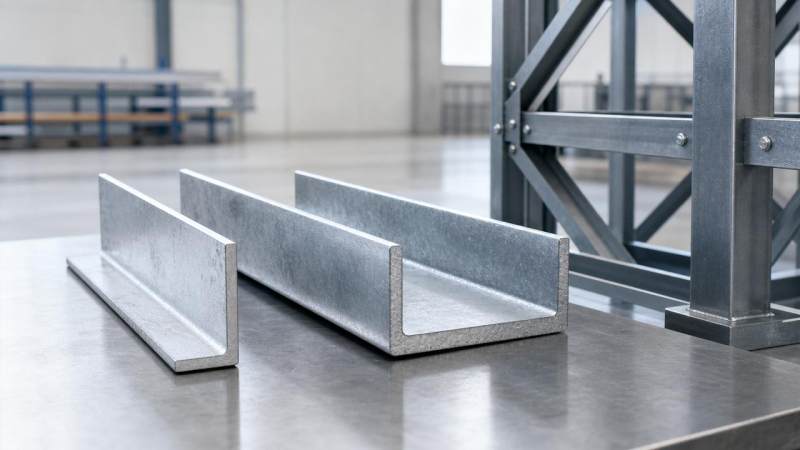
The following visual placeholder can represent the basic profile difference between angle steel and channel steel.
Durability is not simply how long steel can exist before corrosion appears.
It includes resistance to deformation, fatigue, connection failure, surface degradation, and unexpected performance loss during service.
That is why profile selection should be linked with project drawings, service environment, material standards, and acceptance criteria.
Understanding Angle Steel and Channel Steel Behavior
Angle steel has an L-shaped section, usually with equal or unequal legs.
It is widely used for bracing, frames, edge protection, support brackets, towers, shelves, and secondary structural members.
Channel steel has a U-shaped section, with a web and two flanges.
It is often selected for purlins, support rails, frames, equipment bases, lintels, and load-bearing members with directional bending.
In an angle vs channel steel durability comparison, geometry becomes the first technical difference.
Angle steel is simple, adaptable, and easy to connect, but it may twist under eccentric loading.
Channel steel generally offers stronger directional stiffness, especially when the web and flanges align with the applied load.
However, channel sections can trap moisture more easily when orientation, drainage, or coating design is poorly considered.
Core Factors Behind a Reliable Durability Comparison
A useful durability judgment rarely depends on one parameter.
Steel grade, section size, surface treatment, connection design, and project location all shape the final result.
Material grade and standards
Material strength affects yield resistance, bending performance, and tolerance for accidental overload.
Common standards include ASTM, EN, JIS, GB, and DIN, depending on market and project requirements.
Grades such as A36, SS400, S235, Q235, and Q345 may suit different structural expectations.
The standard should match the design calculation, not only the buyer’s familiar specification name.
Section geometry and load direction
Angle steel performs well in bracing and light support where loads are controlled and connections are well detailed.
Channel steel can provide better bending resistance along its strong axis in many beam-like uses.
Still, an angle vs channel steel durability comparison must consider torsion, local buckling, unsupported length, and connection eccentricity.
Corrosion exposure and surface protection
Outdoor projects, marine environments, chemical plants, and humid warehouses need stronger corrosion planning.
Hot-dip galvanizing, primer systems, paint coatings, and maintenance schedules can greatly extend service life.
Profile shape affects where water, dust, and corrosive deposits collect during actual use.
Where Angle Steel Usually Performs Best
Angle steel is valued for flexible installation and straightforward fabrication.
It can be cut, drilled, punched, welded, bolted, and combined into many small structural assemblies.
In practical applications, it is often durable when the design avoids severe eccentric loading.
It works well for diagonal bracing, equipment supports, platform edges, trusses, guard frames, and lattice structures.
Its open shape also makes visual inspection easier in many maintenance programs.
Cracks, corrosion, coating damage, and bolt loosening are often easier to notice on exposed angle surfaces.
For light to medium loads, angle steel may offer a cost-effective balance between strength and fabrication simplicity.
The key is not to use it as a substitute for a stronger bending member without calculation.
Where Channel Steel Has Durability Advantages
Channel steel is often chosen when members must resist bending in a predictable direction.
Its web and flanges allow more efficient load transfer than angle steel in many support conditions.
This can improve stiffness, reduce deflection, and support safer long-term performance.
The durability advantage becomes clearer in equipment frames, floor supports, rail bases, and industrial platforms.
However, channel steel is not automatically more durable in every environment.
If the channel opens upward, it may collect water, dust, oil residue, or chemicals.
That can accelerate corrosion and make hidden defects harder to inspect.
A careful angle vs channel steel durability comparison should include installation orientation, drainage, and access for maintenance.
A Practical Comparison for Project Decisions
The following table summarizes common durability considerations in real steel selection.
This table should not replace structural calculation.
It supports early screening before drawings, specifications, and supplier data are reviewed together.
Do Not Ignore Fabrication and Quality Control
Even the correct section can fail early if fabrication quality is poor.
Welding defects, rough cutting edges, misaligned holes, and poor coating preparation can reduce durability quickly.
Dimensional tolerance also matters because small deviations can affect assembly stress and field alignment.
For exported structural steel, consistency across batches is often as important as the first sample approval.
Hongteng Fengda manufactures and exports structural steel from China for construction, industrial, and manufacturing projects.
Its supply scope includes angle steel, channel steel, beams, cold formed profiles, and customized structural components.
Products can be supplied under major standards such as ASTM, EN, JIS, and GB.
This background matters when an angle vs channel steel durability comparison becomes part of broader sourcing risk control.
Stable capacity, repeatable tolerances, and dependable lead times help reduce project uncertainty across global supply chains.
How Related Structural Profiles Fit Into the Decision
Some projects require more than angle or channel sections.
When higher bending capacity is needed, steel beams may become part of the structural package.
For industrial structures, the I-beam is commonly considered where efficient section performance is required.
Available carbon steel grades may include Q195-Q235, Q345, SS400, A36, ST37-2, S235J0, S235J2, and St52.
Typical lengths can be 6-12m per piece, with customized dimensions available for project needs.
Flange width may range from 100mm to 400mm, depending on specification and design requirement.
Web width may range from 100mm to 900mm, with tolerance commonly controlled around ±1%.
Processing options such as bending, welding, punching, cutting, and decoiling support different fabrication routes.
Including related profiles in planning helps avoid forcing angle or channel steel into unsuitable load conditions.
Application Conditions That Change the Answer
No angle vs channel steel durability comparison is complete without the service environment.
The same profile can perform differently in a dry warehouse and a coastal outdoor structure.
Temperature changes, vibration, impact, chemical exposure, and maintenance frequency can shift the preferred choice.
For indoor equipment frames, channel steel may offer cleaner load support and better stiffness.
For outdoor bracing and visible support networks, angle steel may simplify inspection and coating repair.
In seismic or high-vibration environments, connection detailing becomes especially important.
Bolted joints, weld length, gusset plates, and lateral restraint can decide actual durability more than profile name.
Inspection Priorities Before Acceptance
Before shipment or installation, durability-related inspection should cover both documents and physical steel.
Mill certificates, grade confirmation, dimensions, straightness, coating condition, and packaging all deserve attention.
- Confirm grade, standard, heat number, and certificate consistency.
- Check section dimensions, thickness, length, straightness, and visible defects.
- Review weld quality, hole position, edge condition, and fabrication accuracy.
- Inspect coating coverage, surface preparation, zinc layer, or paint thickness.
- Verify packaging protection for sea freight, storage, and unloading conditions.
These checks create a practical bridge between specification language and real service performance.
They also make the angle vs channel steel durability comparison more measurable during procurement and project delivery.
Building a Safer Selection Framework
A sound selection framework begins with load, not with habit.
Identify whether the member mainly resists bending, compression, tension, torsion, or combined stress.
Then match the profile with its strongest behavior and the project’s inspection plan.
The next step is to verify material grade, standard, size tolerance, and fabrication process.
After that, review exposure conditions and decide whether galvanizing, painting, or special packaging is required.
Supplier capability should also be part of the decision.
Consistent manufacturing, OEM support, standard compliance, and export experience reduce hidden risks in international projects.
A useful angle vs channel steel durability comparison ends with evidence, not assumptions.
Drawings, calculations, inspection records, and environmental requirements should guide the final choice.
When the application, load path, and maintenance conditions are clear, the right structural section becomes easier to justify.
For future sourcing, compare specifications early, request complete documentation, and align profile selection with actual service conditions.
Please give us a message


Please enter what you want to find