Many buyers and DIY users underestimate the real load capacity of angle iron for shelving, especially when size, span, steel grade, and support conditions are ignored. Whether you source steel angle for construction, compare angle iron for construction uses, or evaluate angle iron for trailer frames, understanding safe limits is essential. This guide explains the common misjudgments, practical load factors, and what procurement and project teams should verify before choosing shelving material.
In steel shelving projects, the phrase “it looks strong enough” often leads to poor decisions. A 40 mm angle may appear rigid in a short test setup, yet deflect too much over a 1.8 m span. A thicker section may still fail if the load is concentrated at mid-span, if the steel grade is low, or if welding distorts the section. For warehouse users, workshop operators, distributors, and project engineers, the real question is not only how much weight angle iron can hold, but under what conditions it can hold it safely and consistently.
For B2B buyers, this issue also affects procurement risk, installation cost, and downstream liability. Structural steel products used in shelving should be selected with the same discipline applied to light frames, support brackets, and industrial racks. Manufacturers such as Hongteng Fengda, a structural steel manufacturer and exporter from China, support global projects by supplying angle steel, channels, beams, and custom profiles to ASTM, EN, JIS, and GB requirements, helping buyers balance load performance, consistency, and delivery reliability.
Why Angle Iron Shelving Load Limits Are Commonly Misjudged
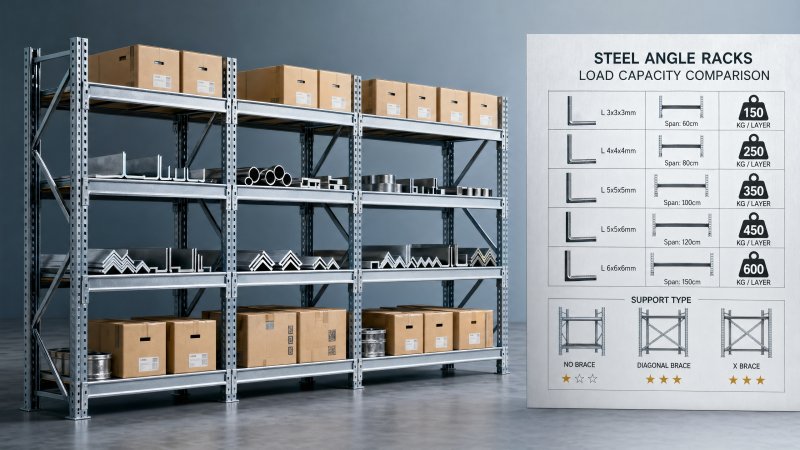
The first mistake is confusing static weight with safe working load. A shelf may survive a one-time 200 kg test, but that does not mean 200 kg is an acceptable operating load. Safe use normally requires a reserve for impact, uneven distribution, and long-term deflection. In practical industrial environments, a design margin of 1.5 to 2.0 is often considered before finalizing a shelving member, especially where manual loading or repeated movement is involved.
The second mistake is overlooking span length. Load capacity does not reduce in a simple linear way as span increases. When span grows from 900 mm to 1800 mm, deflection can become the controlling factor much faster than many buyers expect. Two shelves made from the same angle section can perform very differently if one has center support and the other does not. This is why shelf depth, spacing between uprights, and brace positions must be reviewed together rather than separately.
The third mistake is assuming all angle steel is interchangeable. Equal angle, unequal angle, hot rolled angle, and cold formed angle can differ in section properties, corner geometry, thickness tolerance, and stability under load. Steel grade also matters. A section produced to one standard may have different yield strength from another, even if nominal dimensions look similar on paper. Procurement teams should therefore verify not only size, but also standard, grade, tolerance, and intended service environment.
Three Load Factors That Change the Result Fast
- Span length: increasing from 1.0 m to 1.5 m can reduce acceptable uniform load significantly, even without changing section size.
- Load pattern: a uniformly distributed 150 kg load is usually less severe than a 150 kg point load placed near the center.
- Support condition: fully braced ends and intermediate supports can improve stability more than simply increasing thickness by 1–2 mm.
Another common issue is local weakness at holes, welds, and bolted joints. Even when the main angle section is adequate, oversized bolt holes, poor weld penetration, or heat distortion can reduce effective capacity. For safety managers and quality control teams, this means inspection should include fabrication details, not just mill dimensions. In shelving used for tools, boxed inventory, or spare parts, joint performance is often where the practical limit is reached first.
What Actually Determines the Safe Load of Angle Iron for Shelving
The safe load of angle iron shelving depends on at least five variables: section size, thickness, steel grade, unsupported span, and load type. A 30 × 30 × 3 mm angle can be suitable for light storage in short bays, while 50 × 50 × 5 mm or larger may be more appropriate for heavier workshop shelving. However, no size should be selected by rule of thumb alone. Deflection limits, support arrangement, and fastening details must be reviewed before final approval.
In many applications, serviceability matters as much as ultimate strength. A shelf that does not collapse may still sag enough to damage cartons, create instability, or cause items to roll. For light industrial shelving, buyers often evaluate both maximum stress and acceptable deflection, such as span divided by 180 or span divided by 240, depending on the use case. This is especially important where shelves support long materials, containers, or precision parts.
The table below shows a practical comparison of typical factors that affect shelving performance. These are decision-support ranges rather than a substitute for structural verification, but they help buyers understand why two similar-looking angles can carry very different safe loads.
The key takeaway is that safe load is system-based, not section-based. If a project team only asks for “angle iron” without confirming span, loading method, support spacing, and usage frequency, the material may be either over-specified and costly or under-specified and unsafe. This is why experienced suppliers ask for drawing details, intended load per level, and environment before recommending a section.
How Different Applications Shift the Design Priority
For archive shelving or light retail storage, visual straightness and moderate load performance may be enough. For workshop shelving, the priority often shifts to impact resistance and durable connections. For parts storage in manufacturing plants, frequent loading cycles and concentrated metal components can create higher local stress than the total weight number suggests. In humid or chemical environments, corrosion allowance may also become a design factor.
Mid-project, teams sometimes need non-structural complements for screening, filtering, or equipment guards near shelving systems. In such cases, products like 306 Stainless Steel Welded Mesh can be integrated into adjacent industrial layouts where corrosion resistance and durability are important. Available in stainless steel wire grades such as SS 201, 304, 304L, 316, 316L, and 430, with diameter ranges from 0.0008″ to 0.12″ and mesh from 2 to 635 mesh, this type of product serves filters, sieve systems, chemical industry, mine industry, architecture, and residence-related uses.
Although welded or woven mesh is not a substitute for the load-bearing angle frame itself, understanding companion steel products helps procurement teams standardize sourcing across projects. With roll width up to 240″ and roll length up to 2000′, stainless mesh products are often selected for corrosion, acid, alkali, heat, and chemical resistance in industrial support areas, while angle steel remains the main load-carrying member in shelving frames.
Selection Rules for Buyers, Engineers, and Project Managers
A practical selection process starts with the load per shelf level, not with the price per ton. If one shelf level is expected to carry 120 kg of boxed goods across a 1000 mm span, that is a different design problem from 120 kg of machine parts loaded near the center. Buyers should define at least four items before requesting a quote: load value, load pattern, clear span, and support detail. Without these basics, any price comparison is incomplete.
The second rule is to specify the environment. Indoor dry storage, coastal warehouse use, and chemically exposed workshop areas may require different finishes or material strategies. Carbon steel angle may be sufficient for many indoor shelves, but hot-dip galvanizing, primer systems, or stainless complements may be justified where corrosion risk is higher. A lower upfront price can become expensive if repainting or replacement is needed within 12 to 24 months.
The third rule is to align the material standard with the project region and compliance needs. Global buyers commonly ask for ASTM, EN, JIS, or GB compliance depending on the end market. Reliable manufacturers with stable production capacity and quality control can reduce variation in thickness, straightness, and chemistry, all of which influence fabrication efficiency and final performance. This is particularly important for OEM shelving components and repetitive production orders.
Procurement Checklist Before Order Confirmation
- Confirm angle dimensions and thickness tolerance, such as 40×40×4 mm or 50×50×5 mm.
- State the clear span and whether intermediate support exists at 600 mm, 900 mm, or 1200 mm intervals.
- Define the load as uniform, point load, or mixed load, with estimated maximum kg per level.
- Specify steel standard and grade requirement for the export market or project specification.
- Check fabrication method, including drilling, welding, bolting, coating, and packaging requirements.
The table below helps procurement and technical teams compare common sourcing decisions in shelving projects.
This comparison shows that material cost is only one part of the purchasing decision. In many cases, the biggest avoidable loss comes from wrong assumptions made before production starts. A supplier capable of providing standard sections and customized structural steel components can help buyers reduce sourcing errors, especially when drawings, cut lengths, hole patterns, and OEM requirements are involved.
Installation, Inspection, and Safety Controls on Site
Even well-selected angle iron can underperform if installation quality is poor. Uprights that are not plumb, anchors that are loose, or shelves that are not level will change how loads travel through the frame. During installation, project teams should verify at least three points: frame alignment, fastener tightness, and actual support spacing. A difference of 20 to 30 mm in support position may be enough to affect fit-up and long-span behavior.
Inspection should also focus on signs of early overstress. These include visible sagging, twisted angles, cracked weld toes, elongated bolt holes, and recurring looseness after use. For frequently accessed shelving, operators should report any noticeable change in shelf straightness, especially if heavy items are being stored near the front edge. A visual check every 1 to 3 months is common in active industrial areas, while more formal reviews may be scheduled quarterly or semi-annually.
Safety managers should label intended shelf capacity where practical. This helps prevent misuse by end users who may otherwise stack concentrated loads onto a level designed for distributed storage. If the stored item mix changes from cartons to metal parts, the original load assumption should be reviewed. Shelving is often repurposed over time, and that is when hidden under-design becomes a safety issue.
Site Control Measures That Reduce Failure Risk
- Keep heavy items close to supports where possible instead of concentrating them at mid-span.
- Use bracing or intermediate supports on spans above roughly 1200 mm when loads are moderate to heavy.
- Replace bent or damaged angles promptly rather than reusing them in another bay without review.
- Check corrosion at joints, welds, and cut ends first, since these areas often deteriorate faster than flat surfaces.
For export-oriented projects, packaging and delivery condition also deserve attention. Angle sections that arrive bent, heavily scratched, or with damaged coating can create fit and durability problems before installation begins. Working with a supplier that maintains consistent lead times, controlled fabrication, and inspection discipline can support smoother project execution, especially for distributors and contractors managing multiple sites across North America, Europe, the Middle East, or Southeast Asia.
Frequently Asked Questions Before Choosing Angle Steel Shelving
How do I know whether equal angle or unequal angle is better for shelving?
Equal angle is commonly used when shelf geometry is symmetrical and fabrication is simple. Unequal angle can be useful when one leg must provide a wider bearing surface or fit a specific connection detail. The choice should be based on drawing constraints, load path, and fabrication efficiency, not appearance alone. In many standard shelving frames, equal angle remains the easier and more economical option.
Can I use the same angle iron for shelving and trailer frame work?
Not automatically. Angle iron for trailer frames is exposed to vibration, cyclic loading, road shock, and dynamic stress, which differ from static shelving conditions. A section that is acceptable for a shelf level in a workshop may not be suitable for a moving frame. When buyers compare angle iron for construction uses, shelving, and trailers, they should treat them as separate engineering situations with different safety expectations.
What should distributors and resellers keep in stock most often?
Stock decisions depend on customer mix, but common ranges often include small to medium structural angles suitable for light fabrication, support frames, and shelving. Keeping multiple thickness options in a few popular sizes is usually more practical than holding too many uncommon dimensions. Distributors should also track whether local buyers prefer plain carbon steel, pre-galvanized options, or fabricated OEM parts cut to length.
How long is a typical sourcing cycle for custom shelving angles?
For standard sections, lead time may be relatively short depending on stock and order volume. For OEM structural steel components involving cutting, punching, welding, or coating, buyers often plan in stages: drawing confirmation, production, inspection, and shipment. As a practical purchasing habit, project teams should allow extra time for approval, packaging, and export logistics rather than assuming standard stock timing for customized orders.
Choosing angle iron for shelving is less about guessing a weight number and more about understanding the full load condition: span, support, steel grade, load distribution, joint quality, and operating environment. Buyers who define these factors early can avoid deflection complaints, safety issues, and unnecessary over-specification. For contractors, distributors, and industrial users, that means better cost control and more reliable shelf performance over time.
Hongteng Fengda supports global customers with angle steel, channel steel, steel beams, cold formed steel profiles, and customized structural steel components built for practical project requirements. If you need help comparing section options, confirming standards, or preparing a sourcing plan for shelving and related steel applications, contact us to get a tailored solution, discuss product details, and explore reliable export support for your next project.
Please give us a message


Please enter what you want to find