Understanding angle steel vs channel steel differences is critical for accurate load-bearing calculations—especially when sourcing Steel Channel for construction projects or buy angle steel online. For procurement managers evaluating ASTM A36 Angle Steel price per ton in Philippines or comparing international standards for structural steel products, misidentifying section geometry can compromise safety and compliance. At Hongteng Fengda—a certified structural steel manufacturer and exporter from China—we help technical evaluators, project managers, and buyers avoid costly design errors by clarifying how moment of inertia, torsional resistance, and connection behavior differ between these two key profiles. Discover why these distinctions directly impact MOQ requirements, quality testing protocols, and long-term structural steel lifespan and maintenance.
Why Geometry Dictates Structural Performance
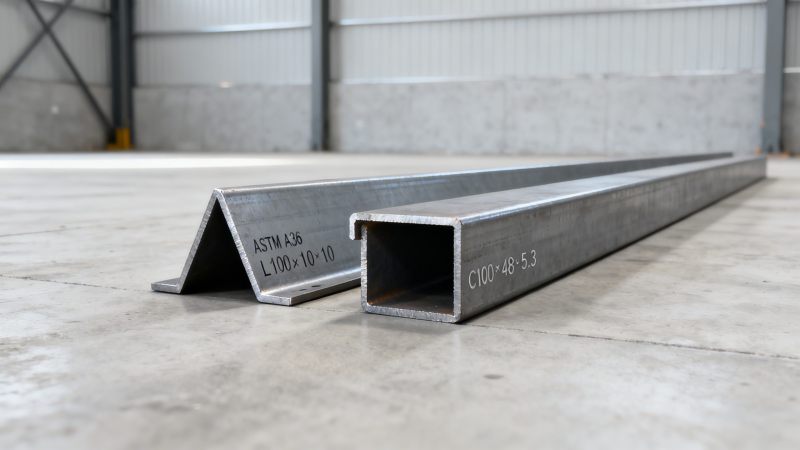
Angle steel (L-section) and channel steel (C-section) share the same base material—but their cross-sectional shapes create fundamentally different mechanical behaviors under real-world loading. While both are widely used in building frames, bracing systems, and equipment supports, their bending stiffness, buckling resistance, and torsional rigidity vary significantly—even at identical weight per meter.
For example, a 100×100×10 mm equal-leg angle steel has a moment of inertia (Ix) of ~178 cm⁴, whereas a C100×48×5.3 mm channel steel delivers ~242 cm⁴—nearly 36% higher—despite similar mass. This difference directly affects deflection limits in roof purlins or crane rails, where serviceability governs design more than ultimate strength.
Torsional resistance is even more divergent: channel sections offer inherent stability against twisting due to their closed-flange geometry, while angles require additional lateral bracing or paired configurations to prevent rotational failure—adding up to 15–20% in field labor and anchoring hardware costs on large-scale industrial builds.
Key Mechanical Differences at a Glance
The table below compares standardized ASTM A36 hot-rolled profiles commonly sourced by global contractors and OEMs. All values reflect typical nominal dimensions and are derived from EN 1993-1-1 and AISC 360-22 design methodologies.
These metrics explain why channel steel is preferred for horizontal beams in modular warehouses or conveyor supports—where unbraced spans exceed 3 meters—while angle steel remains optimal for corner bracing, column gussets, or lightweight truss members where bidirectional stiffness and ease of welding dominate over pure bending capacity.
How Selection Impacts Procurement & Compliance
Procurement teams must align profile selection not only with engineering specs but also with supply chain realities. Angle steel typically requires smaller minimum order quantities (MOQ)—as low as 2–5 metric tons for standard sizes—due to simpler rolling tooling and broader stock availability across Chinese mills. Channel steel, especially non-standard flange widths or web thicknesses, often carries MOQs of 10–20 tons and lead times of 4–6 weeks for custom orders.
Certification adds another layer: EN 10025-2 S235JR channel sections require mill test reports (MTRs) covering tensile yield ≥235 MPa, elongation ≥26%, and Charpy V-notch impact at 20°C ≥27 J. Angle steel under ASTM A36 mandates yield strength ≥250 MPa, tensile ≥400 MPa, and elongation ≥21%. Both demand third-party inspection (e.g., SGS or BV) for export to EU, GCC, or North American markets—yet channel steel’s higher dimensional tolerance sensitivity (+/-0.5 mm on flange width vs. +/-0.8 mm on leg length) increases rejection risk if supplier QA is inconsistent.
This is where Hongteng Fengda’s integrated production control adds value: our cold-formed line achieves ±0.15mm thickness tolerance across all structural profiles, and every batch undergoes ultrasonic testing (UT), magnetic particle inspection (MPI), and salt-spray corrosion validation per ASTM B117 (500+ hours). We also supply Galvanized Pipe for auxiliary framing—ensuring full system corrosion compatibility in coastal or high-humidity installations.
When to Choose Which—and What to Verify Before Ordering
Select angle steel when:
- You need symmetrical biaxial stiffness for diagonal bracing or column bases;
- Welding access is limited, and single-sided fillet welds simplify field assembly;
- Budget constraints prioritize lower unit cost and faster delivery (standard angles ship in 7–15 days);
- Design allows for back-to-back or star-shaped configurations to boost torsional stability.
Choose channel steel when:
- Long-span beams require high Ix/mass ratio without increasing depth;
- Torsional loads dominate—e.g., cantilevered signage arms or rotating equipment mounts;
- Flange provides built-in attachment surface for bolts, clips, or sliding tracks;
- Integration with other rolled sections (e.g., T-beams or hollow structural sections) demands consistent flange alignment.
Before finalizing purchase, verify: (1) actual mill certificate data—not just catalog values; (2) whether galvanizing will be applied pre- or post-fabrication (hot-dip zinc coating affects weld integrity); and (3) dimensional sampling plan (we inspect 5% of each heat lot per ISO 2859-1 Level II).
Why Partner with Hongteng Fengda for Structural Steel Sourcing
As a certified structural steel manufacturer and exporter from China, Hongteng Fengda bridges engineering precision with global procurement efficiency. We produce ASTM, EN, JIS, and GB-compliant angle and channel steel—from standard 20×20×3 mm to heavy-duty 250×250×25 mm—with full traceability down to billet heat number.
Our clients benefit from: stable monthly output capacity of 15,000+ tons; 98.7% on-time delivery rate across 32 countries; dedicated engineering support for load-case review and connection detailing; and flexible trade terms (FOB, CFR, CIF, DAP) backed by LC acceptance and Alibaba Trade Assurance.
Whether you’re validating a structural calculation, comparing ASTM A36 Angle Steel price per ton in Philippines, or specifying corrosion-resistant framing for a petrochemical plant, contact us today for free profile selection guidance, sample coordination, or customized MOQ-based quotation—including bundled offers with Galvanized Pipe for complete system solutions.
Please give us a message


Please enter what you want to find