When comparing angle steel plate and flat plate for structural applications, strength is never just about thickness. For technical evaluators, understanding how shape, load distribution, and connection requirements affect performance is essential to selecting the right material. This article explains the key strength differences between angle steel plate and flat plate, helping buyers make more accurate decisions for engineering, fabrication, and global sourcing projects.
Why does angle steel plate often perform differently from flat plate?
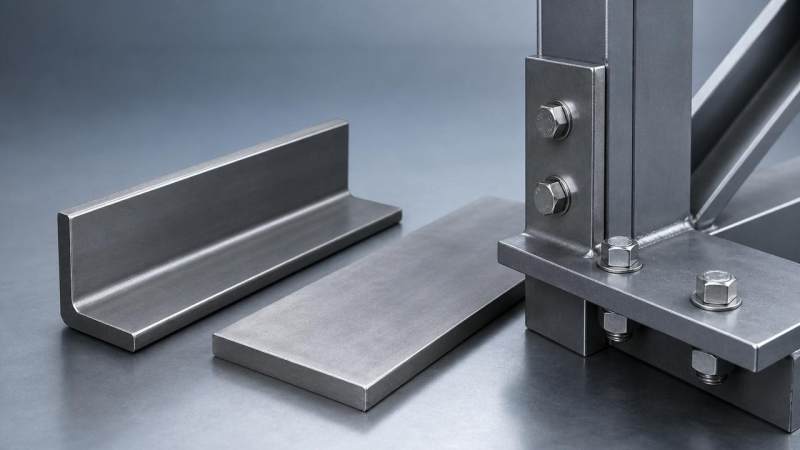
The main reason is geometry. An angle steel plate has two legs joined at a right angle, while a flat plate has a single planar section. Even when both are made from the same steel grade and similar thickness, the section shape changes stiffness, load path, connection behavior, and resistance to bending or twisting.
For technical evaluation, the question is not simply which one is stronger. The correct question is stronger under what kind of load, span, support condition, fabrication method, and service environment. In many structural steel projects, the wrong assumption about strength leads to overdesign, unstable connections, or unnecessary material cost.
In practical sourcing, angle steel plate is often selected where a component must carry combined loads and provide an easy connection edge. Flat plate is usually preferred where load spreads across a surface, where cutting flexibility matters, or where the plate will be welded into a fabricated section.
- Angle sections usually offer better directional stiffness because the folded shape increases the section modulus.
- Flat plates are simpler to process, but they can deflect more under the same unsupported loading condition.
- Connection design can make angle steel plate more efficient in brackets, frames, supports, and edge-reinforced members.
Angle steel plate vs flat plate: a practical strength comparison
Before selecting material, evaluators usually need a side-by-side view. The table below compares angle steel plate and flat plate across core strength-related criteria used in steel fabrication, structural support design, and procurement review.
This comparison shows why angle steel plate is not automatically stronger in every case. It is more efficient when section shape contributes to stiffness. Flat plate remains highly useful when structural performance comes from assembly design, larger bearing area, or multi-part welded construction.
What strength differences matter most in real structural loading?
Bending and section modulus
A key strength difference lies in section modulus. Because the material in an angle steel plate is distributed away from the neutral axis in two directions, it can resist bending better than a flat plate of similar mass in some loading orientations. This makes it useful in supports, braces, cleats, and frame corners.
Flat plate, by contrast, is efficient when loaded in membrane-like or bearing conditions, but as an unsupported strip it tends to bend more easily. To compensate, designers may increase thickness, reduce span, or add welded stiffeners. That adds fabrication time and sometimes offsets the raw cost advantage.
Buckling and edge stability
Local buckling behavior also differs. A flat plate under compression may need careful width-to-thickness control, especially if one edge is free. The angle profile provides a stiffened corner that improves stability in many applications. However, depending on leg dimensions and loading direction, one leg of the angle may still become the weaker element.
That is why technical evaluators should look beyond nominal thickness. The effective load-bearing behavior depends on support conditions, edge restraint, connection spacing, and whether the member acts alone or as part of an assembly.
Welded and bolted performance
In bolted structures, angle steel plate often simplifies connection layout because one leg can connect to the main structure and the other to the supported element. Flat plate may need additional fittings or gussets to achieve a similar arrangement. In welding, flat plate offers broader fabrication flexibility, especially for custom box sections, stiffened panels, and base plate systems.
Which applications favor angle steel plate and which favor flat plate?
Application fit is critical in the steel industry. Technical teams usually assess not only strength, but also fabrication route, transport convenience, coating needs, and installation speed. The table below can support early-stage selection for common project scenarios.
This selection logic helps avoid a common sourcing error: choosing by raw weight or nominal thickness alone. In many projects, shape efficiency and connection simplicity reduce total installed cost more than low material price does.
For corrosion-sensitive environments, technical teams may also evaluate whether a galvanized tube, angle, or plate assembly can reduce lifecycle maintenance. In support-frame, low-pressure pipeline, and shed construction projects, Galv Steel Tube may complement angle sections where corrosion resistance and service life are important.
How should technical evaluators compare angle steel plate during procurement?
Start with the real load case
A proper review begins with identifying the actual working condition. Is the member carrying bending, bearing, compression, impact, or combined load? Is the force applied through one leg, both legs, or over a flat surface? These details determine whether angle steel plate has a structural advantage over flat plate.
Check dimensional tolerances and fabrication route
If the project involves bolted installation, hole position accuracy, leg straightness, and edge quality affect fit-up and assembly speed. If the project involves welding, the evaluator should check material grade compatibility, heat input sensitivity, and whether the profile introduces distortion risks during fabrication.
Review standards and export compatibility
For international projects, consistent compliance matters. Structural steel buyers often need products aligned with ASTM, EN, JIS, or GB requirements. A manufacturer with stable production control can reduce risk in dimensional consistency, chemical composition verification, and documentation matching.
- Confirm the governing design standard before comparing equivalent sections.
- Ask whether standard and OEM dimensions can both be supplied.
- Verify coating, surface condition, and inspection documents early in the RFQ stage.
- Evaluate lead time together with fabrication readiness, not as an isolated purchasing factor.
What mistakes do buyers make when comparing angle steel plate with flat plate?
Many buyers assume that thicker flat plate always equals higher structural strength. That is not reliable. A thicker flat plate can still perform poorly in an unsupported bending application where an angle profile would control deflection better with less material.
Another mistake is ignoring fabrication cost. Flat plate may be cheaper per ton, but if the design requires extra stiffeners, brackets, or machining, the total cost can exceed an angle-based solution. Technical evaluators should compare full installed cost, not only ex-works material pricing.
A third issue is overlooking environmental protection. In humid, outdoor, or industrial settings, corrosion control can decide service life. For some mixed-structure projects, a coordinated solution involving angle sections and Galv Steel Tube improves durability in construction industry, agriculture, storage systems, and support frame applications.
How can a reliable structural steel supplier reduce evaluation risk?
For technical assessment personnel, supplier capability is part of strength evaluation because manufacturing consistency affects actual performance. A section that is correct on paper but inconsistent in angle accuracy, thickness tolerance, or surface condition can create assembly and safety problems on site.
Hongteng Fengda focuses on structural steel manufacturing and export from China, supplying angle steel, channel steel, steel beams, cold formed steel profiles, and customized structural components for global projects. For buyers comparing angle steel plate solutions, this matters in three ways: stable production, specification flexibility, and alignment with widely used standards such as ASTM, EN, JIS, and GB.
This is especially relevant when projects require mixed steel packages rather than a single item. Technical teams may need angle sections for support members, flat plates for connection assemblies, and coated steel tubes for low-pressure fluid lines or outdoor frames. A supplier that can coordinate these needs reduces communication gaps and delivery risk.
FAQ: what do technical evaluators usually ask?
Is angle steel plate always stronger than flat plate?
No. Angle steel plate is often more efficient in directional bending, edge support, and connection-based applications. Flat plate can be stronger or more suitable in bearing, surface load distribution, and fabricated assembly use. The correct comparison depends on the load case and support condition.
What should be checked first during sourcing?
Check steel grade, dimensions, tolerance, standard, and intended loading direction first. After that, review connection type, coating requirement, quantity, and lead time. These factors affect whether angle steel plate or flat plate will deliver the better total solution.
How do standards affect comparison?
Equivalent-looking products may differ under ASTM, EN, JIS, or GB in dimensional rules, mechanical property ranges, and documentation format. A direct comparison without standard alignment can lead to wrong substitution and approval delays.
When is flat plate still the better choice?
Flat plate is often better for gussets, base plates, machine parts, cover plates, and components that require extensive cutting or welding into custom shapes. It is also useful when the design relies on broad contact area instead of sectional stiffness.
Why choose us for structural steel selection and export support?
If you are evaluating angle steel plate for a project, the most useful support is not a generic sales promise. It is a technical response based on application, standards, fabrication, and delivery constraints. Hongteng Fengda supports buyers with structural steel supply and customized solutions for construction, industrial, and manufacturing projects across multiple regions.
You can consult us for parameter confirmation, section selection, standard matching, OEM dimensions, coating requirements, delivery scheduling, sample support, and quotation comparison. If your project includes angle steel, flat plate, beams, cold formed profiles, or related tube products, our team can help organize a practical supply plan around quality consistency and sourcing efficiency.
For technical evaluators, a better decision starts with clear drawings, load conditions, target standard, and project timeline. Share these details, and we can help you compare feasible steel options, reduce sourcing uncertainty, and move your project toward a more accurate procurement outcome.
Please give us a message


Please enter what you want to find