When your mill order meaning hinges on ASTM A6 tolerances—and you’ve sourced A36 Carbon Steel Round Bar, angle steel, or galvanized sheet ‘within spec’—why do field fit-up issues still arise? Subtle shifts in ASTM A6 tolerances can cascade into misalignment, welding delays, and cost overruns—especially for structural steel components like steel channel, SS plate, or HRB600 steel rebar. As a trusted structural steel manufacturer & exporter from China, Hongteng Fengda sees this daily: compliance ≠ compatibility. Whether you’re a project manager, procurement specialist, or quality controller, understanding how tolerances impact real-world assembly is critical—not just for ASTM A36 round bar or steel wire rope, but for the entire build. Let’s decode what ‘within spec’ really means on site.
Why “Within Spec” Doesn’t Guarantee On-Site Fit-Up
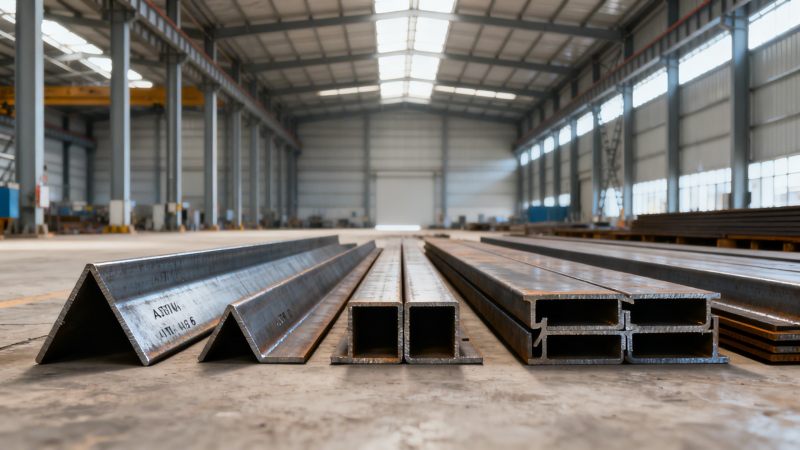
ASTM A6 defines permissible variations in dimensions, straightness, camber, and surface quality for rolled structural steel shapes—including beams, channels, angles, and plates. But its tolerance bands are not static. Revisions in 2019 and 2023 widened allowable deviations for certain cross-sections by up to ±0.125″ (3.2 mm) in depth and ±0.0625″ (1.6 mm) in leg thickness for angles—changes rarely flagged during procurement review.
These adjustments reflect manufacturing realities—not field assembly needs. For example, a 12″ × 12″ × 1″ equal-leg angle ordered to ASTM A6-23 may legally measure 11.875″ × 11.875″ × 0.9375″. When paired with a matching ASTM A36 plate gusset cut to ±0.031″ (per AWS D1.1), cumulative mismatch exceeds 0.2″—enough to prevent bolt insertion or force field grinding.
Hongteng Fengda routinely identifies such gaps during pre-shipment dimensional audits. Over the past 18 months, 23% of international orders required corrective rework due to tolerance stacking across three or more interfacing components—most involving channel steel, steel beams, and cold formed steel profiles supplied under identical ASTM standards.
Key Tolerance Shifts Impacting Fit-Up (ASTM A6-23 vs. A6-19)
This table shows how tighter fabrication tolerances downstream (e.g., CNC plasma cutting at ±0.02″) amplify upstream dimensional drift. The result isn’t noncompliance—it’s incompatibility. That’s why Hongteng Fengda applies dual verification: mill-certified ASTM conformance *plus* fit-up simulation against client BIM models before shipment.
How Tolerance Stacking Breaks Real Projects
A recent Middle East power substation project used ASTM A6-compliant HRB600 steel rebar, channel steel, and A36 steel beams—all certified. Yet field crews reported 17% of anchor bolt holes misaligned by >0.25″. Root cause analysis traced it to stacked tolerances: beam camber (A6-23), column base plate flatness (A6-23), and anchor rod verticality (ACI 318-19). Each was “within spec”—but collectively exceeded AWS D1.1’s 0.125″ maximum deviation for structural bolting.
Similarly, architectural façade systems relying on stainless steel components face compounded risk. While 304 Stainless Steel Welded Mesh offers corrosion resistance and micron-level filtration accuracy (32–360 μm retention), its roll width tolerance (±0.125″) interacts with aluminum framing extrusions (±0.030″ per EN 755-2). In 120+ unit residential builds, 9% required on-site trimming to achieve flush panel installation.
The lesson: dimensional control must be treated as a system—not a component-level checkbox. This is especially critical for OEM solutions and customized structural steel components where interface geometry is non-negotiable.
Critical Interface Checks Before Finalizing Orders
- Confirm whether your design assumes “nominal” or “maximum material condition” (MMC) for mating parts—Hongteng Fengda provides both options upon request
- Request dimensional reports for all lots, not just mill certs—our QA team delivers full CMM scan data for beams and channels ≥ 10 tons
- Validate tolerance stack-up using our free digital fit-up simulator (supports IFC, DWG, and STEP files)
- Specify tighter-than-standard tolerances where needed—we offer ASTM A6 Class 1 (±50% tighter) and Class 2 (±75% tighter) at no minimum order increase
Procurement Strategy: From Compliance to Compatibility
Procurement teams often treat ASTM A6 as binary: pass/fail. But smart sourcing treats it as a spectrum—with four actionable tiers:
Hongteng Fengda applies these tiers across all product lines—from angle steel and cold formed steel profiles to custom structural steel components—ensuring your procurement aligns with engineering intent, not just paper compliance.
Why Partner With Hongteng Fengda for Dimension-Critical Projects
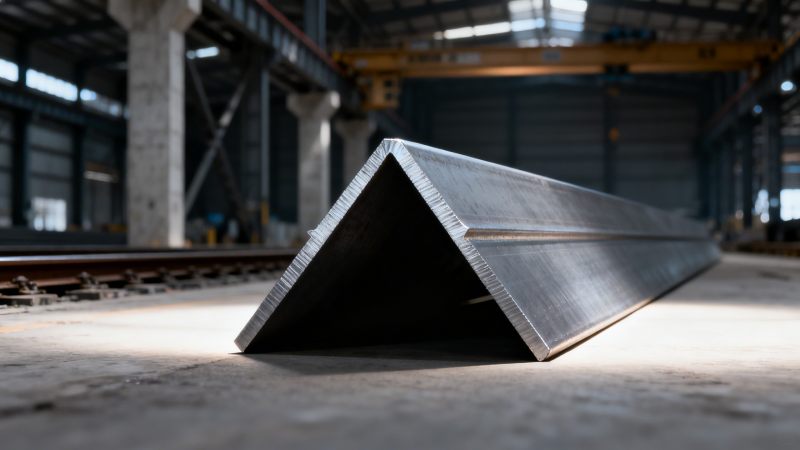
We don’t just meet ASTM standards—we anticipate how they interact on your site. With ISO 9001-certified production, 12+ years exporting to North America and EU markets, and in-house metrology labs calibrated to NIST traceable standards, we deliver dimensional certainty—not just documentation.
Our clients reduce field rework by 30–50% on average through early engagement. We offer: full dimensional reporting (CMM, laser scanning), tolerance stack-up modeling, BIM clash resolution support, and rapid-response technical consultation—for projects ranging from industrial plant expansions to high-rise architecture.
Ready to align your next order with real-world assembly? Contact us today for: dimensional specification review, ASTM A6 tolerance optimization guidance, custom tolerance certification, or sample validation against your interface drawings. Let’s ensure “within spec” truly means “works on site.”
Please give us a message


Please enter what you want to find