ASTM A106 Gr B chemical composition directly affects strength, toughness, and weldability, making it critical for engineers, buyers, and project managers evaluating ASTM A106 Gr B pipe. Understanding ASTM A106 Gr.B specification, ASTM A106 Gr.B equivalent grades, and related ASTM A106 Gr B mechanical properties helps reduce welding defects, sourcing risks, and performance uncertainty in demanding industrial and structural applications.
For technical evaluators, procurement teams, quality managers, and project owners, the issue is not only whether ASTM A106 Grade B meets the paper specification. The practical question is how its carbon, manganese, phosphorus, sulfur, silicon, and residual elements influence fabrication, heat input, service life, and field repairability under real production conditions.
In many oil, gas, power, process, and structural support projects, pipe selection errors are discovered late, often during welding, hydrotest, or commissioning. A small variation in chemistry can increase hardness in the heat-affected zone, reduce low-temperature toughness, or raise the likelihood of cracking, especially when welding thickness, restraint, and ambient temperature are not properly controlled.
This article explains the ASTM A106 Gr B chemical composition range, its effect on weldability risks, how it compares with equivalent grades, and what buyers should verify before ordering. It also highlights inspection points, fabrication precautions, and sourcing recommendations relevant to global industrial and steel supply chains.
Understanding ASTM A106 Gr B Chemistry and Why It Matters
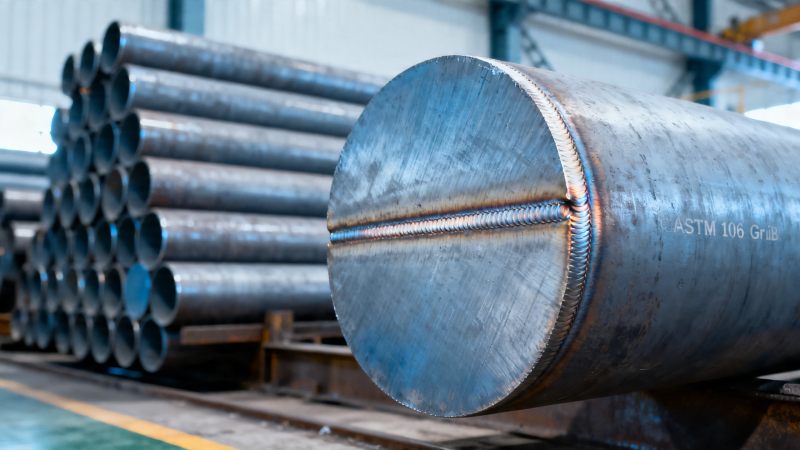
ASTM A106 Grade B is a seamless carbon steel pipe grade widely used for high-temperature service. Its base chemistry is designed to balance strength, formability, and process stability. In practice, however, “within standard” does not always mean “equal in fabrication performance.” Even when material passes specification, chemistry near the upper limit of carbon or sulfur can change welding behavior and downstream reliability.
For most buyers, the starting point is the ASTM A106 Gr.B specification. Typical composition limits include carbon up to about 0.30%, manganese from roughly 0.29% to 1.06%, phosphorus not over 0.035%, sulfur not over 0.035%, and silicon at a minimum around 0.10%. These numbers are small, but they have a direct impact on tensile strength, yield response, weldability, and susceptibility to fabrication defects.
Higher carbon generally improves strength but reduces weldability. Manganese helps strength and hardenability, but when combined with high restraint welding, it can contribute to higher local hardness. Phosphorus and sulfur are impurity-controlled elements. If they approach their maximum limits, toughness and hot workability may decline, while sulfur can increase the risk of inclusions that weaken weld zone integrity.
For engineering teams, the key is to read chemistry together with mechanical properties and service conditions. ASTM A106 Gr B mechanical properties commonly include tensile strength of at least 415 MPa and yield strength of at least 240 MPa. These baseline values are useful, but actual fabrication quality depends on welding procedure qualification, joint design, wall thickness, and preheat control as much as on mill test certificates.
Typical Chemical Composition Range
The following table summarizes the commonly referenced ASTM A106 Grade B chemical limits and their practical influence on production and welding.
These limits should not be viewed in isolation. A106 Grade B pipe intended for field welding in ambient temperatures below 5°C, or for wall thickness above 20 mm, generally deserves stricter review of chemistry and welding procedure control. For procurement teams, it is often wise to request heat-by-heat mill test reports rather than relying only on nominal grade statements.
What Technical Teams Should Check First
- Confirm actual chemistry values, not just grade name, especially carbon, sulfur, and manganese.
- Review wall thickness and welding process together; GTAW, SMAW, and SAW respond differently to heat input and restraint.
- Check whether the service involves elevated temperature, cyclic loading, or field joints in cold weather.
- Ask for supplementary NDT, hardness checks, or PMI when project risk is high or multiple grades are present onsite.
Weldability Risks: From Carbon Content to Field Fabrication Defects
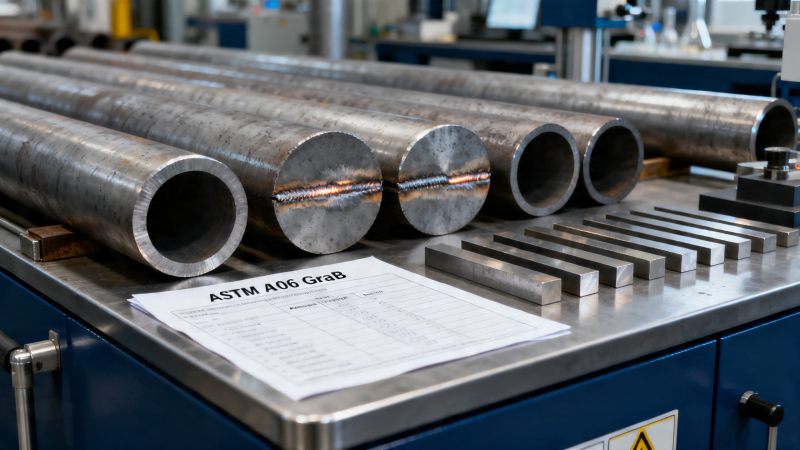
Weldability risk in ASTM A106 Gr B pipe is not usually caused by one factor alone. Problems arise when chemistry, thickness, restraint, filler selection, and welder practice combine unfavorably. A pipe with compliant chemistry can still suffer lack of fusion, underbead cracking, porosity, or excessive hardness if fabrication controls are weak.
One of the most practical indicators is carbon equivalent, even though ASTM A106 does not define procurement solely by CE. In many shop and field environments, a CE level approaching around 0.40 to 0.45 suggests the need for closer attention to preheat and interpass temperature. This is especially relevant for thicker wall pipe, restrained joints, and applications involving repeated thermal cycles.
Hydrogen-induced cracking is a major concern when moisture control is poor or when low-hydrogen consumables are mishandled. Risk increases if welding is done at low ambient temperature, if preheat is skipped, or if the heat-affected zone cools too quickly. Even short production delays between passes can affect interpass control and final microstructure.
Another common issue is mismatch between base metal condition and welding assumptions. Some project teams treat all carbon steel pipe as interchangeable, but ASTM A106 Grade B, ASTM A53 Grade B, and API 5L Grade B may behave differently in forming, beveling, and repair welding depending on chemistry range, manufacturing route, and supplementary requirements.
Common Weldability Risk Points
The table below links typical fabrication risks to their causes and control actions. It is particularly useful for project managers, QA/QC personnel, and welding coordinators.
A practical takeaway is that chemistry review should be part of welding planning, not only incoming inspection. When pipe is sourced from multiple heats or different mills, variation control becomes more important. For high-consequence service, aligning the WPS, welder qualification, and heat-by-heat chemistry record can prevent expensive rework within 1 to 3 weeks of fabrication startup.
Field-Control Checklist
- Store electrodes and flux according to the manufacturer’s baking and holding guidance.
- Measure preheat on both sides of the joint, not at one point only.
- Separate heats and grades during fit-up to avoid material mix-up.
- Perform visual inspection plus RT or UT based on joint category and project code.
Equivalent Grades, Mechanical Property Comparison, and Material Selection
Many users search for ASTM A106 Gr.B equivalent grades because cross-standard projects often include ASTM, EN, JIS, or GB materials in the same supply package. However, “equivalent” should be treated as functional approximation rather than one-to-one substitution. Mechanical properties may look similar, yet differences in manufacturing route, impact requirements, or chemistry limits can affect fabrication and approval.
ASTM A106 Grade B is often compared with ASTM A53 Grade B and API 5L Grade B. A106 is typically preferred for higher-temperature service and seamless pipe applications. A53 may be suitable for mechanical and pressure use depending on project conditions, while API 5L is more common in line pipe systems. Engineers should confirm not only tensile and yield strength, but also product form, NDT expectations, end-use temperature, and code acceptance.
When evaluating ASTM A106 Gr B mechanical properties, the baseline values are helpful for quick screening, but material selection should also include flattening, hydrotest, dimensional tolerance, and weld repair limitations where applicable. For procurement and finance approval teams, selecting a lower-cost substitute without validating fabrication compatibility can create hidden costs in delay, requalification, or rejection.
This material-selection logic applies broadly across steel sourcing. For example, some projects require corrosion-resistant auxiliary steel components alongside pipe systems. In such cases, products like DC01 Galvanized Round Steel may be chosen for towers, highway protection, building steel structure components, street light poles, marine-related parts, or precision processing uses such as metal stamping and automatic lathe work. Typical tensile strength is in the 570–820 MPa range, with diameter options from 16–250 mm or customized sizes, which makes it suitable for structural and fabrication support needs outside the pressure-pipe scope.
Comparison for Initial Screening
The table below is intended for early-stage screening only. Final substitution must follow project code, service condition, and purchaser approval.
For distributors and project purchasing teams, a two-step review works best: first compare strength and service intent, then compare chemistry tolerance and fabrication impact. This prevents the common mistake of approving a “same-strength” material that later causes welding procedure revision or site rejection.
Selection Criteria for Buyers
- If operating temperature is high, prioritize A106-specific suitability over nominal strength similarity.
- If multiple steel items are ordered together, confirm each product standard separately rather than using one blanket approval.
- Request MTCs, dimensional records, and NDT scope before shipment release, especially for export orders with 2–4 week logistics windows.
Procurement, Quality Control, and Delivery Risk Management
For B2B steel sourcing, chemistry and weldability review should be integrated into procurement control, not handled only by production teams after arrival. A well-managed order normally includes 4 layers of verification: specification review, mill documentation check, incoming inspection, and fabrication readiness assessment. Skipping any one of these can shift a manageable risk into a site-level delay.
Quality control teams should verify heat number traceability, outside diameter, wall thickness, end preparation, surface condition, and certificate consistency. Where mixed shipments are possible, positive material identification may be justified for high-risk packages. For critical projects, hardness spot checks or random chemical verification can provide an additional safeguard, especially when multiple purchase lots arrive over 7 to 15 days.
From a commercial perspective, the lowest unit price does not always deliver the lowest project cost. Rework, rejected welds, or repeated NDT can consume more budget than a modest difference in initial pipe cost. Financial approvers and business evaluators should therefore consider hidden cost drivers such as documentation completeness, packaging quality, export marking accuracy, and supplier response time for technical clarification.
For global buyers working with Chinese manufacturers and exporters, supplier capability matters. Stable production planning, compliance with ASTM, EN, JIS, and GB standards, and controlled lead times are valuable because they reduce uncertainty across manufacturing, shipment, and project sequencing. A supplier that can support both standard structural steel and customized OEM steel components can also simplify multi-item procurement.
Recommended Procurement Control Matrix
The matrix below helps buyers, QA teams, and project managers align purchasing decisions with fabrication risk.
A disciplined verification process shortens clarification cycles and helps projects stay on schedule. In many export-driven steel projects, preventing one rejected lot can save 1 to 2 weeks of replacement time and avoid secondary costs in labor rescheduling, storage, and client communication.
Practical Sourcing Advice
- Define chemical and documentation expectations in the PO, not after production.
- For multi-grade orders, require separate marking and packing lists by heat and standard.
- Ask technical questions before order release, including welding environment, wall thickness, and code use.
- Work with suppliers that can coordinate standard steel products and customized structural components in one supply chain.
FAQ: Practical Questions About ASTM A106 Gr B Composition and Weldability
The questions below reflect common concerns from engineers, end users, purchasing staff, distributors, and project managers who need quick but technically useful guidance.
How does carbon content influence ASTM A106 Gr B weldability?
Carbon is one of the strongest drivers of hardenability in this grade. As the value moves closer to the 0.30% upper limit, weldability becomes more sensitive to cooling rate and restraint. In practical shop work, this means thicker sections, low ambient temperature, and high-restraint joints may need more careful preheat and low-hydrogen control than material with lower actual carbon content.
Is ASTM A106 Gr B always interchangeable with ASTM A53 Gr B?
No. They can overlap in some pressure-service applications, but interchangeability depends on temperature, product form, code acceptance, and project specification. A106 Grade B is commonly favored for seamless high-temperature service. Buyers should confirm approval before substitution rather than assuming equal strength means equal performance.
When should a project require stricter welding control?
Stricter control is usually justified when wall thickness exceeds about 20 mm, ambient temperature is below 5°C, joints are highly restrained, or repair welding is expected. It is also prudent when the material comes from multiple heats or multiple mills, because chemistry variation can change the effective welding window.
What documents should buyers request before shipment?
At minimum, request the mill test certificate, dimensional inspection record, packing list, and product marking details. For higher-risk orders, additional NDT records, hardness results, or third-party inspection reports may be useful. These documents improve traceability and reduce disputes after delivery.
ASTM A106 Grade B remains a reliable choice for seamless carbon steel pipe when its chemistry, welding conditions, and project requirements are reviewed together rather than separately. Carbon, manganese, sulfur, and phosphorus levels directly affect weld behavior, while mechanical properties alone do not tell the full fabrication story.
For buyers and project teams, the most effective approach is to combine specification compliance, heat-by-heat chemistry review, welding procedure control, and disciplined incoming inspection. This reduces the risk of cracking, repair work, delivery disputes, and substitution errors across industrial and structural steel projects.
If you are evaluating ASTM A106 Gr B pipe or need coordinated supply of structural steel products and customized steel components from China, Hongteng Fengda can support standard-compliant sourcing, quality-focused production, and practical project coordination. Contact us now to get product details, technical clarification, or a customized steel supply solution for your next project.
Please give us a message


Please enter what you want to find