When comparing galvanised steel pipe suppliers, buyers often see different zinc weight quotes for the same pipe size. This is normal in the steel industry.
The reason usually relates to coating standards, galvanizing methods, base steel condition, and required service environment rather than simple pricing differences.
Understanding zinc weight helps judge corrosion resistance, expected service life, maintenance cost, and the real value behind each quotation.
This guide explains why galvanised steel pipe suppliers quote different zinc weights and how to compare offers more accurately and confidently.
What does zinc weight mean in galvanized steel pipe?
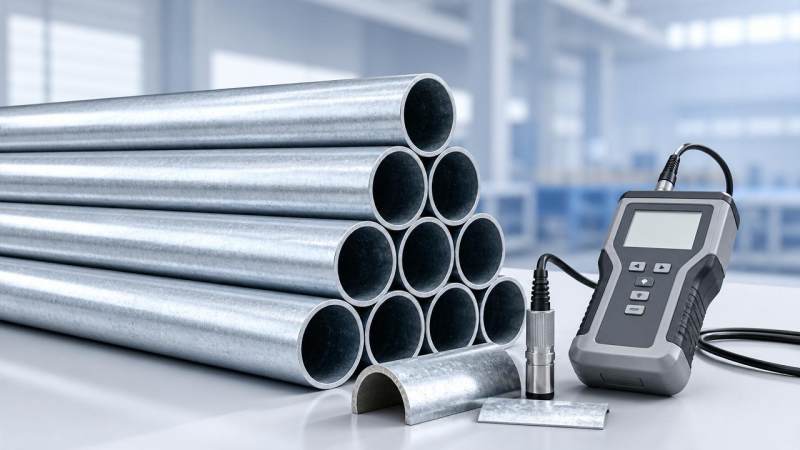
Zinc weight refers to the amount of zinc coating applied to the pipe surface. It is commonly expressed in g/m² or sometimes by coating thickness in microns.
For galvanised steel pipe suppliers, this value is one of the main indicators of anti-corrosion performance. More zinc usually means better protection in harsh environments.
However, a higher zinc weight is not always necessary. The suitable level depends on exposure conditions, project duration, and target standard.
A pipe used indoors may not need the same coating as a pipe installed in coastal, humid, or chemical environments.
Common ways zinc coating is described
- Coating mass in g/m²
- Coating thickness in microns
- Single-side or double-side coating
- Minimum local value or average value
Different quoting habits already create confusion. That is one reason galvanised steel pipe suppliers may seem to offer different products even when the nominal pipe size matches.
Why do galvanised steel pipe suppliers quote different zinc weights?
The most common reason is that suppliers follow different standards. ASTM, EN, JIS, and GB may define coating requirements differently.
Some galvanised steel pipe suppliers quote the minimum guaranteed zinc weight. Others quote average production values or target values during process control.
Production method also matters. Hot-dip galvanized pipe and pre-galvanized pipe usually have different coating ranges and performance levels.
Steel chemistry affects zinc adhesion too. Silicon and phosphorus content can influence the reaction during hot-dip galvanizing and change final coating thickness.
Surface preparation is another factor. Pickling quality, oil removal, and scale condition all affect coating formation.
Some quotes are built for price competition. Others are designed for long service life. The number alone does not tell the full sourcing story.
Main causes behind quote differences
- Different international or local standards
- Hot-dip versus pre-galvanized process
- Minimum value versus average value
- Different base steel chemistry
- Variation in intended application environment
- Different quality control and test methods
How do standards and test methods change the quotation?
A major source of confusion is that standards do not always specify coating in the same way. One standard may focus on thickness, another on coating mass.
Sampling rules also differ. A supplier may quote based on batch average results, while another quotes according to minimum values at tested points.
Test methods can include magnetic thickness measurement, gravimetric methods, or destructive checks. Each method can report slightly different numbers.
This means galvanised steel pipe suppliers should never be compared by zinc weight alone without confirming the standard and inspection basis.
Does higher zinc weight always mean better value?
Not always. A higher coating often improves corrosion resistance, but it can also increase cost, lead time, and weight-related logistics expense.
If the pipe is used in dry indoor structures, a very high zinc weight may not provide proportional return.
In contrast, outdoor infrastructure, marine zones, industrial plants, or humid utility areas may justify stronger coating protection.
The best quote from galvanised steel pipe suppliers is the one that matches service conditions, compliance requirements, and total lifecycle cost.
Mid-project material planning also matters. Many construction projects combine pipes, beams, sections, and reinforcement materials under one sourcing strategy.
For example, structural packages may also include Wire rod for civil engineering construction, bridges, roads, foundations, beams, columns, walls, slabs, and rebars.
This product is available in grades such as HRB335, HRB400, and HRB500, with surface treatment options including galvanized, black, PVC, and anti-rust oil.
When steel supply is coordinated under ASTM, EN, JIS, or GB requirements, overall quality consistency becomes easier to control across the project.
Value should be judged by these factors
- Required service life
- Site environment severity
- Maintenance access and cost
- Project standard or certification demand
- Balance between coating level and total budget
How can you compare offers from galvanised steel pipe suppliers correctly?
Start with the same technical basis. Ask every supplier to quote against the same pipe size, steel grade, standard, coating requirement, and test method.
Request clarification on whether the zinc weight is average, minimum, inside and outside combined, or one-side only.
It is also important to confirm whether the quoted pipe is hot-dip galvanized after fabrication or galvanized strip formed into pipe.
Review mill test certificates and ask for previous coating inspection records if long-term corrosion performance is critical.
Reliable galvanised steel pipe suppliers should explain coating tolerance, process route, and how quality is controlled during production.
Checklist before accepting a quote
- Which standard applies to the pipe and coating?
- What exact zinc weight is guaranteed?
- How is the coating measured and sampled?
- Is the process hot-dip or pre-galvanized?
- What environment is the pipe designed for?
- Are certificates and inspection reports available?
What mistakes cause wrong decisions on zinc coating?
One common mistake is comparing only unit price. A lower price may reflect lower coating mass, weaker quality control, or a different galvanizing route.
Another mistake is assuming all galvanised steel pipe suppliers use the same definition for zinc weight. They often do not.
Some buyers also overlook end use. Pipes for greenhouse frames, water systems, scaffolding, fencing, or structural supports may need different protection levels.
Ignoring transport and storage conditions can create early corrosion too. Even a good zinc coating can be damaged by poor handling.
The safest approach is to combine coating data, standard compliance, process transparency, and supplier stability in one evaluation.
Quick FAQ table
How should final sourcing decisions be made?
The best way to review galvanised steel pipe suppliers is to compare total technical alignment, not just surface numbers on a quotation sheet.
Match zinc weight to project environment, confirm the testing basis, and ask for verifiable quality documents before placing the order.
For projects requiring stable structural steel supply, it is also useful to work with partners that understand international standards and customized specifications.
Hongteng Fengda, as a structural steel manufacturer and exporter from China, supports global projects with reliable steel products, strict quality control, and customized solutions.
If you are reviewing galvanised steel pipe suppliers, prepare one unified technical inquiry sheet and compare every offer against the same coating and inspection requirements.
That simple step reduces sourcing risk, improves price transparency, and leads to a more durable and cost-effective result.
Please give us a message


Please enter what you want to find