For project managers, even a small change in Z section steel thickness can affect structural performance, procurement cost, installation accuracy, and overall project risk. Thickness influences load capacity, weight, tolerance control, corrosion allowance, and compliance with engineering standards, making it a critical factor in both design and sourcing decisions. Understanding these impacts helps teams avoid delays, reduce rework, and select reliable steel suppliers capable of delivering consistent quality for demanding construction and industrial projects.
In steel construction, thickness is not only a drawing dimension. It determines how Z section steel behaves during handling, bolting, purlin alignment, cladding support, storage, transportation, and long-term service. A difference of 0.2 mm or 0.5 mm may appear minor during quotation, yet it can change load calculations, nesting plans, galvanizing allowance, and site installation tolerance.
For project managers responsible for budget, schedule, safety, and supplier coordination, thickness control becomes a practical risk management issue. The goal is not always to choose the thickest section, but to select the correct specification, verify production consistency, and ensure each batch matches engineering intent.
How Z Section Steel Thickness Affects Structural Risk
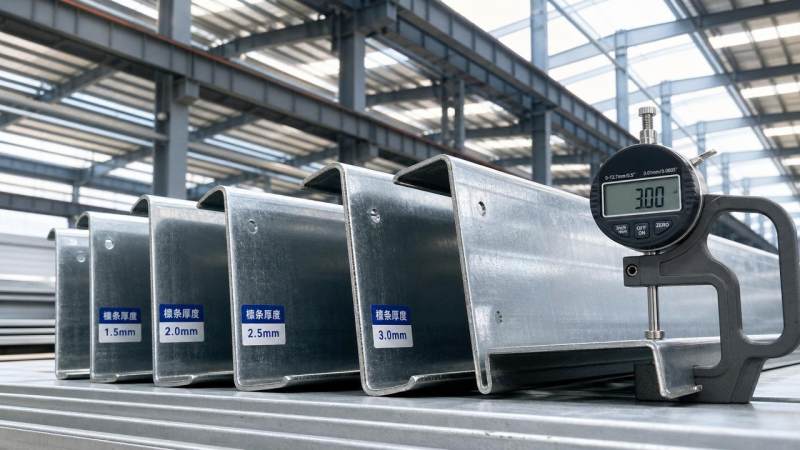
Z section steel is commonly used for roof purlins, wall girts, secondary framing, mezzanine support, and light industrial structures. Its efficient shape allows overlapping connections and continuous spans, but the performance depends heavily on material thickness, yield strength, hole accuracy, and roll forming stability.
In typical projects, Z profiles may be supplied in thickness ranges such as 1.5 mm, 2.0 mm, 2.5 mm, or 3.0 mm, depending on span, wind load, roof system, and engineering code. When the actual thickness deviates beyond agreed tolerance, risk can move from the procurement desk to the construction site quickly.
Load Capacity and Deflection Control
Thickness directly influences section modulus, moment of inertia, and resistance to local buckling. A thinner Z section steel profile may still look acceptable visually, but it can show higher deflection under roof loads, snow loads, maintenance loads, or wind suction.
For example, a long-span purlin system may have a deflection limit such as L/180 or L/240, depending on project requirements. If the supplied thickness is lower than the design basis, the installed frame may struggle to meet serviceability criteria even before ultimate strength becomes a concern.
Connection Strength and Hole Alignment
Thickness also affects bolted joints, lap connections, cleat fixing, and self-drilling screw performance. If the section is too thin, bearing capacity around holes may reduce. If it is too thick without coordination, installers may need different fasteners or drilling procedures.
Project managers should review at least 4 connection details before approval: lap length, bolt diameter, hole spacing, and edge distance. These details help determine whether the selected Z section steel thickness supports both engineering safety and efficient assembly.
The table below summarizes common project risks linked to thickness variation. Values should be verified by the project engineer, but the risk logic is useful during design review and supplier comparison.
The key conclusion is simple: Z section steel thickness must be managed as an engineered parameter, not as a flexible purchasing variable. When the design, procurement, and quality teams use the same definition, downstream risk decreases.
Why Small Deviations Become Large Site Problems
A small thickness deviation can multiply across hundreds or thousands of pieces. On a 3,000 square meter roof, repeated variation may affect purlin line, roof panel seating, screw pull-out behavior, and rework frequency.
This is why experienced project managers ask suppliers to clarify whether thickness is nominal, minimum, or measured after coating. That one question can prevent confusion during inspection and payment approval.
Procurement Decisions: Cost, Weight, Tolerance, and Standards
The procurement team often sees Z section steel thickness through the lens of price per ton or price per meter. Both views are useful, but neither is complete. A lighter section may reduce material cost, while a thicker section may reduce engineering risk or improve handling durability.
A practical sourcing review should cover at least 6 points: steel grade, thickness tolerance, yield strength, forming accuracy, coating specification, and packaging method. These factors are especially important for export projects where replacement shipments may take 3 to 6 weeks.
Thickness and Total Installed Cost
A lower quotation is not always the lower project cost. If Z section steel arrives with poor dimensional control, the team may face extra sorting, drilling adjustment, crane waiting time, or roof installation delay.
For project managers, the more useful comparison is total installed cost. This includes material price, waste rate, installation hours, inspection effort, transport cost, and schedule exposure. A 2% material saving can disappear after 1 day of site delay.
Standards and Verification Requirements
International projects often refer to ASTM, EN, JIS, or GB requirements. These standards may define mechanical properties, dimensional tolerance, chemical composition, and testing methods. The selected Z section steel must match both the design code and the purchase contract.
Hongteng Fengda supplies structural steel products, including angle steel, channel steel, steel beams, cold formed profiles, and customized components. For export orders, clear specification confirmation helps align production, inspection, packing, and documentation before shipment.
Project teams can use the following matrix when comparing suppliers. It connects technical requirements with procurement risk, helping buyers avoid decisions based only on headline price.
This comparison shows that reliable Z section steel sourcing depends on traceability and communication. A qualified supplier should be able to explain the specification, not merely quote a price.
Where Roofing and Envelope Materials Fit
Z profiles often support roof and wall systems, so project managers should review the full assembly. For envelope applications, Color Coated Galvalume Steel Sheet PPGL is widely used in agricultural, residential, commercial, and public building projects.
This material is based on aluminized zinc steel containing 55% aluminum, 43.3% zinc, and 1.6% silicon. Typical thickness ranges from 0.2 mm to 1.2 mm, with widths from 600 mm to 1250 mm and lengths from 750 mm to 1100 mm.
When roof panels and Z section steel are purchased together, coating compatibility, fastener choice, panel profile, and purlin spacing should be checked as one system. This reduces leakage risk, corrosion exposure, and installation conflict.
How Project Managers Should Specify Z Section Steel Thickness
A good specification does more than list a size. It tells the supplier what must be controlled, how it will be measured, and which documents are required. This is especially important when Z section steel is customized for hole patterns, lap details, or special lengths.
For most procurement packages, project managers can separate requirements into 3 groups: engineering requirements, manufacturing requirements, and delivery requirements. This structure makes supplier communication clearer and reduces revision cycles.
A 5-Step Specification Workflow
- Confirm design loads, span length, support condition, and deflection limit with the project engineer.
- Define Z section steel size, nominal thickness, steel grade, coating, and applicable standard.
- Review shop drawings for holes, laps, end cuts, bundle marks, and installation sequence.
- Set inspection points for thickness, dimensions, straightness, surface condition, and documentation.
- Confirm packing, loading, shipping marks, and replacement procedure before final production release.
This 5-step workflow is simple, but it prevents common gaps between design intent and delivered steel. It also gives procurement teams a consistent checklist for comparing multiple offers.
Key Inspection Points Before Shipment
Pre-shipment inspection should not be limited to counting bundles. For Z section steel, inspectors normally verify thickness, profile dimensions, hole positions, straightness, surface finish, and label accuracy. A sampling plan may check 3 to 5 pieces per bundle group, depending on project size.
Thickness measurement should use calibrated tools and agreed locations. If coating is included, the contract should clarify whether the measured value refers to base metal thickness, total coated thickness, or a minimum accepted value after forming.
Documentation That Reduces Disputes
- Material certificate linked to heat number, steel grade, and mechanical properties.
- Dimensional inspection report covering thickness, height, flange, lip, length, and hole layout.
- Packing list showing bundle quantity, mark number, gross weight, and project reference.
- Photos of finished profiles, bundle labels, protection method, and container loading condition.
These documents are not paperwork for its own sake. They help the project team identify materials quickly, support customs or receiving checks, and resolve questions before installation crews are waiting on site.
Common Mistakes That Increase Project Risk
Many Z section steel problems begin before production starts. Ambiguous drawings, incomplete standards, and unclear thickness definitions can create hidden risk. Once material is rolled, punched, packed, and shipped, correction becomes much more expensive.
Project managers can reduce this exposure by challenging assumptions early. Even a 30-minute technical review between engineering, procurement, and the steel supplier can avoid days of rework later.
Mistake 1: Treating Thickness as a Price Adjustment Only
When thickness is reduced to meet a target budget, structural verification must be repeated. A substituted profile may require different spacing, additional bracing, or revised connections. Without approval, this becomes a technical and contractual risk.
Mistake 2: Ignoring Tolerance in the Purchase Order
A purchase order that only states “2.0 mm Z purlin” may not be enough. It should clarify accepted tolerance, coating condition, standard reference, and inspection method. Clear wording reduces disagreement when measured values differ slightly.
Mistake 3: Separating Steel Profiles From the Building System
Z section steel interacts with roof panels, wall sheets, insulation, fasteners, bracing rods, and main frames. If these packages are sourced independently without coordination, the site may face mismatched holes, wrong lap direction, or insufficient bearing length.
Practical Warning Signs During Supplier Review
- The supplier cannot explain whether thickness is nominal or minimum.
- Shop drawings are not provided before mass production.
- Tolerance, steel grade, and coating requirements are missing from the quotation.
- Packing marks do not match the erection sequence or project zones.
These warning signs do not always mean a supplier is unqualified, but they indicate that the project team should ask more detailed questions before approval.
Building a Lower-Risk Supply Plan With the Right Steel Partner
Reliable delivery of Z section steel depends on engineering understanding, production control, and export coordination. A manufacturer should be able to support standard specifications as well as OEM requirements, especially for projects with repeated lengths, punched holes, or phased deliveries.
Hongteng Fengda works with global construction, industrial, and manufacturing buyers who need structural steel products made to clear requirements. Modern facilities, quality control procedures, and familiarity with ASTM, EN, JIS, and GB standards help reduce sourcing uncertainty.
What a Strong Supplier Collaboration Looks Like
A strong collaboration usually includes 4 stages: technical confirmation, sample or drawing approval, controlled production, and pre-shipment verification. Each stage creates an opportunity to catch problems before they affect the project schedule.
For project managers, the best steel partner is not simply the one with the lowest unit price. It is the supplier who can maintain consistent Z section steel thickness, communicate clearly, and deliver documentation that supports project control.
Action Points Before Your Next Order
- Ask engineering to confirm the required section thickness and acceptable tolerance.
- Request a quotation that separates steel grade, coating, processing, and freight assumptions.
- Approve drawings before production, especially for customized holes and lengths.
- Require inspection records and packing details before shipment release.
Thickness changes in Z section steel influence strength, cost, installation, compliance, and schedule. Managing those changes early gives project managers better control over both technical risk and commercial outcomes.
If your project requires standard or customized structural steel from China, Hongteng Fengda can help review specifications, coordinate production details, and support dependable export delivery. Contact us to discuss your Z section steel requirements, request a tailored solution, or learn more about suitable structural steel options for your next project.
Please give us a message


Please enter what you want to find