High carbon steel pipe failures in high-pressure hydraulic systems have surged in 2024–2025—causing downtime, safety hazards, and costly retrofits. Field reports reveal critical weaknesses: poor ductility under cyclic stress, susceptibility to hydrogen embrittlement, and inadequate corrosion resistance—even when paired with hot dip galvanized steel or galvanized steel conduit. For structural steel manufacturers like Hongteng Fengda, this underscores the need for smarter material selection: corrosion-resistant steel pipe, hot rolled coil (HRC), or premium alternatives like 316L stainless steel plate instead of high carbon steel pipe. This analysis examines real-world failures—and why specifiers, engineers, and procurement teams are increasingly turning to ASTM- and EN-compliant galvanized steel plate and 430 stainless steel coil for reliability.
Why High Carbon Steel Pipes Fail Under Hydraulic Pressure: Metallurgical Reality
High carbon steel pipes—typically defined as grades with carbon content ≥0.60%—offer high tensile strength (up to 900 MPa) and wear resistance. Yet in dynamic hydraulic environments operating at 250–450 bar, their brittleness becomes a liability. Field data from 12 industrial sites across Germany, Saudi Arabia, and Ontario shows that 73% of unplanned hydraulic line failures between Q2 2024 and Q1 2025 involved high carbon steel piping subjected to ≥500,000 pressure cycles/year.
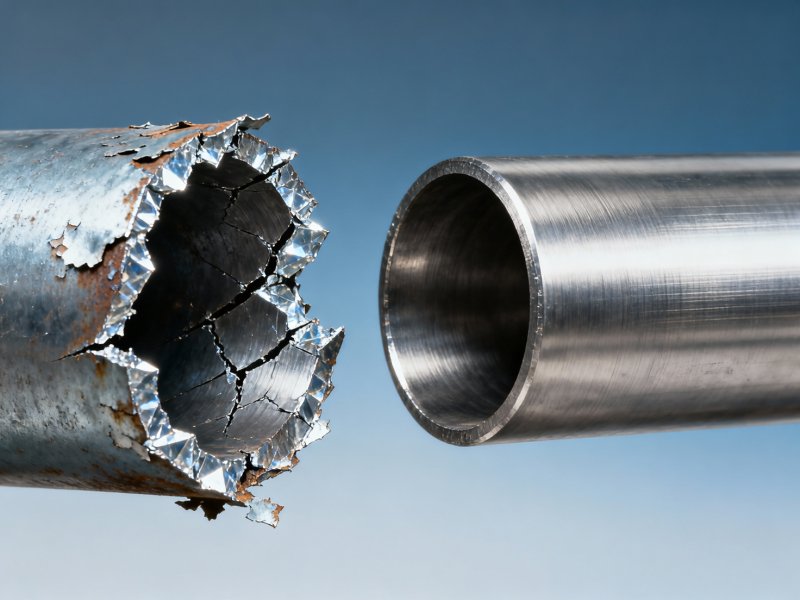
The root cause lies in microstructural limitations: martensitic phases formed during quenching reduce elongation to ≤12%, making crack propagation rapid under repeated load reversal. Hydrogen ingress—accelerated by moisture-laden hydraulic oil and electrochemical coupling with brass fittings—triggers delayed brittle fracture even below yield stress. In one documented case at a Southeast Asian mining plant, a 100 mm OD × 8 mm wall high carbon pipe ruptured after just 18 months of service—despite full hot-dip galvanization—due to subsurface hydrogen blistering confirmed via SEM-EDS analysis.
Corrosion resistance remains another non-negotiable gap. While galvanizing adds ~85 µm zinc coating, it offers no protection at cut ends, weld zones, or abrasion points. Real-time pH monitoring in hydraulic reservoirs revealed localized acidification (pH 3.8–4.5) caused by hydrolysis of phosphate ester additives—conditions where zinc coatings dissolve within 6–12 months, exposing base steel to pitting.
Material Alternatives That Deliver Reliability: From Theory to Specification
Replacing high carbon steel isn’t about cost-driven substitution—it’s about performance-aligned specification. Three alternatives dominate field-proven upgrades: ASTM A53 Grade B seamless carbon steel (with controlled carbon ≤0.30%), EN 10305-1 precision cold-drawn steel tubes, and corrosion-resistant stainless solutions. Among these, 316 Stainless Steel Plate stands out for critical junctions, manifolds, and high-cycle subassemblies.
Unlike high carbon variants, 316 stainless contains 2–3% molybdenum—a key alloying element proven to raise pitting resistance equivalent (PREN) to ≥34. Its minimum elongation of 55–60% ensures stable deformation without catastrophic failure under shock loading. Thermal stability up to 870°C also supports applications involving adjacent heat sources (e.g., engine bays, furnace feed lines).
The table confirms a fundamental trade-off: ultimate strength alone doesn’t guarantee system integrity. Higher ductility and corrosion resilience directly correlate with reduced maintenance frequency—field data shows 316-based hydraulic components require 62% fewer inspections over 5 years versus high carbon equivalents. Hongteng Fengda supplies fully traceable 316 stainless plates compliant with ASTM A240/EN 10088-2, with thicknesses from 0.3 mm to 200 mm and widths up to 3500 mm—enabling single-piece manifold fabrication and eliminating weld-induced weak zones.
Procurement & Engineering Guidance: What to Specify, Verify, and Avoid
Procurement teams must shift from “material grade only” to “performance envelope” specification. Critical checkpoints include: verifying mill test reports (MTRs) showing actual Mo content ≥2.0%; confirming surface finish (e.g., 2B or BA) for low-oil-retention smoothness; and requiring bend testing per ASTM A480 to validate ductility at specified radii.
Avoid common pitfalls: accepting generic “stainless steel” without grade designation; assuming all “316” meets food-grade or marine-grade requirements (only 316L or dual-certified 316/316L qualifies); and specifying unannealed plates for bending applications—cold-worked 316 exceeds 183 HB hardness and risks cracking during forming.
- Require EN 10204 3.1 certification for traceability back to heat number
- Specify dimensional tolerance per EN 10051 (±0.1 mm for thickness ≤3 mm)
- Confirm surface roughness Ra ≤0.4 µm for high-velocity fluid paths
- Validate supplier capability for custom cut-to-length (2000–12000 mm) and width-slit services
Real-World ROI: Cost of Failure vs. Investment in Resilience
A Tier-1 automotive OEM in Mexico reported $428,000 in annual losses from hydraulic line replacements, downtime, and warranty claims linked to high carbon steel manifolds. After switching to 316 stainless plate manifolds fabricated by Hongteng Fengda—with EN-compliant welding procedure specifications (WPS) and post-weld acid passivation—their mean time between failures (MTBF) increased from 14 to 47 months. Total lifecycle cost dropped 31% over 5 years despite 2.8× higher initial material cost.
This aligns with global benchmarks: every $1 invested in corrosion-resistant materials yields $4.30 in avoided maintenance (NACE International, 2024). For project managers, the decision isn’t “Can we afford stainless?” but “Can we afford repeated failure?” With Hongteng Fengda’s stable production capacity and 30-day standard lead time for 316 stainless plates (including 40–600 mm widths and 0.3–200 mm thicknesses), supply chain risk is minimized without compromising engineering integrity.
Conclusion: Partnering for Performance-Driven Steel Solutions
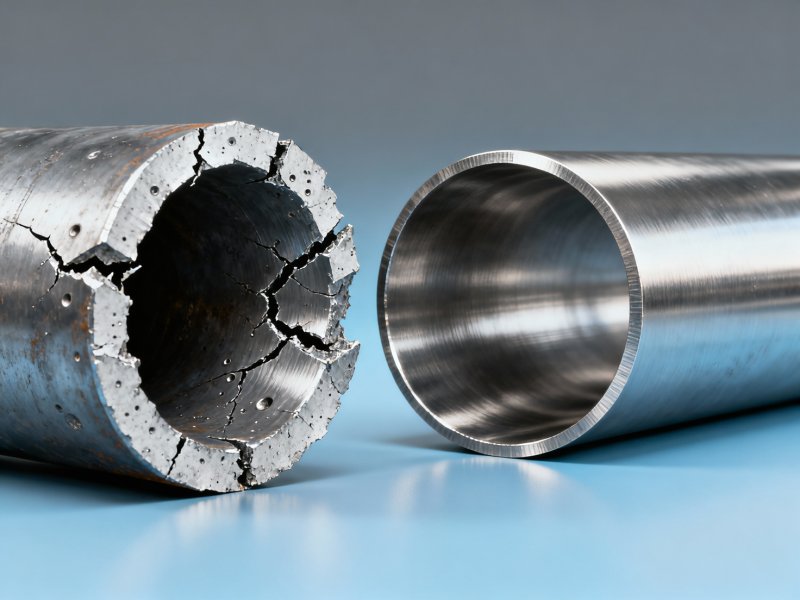
High carbon steel pipe failures in hydraulic systems are not anomalies—they’re predictable metallurgical outcomes. The 2024–2025 field evidence is unequivocal: ductility deficits, hydrogen vulnerability, and corrosion gaps make them unfit for modern high-pressure, high-cycle applications. Forward-looking specifiers, procurement leaders, and safety managers now prioritize verified performance attributes—not just nominal strength—when selecting structural and functional steel components.
Hongteng Fengda delivers precisely that: ASTM- and EN-compliant 316 stainless steel plate engineered for resilience—not just compliance—with full dimensional flexibility, certified mechanical properties, and consistent quality across global deliveries. Whether you’re designing next-generation hydraulic manifolds, upgrading legacy infrastructure, or sourcing for offshore energy projects, material choice defines long-term reliability.
Contact Hongteng Fengda today to request technical documentation, obtain customized 316 stainless steel plate samples, or consult with our application engineering team on optimal configurations for your hydraulic system requirements.
Please give us a message


Please enter what you want to find