When steel plate for construction turns into an overbudget item, buyers must look beyond the initial quote. Fluctuations in carbon steel price, sourcing strategy, quality standards, and supplier capability can all reshape total project cost. For procurement teams, engineers, and project managers, understanding these factors is essential to control budgets, reduce risk, and choose a reliable structural steel partner.
In real projects, a steel plate that appears competitive on paper can become expensive after freight, cutting loss, coating requirements, inspection costs, rework, and schedule delays are added. This is especially true for global buyers comparing multiple suppliers across China, Southeast Asia, the Middle East, or domestic stockists with very different service levels and production control.
For construction contractors, fabricators, distributors, and industrial buyers, budget discipline depends on understanding total landed cost rather than unit price alone. It also depends on selecting suppliers that can align steel grade, tolerance, standards, and delivery rhythm with the actual project plan. That is where a capable structural steel manufacturer can reduce hidden cost far more effectively than a low headline offer.
Why Construction Steel Plate Costs Rise Faster Than Expected
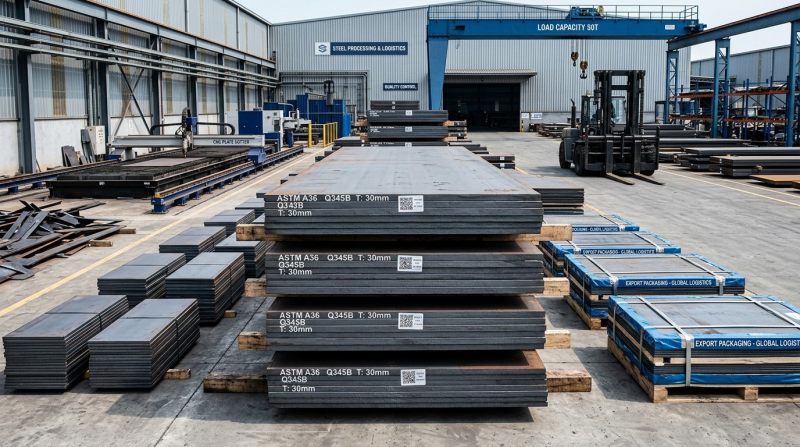
Steel plate budgets usually break for 4 practical reasons: volatile raw material pricing, specification mismatch, undercounted processing cost, and weak supplier execution. In many projects, the original estimate is built using a reference carbon steel price from 2 to 6 weeks earlier. By the time the order is placed, the market may have shifted enough to affect procurement by 5% to 15%, especially for medium and heavy plate.
A second issue is specification drift. Early-stage drawings may call for a general plate grade, but final engineering often adds tighter flatness, impact toughness, galvanizing compatibility, or certified traceability. Each added requirement changes the cost base. A plate meeting ASTM, EN, JIS, or GB standards may still vary in chemistry control, dimensional tolerance, and testing scope, which directly affects price and usability.
The third driver is processing waste. Cutting plans, edge trimming, hole making, beveling, and fabrication allowances can increase effective material consumption by 3% to 12%. If buyers only compare tonnage price without evaluating yield from standard plate sizes, they may approve a supplier that looks cheaper but generates more scrap and more workshop labor.
Finally, delivery reliability matters. A 7-day delay on structural steel can trigger crane idle time, labor rescheduling, and subcontractor claims. In high-tempo projects, indirect loss often exceeds the price gap between two steel quotes. This is why experienced buyers examine not only ex-works cost but also production capacity, inspection discipline, export packing, and shipment planning.
Common budget blind spots in steel plate sourcing
The table below highlights cost items that are frequently excluded at quotation stage but emerge later during execution. These items are especially relevant when comparing mills, traders, and processing suppliers for construction steel plate.
The key lesson is simple: a low ton price can lose its advantage once hidden variables are included. Procurement teams should ask suppliers to separate base material cost, testing, processing, coating, packing, and freight terms before making any comparison.
How to Evaluate Steel Plate Beyond the Quoted Price
A useful buying framework starts with technical fit. Engineers and quality teams should confirm grade, thickness range, plate size, tolerance, weldability, and any surface treatment requirement before requesting final pricing. Even a 1 mm thickness difference across large tonnage can materially change both structural performance and total spend. In large building, industrial, and infrastructure projects, disciplined specification review often saves more than aggressive negotiation.
The next layer is supplier capability. A structural steel manufacturer with stable production planning, consistent quality control, and export experience is usually better positioned to protect project budgets than a purely opportunistic trader. Hongteng Fengda, as a structural steel manufacturer and exporter from China, supports buyers with angle steel, channel steel, steel beams, cold formed steel profiles, and customized structural components produced to ASTM, EN, JIS, and GB related requirements.
For global buyers, the supplier review should include at least 6 checkpoints: mill source stability, available processing scope, inspection process, packing standard, lead time discipline, and document accuracy. A supplier that can answer all 6 clearly is easier to work with than one offering only a price list. This matters when projects require repeated shipments over 2 to 4 months rather than a single one-time purchase.
Commercial teams should also compare payment terms and delivery sequencing. A supplier offering staged production and shipment can reduce inventory pressure at site. For example, splitting a 300-ton order into 3 deliveries may improve cash flow and lower storage damage risk, even if the unit price is slightly higher than a full-batch shipment.
A practical 5-point assessment model
The following checklist helps procurement, engineering, and project management teams align technical and commercial decision-making before they release a steel plate order.
- Confirm applicable standard and grade first, then lock testing scope. Do not negotiate price before clarifying whether MTCs, third-party inspection, or impact tests are mandatory.
- Review cutting layout and yield based on real fabrication drawings. A better plate size mix can reduce scrap by several percentage points.
- Ask for production lead time by stage, such as raw material preparation, rolling or processing, inspection, packing, and booking.
- Compare Incoterms carefully. EXW, FOB, CFR, and DDP can produce very different landed cost outcomes.
- Evaluate whether the supplier can support replacement, supplementary quantities, or drawing changes within the project cycle.
When these 5 points are checked early, buyers can reduce both pricing surprises and execution friction. The result is not just lower procurement risk but also better site coordination and fewer installation delays.
Mid-Project Cost Control: Materials, Coatings, and Related Steel Components
Construction budgets are rarely affected by steel plate alone. Many projects also include structural sections, lifting components, safety systems, cable support elements, or corrosion-resistant accessories. When these related products are sourced separately without coordination, project teams often pay more in transport, inspection, and handling than expected. A bundled sourcing strategy can improve both cost visibility and delivery control.
For projects that require corrosion resistance in marine industries, mining, cranes, elevators, cableways, photovoltaics, or road fence systems, buyers often evaluate galvanized steel products alongside structural steel packages. One example is Hot dipped Galvanized Steel Wire Rope, which is used in loading systems, tower cranes, container cranes, digger derricks, pile-drivers, drilling, railways, and agriculture where durability under different corrosion levels is important.
From a technical perspective, this product is available in steel and stainless steel options, with normal tensile strength ranging from 1470 MPa to 1960 MPa and diameter coverage from 1.0 mm to 22 mm. Common constructions include 6X7+FC, 6X19+IWR, 6X19+IWS, and 8x19S+FC. It can be supplied in plain, electro galvanized, or hot dipped galvanized finishes depending on working conditions and expected exposure.
For procurement teams, the larger lesson is that coating level must match service environment. A thin coating group of 15 to 135 g/m2 may be suitable for mild corrosion conditions, while medium coating of 60 to 200 g/m2 or thick galvanized coating of 75 to 260 g/m2 is better suited for tougher industrial or marine exposure. Matching the specification to the environment avoids the common mistake of either overspending on unnecessary protection or underbuying and facing early replacement.
Why related component selection affects steel plate budgets
Cost overruns often begin when each steel item is quoted and ordered in isolation. The table below shows how integrated sourcing decisions influence total project economics, especially where structural steel and corrosion-resistant accessories must work together.
An integrated approach supports procurement efficiency. Instead of reacting to separate overbudget items one by one, project teams can evaluate structural steel, surface protection, and critical accessories as a coordinated package with a clearer total cost picture.
Choosing a Structural Steel Supplier That Helps Control Total Project Cost
The right supplier should contribute to cost control in 3 ways: stable manufacturing, dependable quality, and practical communication. In export business, these three factors are closely linked. If production is unstable, lead times slip. If quality control is inconsistent, rework rises. If communication is weak, drawing revisions and document errors create avoidable delay. Cost control is therefore an operational issue, not only a pricing issue.
Hongteng Fengda serves buyers across North America, Europe, the Middle East, and Southeast Asia with structural steel products and customized solutions. For buyers managing multi-market projects, this type of supplier profile matters because it indicates familiarity with different standards, shipping routes, and documentation expectations. Reliable support on standards such as ASTM, EN, JIS, and GB helps buyers avoid mismatched compliance assumptions that can stall procurement.
A qualified supplier should also be able to support OEM or customized structural steel components when standard sections are not enough. In construction and industrial work, many cost overruns happen because the project starts with stock material assumptions but later requires fabricated parts, pre-cut lengths, or special profiles. Early confirmation of customization capability can prevent expensive late-stage switching.
Lead time transparency is another cost-control tool. Buyers should request expected cycles for order confirmation, manufacturing, inspection, packing, and shipment release. Even a simple 5-step timeline can improve project planning. For many export orders, production may require 2 to 5 weeks depending on specification, tonnage, and processing depth, so vague promises are not enough.
Supplier comparison matrix for decision-makers
The matrix below can help business evaluators, project leaders, and purchasing managers compare suppliers on criteria that directly affect cost, risk, and execution quality.
This type of comparison often shows why the “cheapest” option is not the lowest-cost option. In structural steel, execution reliability has measurable financial value, particularly where delivery windows are tight and quality failure has downstream consequences.
FAQ: Preventing Steel Plate From Becoming an Overbudget Item
Many buyers face the same questions when construction steel costs start moving beyond plan. The answers below focus on practical actions that can be taken before and during procurement to keep the project under control.
How early should a buyer lock steel plate pricing?
For projects sensitive to carbon steel price changes, buyers should move from budget inquiry to formal quotation as soon as drawings and standards are 80% to 90% stable. Waiting until every detail is perfect may expose the order to avoidable market movement. A practical method is to lock core tonnage first, then manage small specification adjustments separately.
What are the most important metrics besides ton price?
The most useful metrics are scrap rate, tolerance consistency, lead time, inspection scope, and landed freight cost. If two suppliers differ by only 2% on unit price but one reduces waste by 5% and shortens delivery by 1 week, the total project result may be significantly better with the second option.
How can project managers reduce the risk of late cost escalation?
Project managers should align engineering, procurement, and logistics in a simple review cycle. A 3-stage process works well: first confirm technical requirements, then validate commercial scope, and finally check delivery sequencing. This reduces the chance that site needs, testing needs, and shipping needs are addressed too late.
Is it better to buy from a trader or a manufacturer?
It depends on project complexity. Traders may help with spot availability for urgent, standard material. However, for repeated shipments, custom processing, or multi-item structural packages, a manufacturer-exporter often offers better control over quality, scheduling, and technical coordination. That can be more valuable than a small short-term price advantage.
When steel plate for construction becomes an overbudget item, the root cause is usually not one single price change but a chain of decisions around specification, sourcing, processing, inspection, and delivery. Buyers who evaluate total cost, verify standards carefully, and work with capable structural steel suppliers are in a much stronger position to protect both budget and schedule.
Hongteng Fengda supports global construction, industrial, and manufacturing buyers with structural steel products, customized solutions, consistent quality control, and dependable export service. If you need a more efficient sourcing plan for steel plate, structural sections, or related steel components, contact us now to get a tailored solution, discuss technical details, and reduce sourcing risk for your next project.
Please give us a message


Please enter what you want to find