When project requirements involve corrosion resistance, hygiene, or long-term durability, angle stainless steel can offer clear advantages over carbon steel. For buyers comparing materials for construction, industrial, or fabrication use, understanding where stainless options deliver better lifecycle value helps reduce maintenance costs, improve performance, and support more reliable sourcing decisions.
What makes angle stainless steel a better choice in some steel projects?
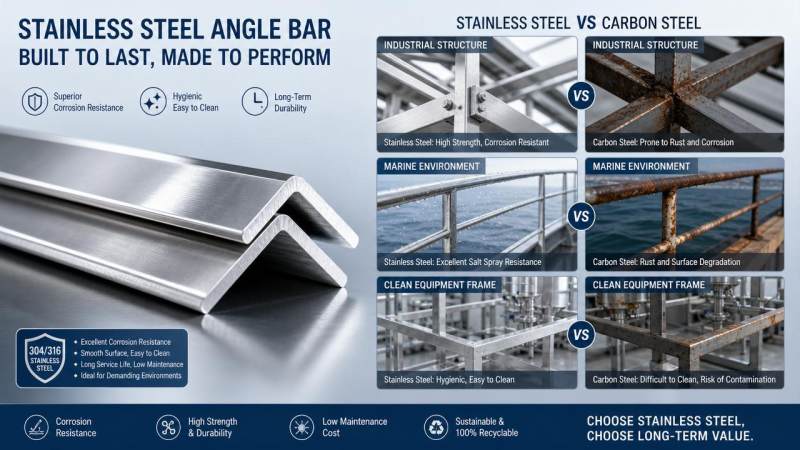
For many information-stage buyers, the core question is not whether stainless steel is stronger in every case. The real issue is whether angle stainless steel performs better in the actual service environment. In steel selection, exposure conditions often matter more than base material price.
Angle stainless steel is widely selected when the application faces moisture, chemicals, cleaning agents, outdoor weather, or contamination risks. Carbon steel angle remains common for structural and cost-sensitive uses, but it usually needs coating, painting, or galvanizing to resist corrosion over time.
This difference affects maintenance schedules, shutdown risk, appearance retention, and long-term replacement cost. For buyers managing industrial plants, coastal infrastructure, food processing lines, or exposed architectural steelwork, these factors can outweigh the initial material premium.
- Use angle stainless steel when corrosion resistance is a primary design requirement, not an afterthought.
- Choose it when regular repainting or recoating would disrupt operations or increase lifecycle cost.
- Consider it for projects where surface cleanliness, hygiene, or visual finish affects operational compliance or customer perception.
Angle stainless steel vs carbon steel: where does performance really change?
Before comparing purchase prices, buyers need a practical view of how angle stainless steel and carbon steel differ in service. The table below highlights where material choice changes maintenance, durability, and procurement decisions in steel applications.
The most important takeaway is simple: angle stainless steel outperforms carbon steel when corrosion, sanitation, or difficult maintenance conditions increase total ownership cost. Carbon steel still works well in dry indoor environments, hidden structures, and projects where protective coating is easy to maintain.
Strength is only one part of the selection decision
Many buyers focus first on mechanical strength, but service life often depends more on environmental resistance and fabrication suitability. A carbon steel angle with strong load-bearing capacity may still become the wrong choice if rust leads to early repair, contamination, or visual rejection.
In contrast, angle stainless steel can maintain both structural function and surface integrity longer in demanding conditions. That makes it especially relevant for projects with strict inspection cycles, export compliance, or hard-to-access installation points.
Which application scenarios favor angle stainless steel?
Not every project needs stainless material. Buyers can reduce confusion by matching the steel angle type to the real operating environment. The table below groups common scenarios where angle stainless steel often delivers stronger lifecycle performance than carbon steel.
Scenario-based selection is often more useful than general claims about one material being superior. In dry indoor warehouses or temporary structures, carbon steel may remain the practical option. In wet, hygienic, or visually exposed areas, angle stainless steel typically provides a stronger value case.
Common project types where buyers should reassess carbon steel
- Projects near coastlines, ports, desalination plants, or marine logistics facilities.
- Manufacturing lines exposed to frequent cleaning, steam, washdown, or chemical contact.
- Structures installed in difficult-to-repair areas where future maintenance access is costly.
- Export projects where the buyer must align with ASTM, EN, JIS, or GB specification expectations.
How should buyers compare cost beyond the steel price?
Price comparisons often stop too early. Buyers see a higher quotation for angle stainless steel and assume carbon steel is the economical choice. That approach can be misleading if the project also includes coating, maintenance labor, shutdown time, replacement risk, or appearance-related rework.
A better method is lifecycle comparison. Instead of asking which material costs less today, ask which material reduces risk and operating cost over the intended service period. This is especially important in export procurement, where replacement delays can disrupt project schedules and increase freight costs.
A practical cost checklist for information-stage buyers
- Add the cost of surface treatment if carbon steel will need painting, galvanizing, or periodic recoating.
- Estimate maintenance access difficulty. If a steel angle is installed high, enclosed, or behind equipment, repairs become more expensive.
- Consider hygiene and contamination risk. In food, pharmaceutical, or clean-process areas, corrosion can create compliance issues.
- Review project life expectancy. Long-life assets often justify angle stainless steel more easily than short-term installations.
- Check replacement lead time. Imported structural components can create schedule pressure if early failure occurs.
This broader view helps buyers defend decisions internally. Procurement teams can explain why a higher material price may still reduce total project exposure, especially when long-term reliability matters more than short-term purchasing optics.
What technical and compliance points should you verify before ordering?
Whether you choose angle stainless steel or carbon steel, specification clarity matters. Many sourcing problems do not come from the base material alone. They come from unclear dimensional tolerances, incomplete grade confirmation, or mismatched standards between project documents and supplier production.
Key items to confirm with a structural steel supplier
- Material grade and applicable standard, such as ASTM, EN, JIS, or GB requirements.
- Angle dimensions, thickness range, length tolerance, and whether equal or unequal angles are needed.
- Surface finish expectations, especially for exposed or sanitary applications.
- Fabrication services such as cutting, punching, welding preparation, or OEM customization.
- Inspection documents, mill test records, and packaging method for export handling.
For global buyers, working with a manufacturer that understands multiple standard systems reduces communication gaps. Hongteng Fengda supplies structural steel products for international markets and supports buyers with standard specifications as well as customized steel components for project-based procurement.
Because the company works across North America, Europe, the Middle East, and Southeast Asia, its manufacturing and export experience is relevant when buyers need stable production capacity, controlled lead times, and documentation aligned with cross-border project requirements.
How can buyers reduce sourcing risk when selecting angle stainless steel?
Information-stage buyers often face uncertainty in three areas: material mismatch, supplier inconsistency, and delivery disruption. These risks become more serious when the steel angle is part of a larger structural assembly or when installation timing is fixed.
A practical sourcing process helps reduce these issues before an order is placed. The goal is not only to secure a quotation, but to verify whether the supplier can support the technical and logistical reality of the project.
Recommended procurement workflow
- Define the service environment clearly, including humidity, chemicals, outdoor exposure, and cleaning frequency.
- Send drawings or dimensional lists early so the supplier can confirm angle section feasibility and processing needs.
- Request standard alignment and inspection document expectations before price comparison.
- Check lead time, production batch capability, and export packing details for the destination market.
- Compare suppliers on consistency and response quality, not only on unit price.
For buyers sourcing from China, this process becomes even more important. A capable structural steel manufacturer should be able to explain options, identify specification gaps, and support customized solutions instead of only offering standard price lists.
FAQ: what do buyers often misunderstand about angle stainless steel?
Is angle stainless steel always stronger than carbon steel?
No. Strength depends on grade, design, and application requirements. Angle stainless steel is not automatically the better structural choice in every load case. Its advantage often comes from corrosion resistance, cleaner surface performance, and lower maintenance demand in specific environments.
Is carbon steel acceptable if it is painted or galvanized?
In many projects, yes. Painted or galvanized carbon steel can perform well, especially in less aggressive conditions. However, if coatings are likely to be damaged, difficult to maintain, or exposed to frequent washdown, angle stainless steel may still be the more dependable option.
Which buyers should evaluate stainless angles more carefully?
Project owners, contractors, equipment fabricators, and import buyers should all reassess material choice when service conditions include salt exposure, humidity, chemicals, hygiene standards, or visible architectural finishes. These are the situations where lifecycle value changes quickly.
What should I send a supplier to get a useful quotation?
Provide section dimensions, thickness, length, quantity, grade expectation, applicable standard, destination market, and whether fabrication is required. If your team is comparing angle stainless steel against carbon steel, include the service environment so the supplier can recommend a more suitable option instead of quoting blindly.
Why work with a structural steel manufacturer that supports both standard and customized supply?
Material performance is only one part of a successful steel purchase. Buyers also need reliable production, quality control, standard compliance, and delivery coordination. Hongteng Fengda focuses on structural steel manufacturing and export, covering angle steel, channel steel, steel beams, cold formed steel profiles, and customized structural steel components.
This matters when you need more than a generic catalog item. Many projects require OEM processing, multi-standard compliance, or coordinated shipments for construction and industrial use. A supplier with modern manufacturing facilities and strict quality control can help reduce sourcing risk while keeping communication practical and project-focused.
If you are comparing angle stainless steel with carbon steel for an upcoming project, you can discuss section parameters, application suitability, lead time, customization options, inspection documents, and export packing requirements before making a final material decision.
What you can consult us about
- Angle section selection based on corrosion level, fabrication method, and project environment.
- Standard confirmation for ASTM, EN, JIS, or GB-oriented procurement documents.
- Lead time planning for bulk orders, customized components, and export delivery schedules.
- Sample support, quotation comparison, and dimensional review before batch production.
- Related structural steel products when a project also involves beams, channels, profiles, or reinforcement solutions.
For construction projects that also require reinforcement materials, you may also review HRB600 Rebar. This hot-rolled ribbed reinforcing bar is designed for construction use, offers a standard yield strength of 600 MPa, and is available in specifications from φ6 to φ50 with common lengths such as 1M, 4M, 6M, 8M, and 12M. It can be a practical option when your project aims to reduce the required reinforcement ratio and decrease steel consumption while aligning with standards such as ASTM, DIN, GB, JIS, and others.
If you are still in the research stage, contact us with your drawings, target standards, environment details, and expected delivery window. We can help you compare angle stainless steel with carbon steel, confirm suitable structural steel products, and discuss whether HRB600 Rebar or other supporting materials fit your broader project plan.
Please give us a message


Please enter what you want to find