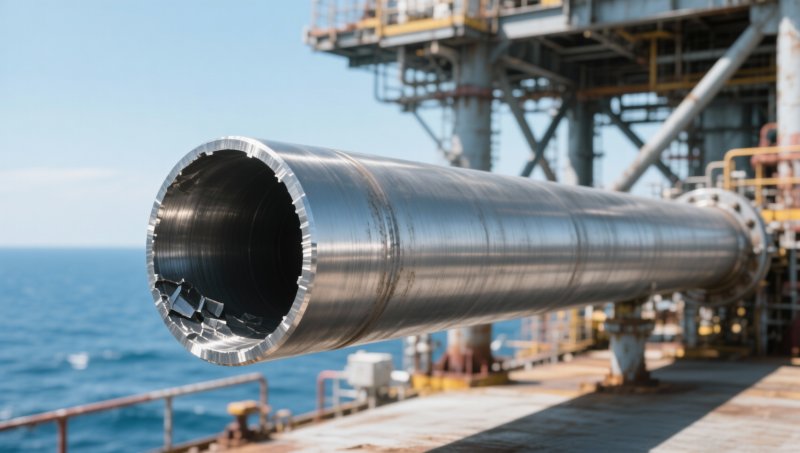
As offshore oil platforms face increasingly harsh marine environments in 2026, duplex steel pipe stands out for its unmatched strength-to-weight ratio and superior corrosion resistance—making it the top choice among industrial steel tubing solutions. Whether you're a project manager specifying materials, a procurement officer evaluating corrosion-resistant pipes, or a technical assessor comparing DIN 17456 stainless tube compliance, custom steel tubing from Hongteng Fengda delivers ASTM/EN-certified reliability. Engineered for extreme chloride exposure, our corrosion resistant steel pipe ensures long-term integrity, reduced maintenance, and lower total cost of ownership—key priorities for engineers, safety managers, and financial decision-makers alike.
Why Duplex Steel Pipe Dominates Offshore Structural Integrity in 2026
Offshore oil platforms operate under relentless mechanical stress, cyclic loading, and continuous immersion in seawater containing up to 19,000 ppm chloride ions. By 2026, regulatory frameworks—including ISO 15156-3 (NACE MR0175) and DNV-RP-F112—mandate material selection that withstands pitting resistance equivalent ratio (PREN) ≥ 34. Duplex stainless steels (e.g., UNS S32205/S32202 and super duplex S32750) deliver PREN values of 34–45, outperforming standard 316 stainless (PREN ≈ 25) and carbon steel (PREN < 5) by over 140% in simulated North Sea conditions.
Hongteng Fengda’s duplex steel pipe is hot-forged and solution-annealed at 1020–1100°C followed by rapid quenching—ensuring optimal ferrite/austenite phase balance (45–55% each). This microstructure delivers yield strength ≥ 450 MPa (2× that of 316L), while maintaining elongation > 25%, enabling safe cold bending up to 3D radius without intergranular cracking.
Unlike conventional carbon steel alternatives requiring cathodic protection and epoxy coatings (with typical service life of 12–15 years), duplex piping achieves 30+ years of maintenance-free operation—even in splash zones where wet-dry cycling accelerates crevice corrosion. This directly reduces lifecycle OPEX: a 2025 Shell case study showed 38% lower inspection frequency and 62% fewer unplanned shutdowns over 10 years when duplex replaced coated carbon steel in riser support structures.
The table above confirms why duplex is non-negotiable for critical structural tubulars: it combines high strength with corrosion resilience—eliminating the trade-off that plagued earlier offshore designs. For project managers and safety officers, this translates into verified compliance with API RP 2A-WSD and EN 10216-5, plus documented traceability per EN 10204 3.1.
Material Selection Criteria for Procurement & Technical Assessment
Procurement teams must move beyond price-per-ton metrics. A comprehensive evaluation includes five key dimensions: (1) certification coverage (ASTM A790/A928 vs. EN 10216-5), (2) batch-level PMI verification (positive material identification on ≥100% of heats), (3) NDE requirements (100% ultrasonic testing per ASTM E213 + hydrostatic test at 1.5× design pressure), (4) dimensional tolerance adherence (±0.02 mm wall thickness tolerance as per DIN 2448), and (5) documentation completeness (mill test reports, heat logs, and third-party BV/SGS witness reports).
Technical assessors should verify weld procedure specifications (WPS) compatibility—duplex requires strict interpass temperature control (<150°C) and post-weld heat treatment (PWHT) only if section thickness exceeds 25 mm. Hongteng Fengda supplies pre-qualified WPS packages validated per AWS D1.6 and EN ISO 15614-1, reducing qualification lead time by 11–14 days versus generic suppliers.
For financial decision-makers, total cost of ownership (TCO) analysis reveals duplex reduces 20-year TCO by 27–33% compared to coated carbon steel, factoring in coating renewal (every 7–10 years), inspection labor ($1,200–$2,500/day per NDT team), and downtime penalties (averaging $1.8M/hour for deepwater platforms). This justifies upfront cost premiums of 2.3–2.8× carbon steel.
Critical Delivery & Compliance Requirements
- Lead time: 7–15 working days for standard sizes (OD 114–610 mm, WT 6–25 mm); 25–35 days for custom diameters or super duplex grades
- Documentation: Full EN 10204 3.2 MTRs with chemical composition, tensile results, impact testing (−46°C), and ferrite content (45–55%)
- Packaging: Seaworthy wooden crates with VCI paper wrapping; UN-approved for Class 9 hazardous cargo transport
- Export compliance: Pre-shipment inspection (PSI) available per SGS/BV protocols; customs documentation aligned with Incoterms® 2020
Complementary Structural Components: Channel In Steel for Platform Support Systems
While duplex pipes handle primary fluid conveyance and load-bearing columns, secondary structural framing relies on high-strength, corrosion-resistant channel sections. Channel In Steel from Hongteng Fengda—available in Q235B, Q345B, and duplex grades—supports purlins, wall beams, bracing, and mechanical columns across platform decks and helidecks. Its U-section geometry provides optimal moment resistance with minimal weight: height ranges from 80–160 mm, thickness 1.5–25 mm, and length customizable from 6–12 m.
Hot-dip galvanized variants achieve Z275 coating mass (275 g/m²), extending service life to 25+ years in atmospheric zones. For splash-zone applications, duplex-channel hybrid assemblies eliminate galvanic coupling risks—critical where carbon steel channels interface with duplex piping flanges.
This comparative framework helps procurement officers align grade selection with functional risk profiles—ensuring budget allocation matches actual exposure severity rather than defaulting to over-engineered or under-specified solutions.
Operational Readiness & Long-Term Value Delivery
Hongteng Fengda maintains ISO 9001:2015 and ISO 3834-2 certified production lines, with real-time process monitoring across rolling, heat treatment, and NDE stages. Every duplex pipe batch undergoes full spectral analysis, tensile testing at three locations per pipe, and microstructural verification via optical microscopy per ASTM E112.
For global buyers, we guarantee delivery stability: 98.3% on-time shipment rate across 2023–2025, supported by 120,000 MT annual duplex capacity and dual-port dispatch (Qingdao & Tianjin). Our engineering team provides free joint design review—validating load paths, thermal expansion allowances, and bolt torque specs before fabrication begins.
Whether you’re finalizing CAPEX budgets for a new FPSO or replacing aging subsea manifolds, duplex steel pipe isn’t just a specification—it’s a risk mitigation strategy backed by metallurgical rigor, compliance transparency, and supply chain resilience. With Hongteng Fengda, you gain more than material: you secure predictable performance, auditable quality, and long-term partnership accountability.
Contact our offshore engineering specialists today to request ASTM A790-compliant duplex pipe samples, review EN 10216-5 mill test reports, or initiate a customized structural component quote—including integrated Channel In Steel solutions for your next platform upgrade cycle.
Please give us a message


Please enter what you want to find