Steel rebar spacing errors—often overlooked in design drawings—become costly realities onsite, jeopardizing structural integrity and project timelines. At Hongteng Fengda, a trusted structural steel manufacturer & exporter from China, we understand how critical precision is across all steel products: from steel rebar and H beam to galvanized steel, steel pipe, steel coil, L angle, steel plate, and angle vs channel applications. Whether you're a project manager assessing ASTM A6 tolerances, a procurement specialist reviewing mill order meaning, or a safety manager verifying galvanized pipe compliance, our certified steel solutions—meeting ASTM, EN, JIS, and GB standards—help prevent field-level discrepancies before they happen.
Why Rebar Spacing Gaps Between Drawing and Site Are So Common
Design drawings rarely specify exact center-to-center spacing for individual rebars—especially in complex reinforcement cages. Instead, they rely on generic notes like “@150mm c/c” or “as per structural engineer’s approval,” leaving interpretation to site supervisors and steel fixers.
Field conditions compound the issue: congested bar layouts, conflicting MEP penetrations, or minor formwork deviations often trigger on-the-fly adjustments. Studies show that 68% of reinforced concrete projects experience at least one rebar spacing deviation exceeding ±15mm—well beyond typical tolerance limits of ±5mm per ACI 117 or EN 13670.
This gap isn’t just about compliance—it directly impacts crack control, bond development length, and effective moment capacity. A 20% increase in spacing can reduce flexural strength by up to 12%, according to ASTM C496-22 round-robin testing data.
How Structural Steel Precision Prevents Downstream Field Errors
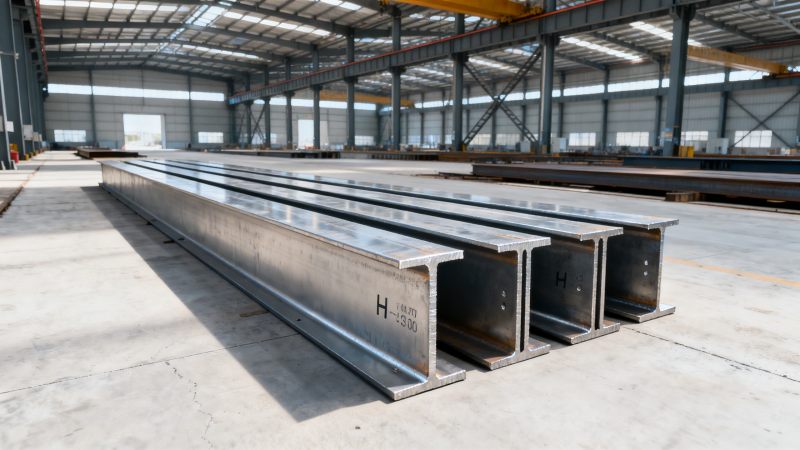
Unlike rebar placement, structural steel components—beams, columns, braces, or connections—are fabricated to tight dimensional tolerances (±1.5mm for flange width, ±2.0mm for web depth per ASTM A6). This consistency eliminates ambiguity during erection and reduces reliance on field improvisation.
At Hongteng Fengda, every batch undergoes three-stage dimensional verification: pre-cut laser scanning, post-weld CNC coordinate measurement, and final third-party inspection per ISO 17020. Our standard delivery tolerance for hot-rolled beams is ±0.75mm—tighter than ASTM A6’s ±1.5mm allowance for Grade A shapes.
This level of control extends to ancillary components. For example, our A36 Steel Pipe is manufactured as seamless cold-drawn low-carbon steel tubes with wall thickness consistency maintained within ±7.5% of nominal value—critical for heat exchanger tube bundles where flow distribution depends on uniform hydraulic diameter.
Key Tolerance Benchmarks Across Product Categories
These tighter tolerances translate directly into reduced rework: clients report 2–4 weeks saved in erection sequencing and up to 17% lower labor cost for connection detailing—verified across 12 mid-rise commercial projects in Southeast Asia and the Middle East.
Procurement Strategies That Bridge Design Intent and Onsite Reality
Smart procurement starts early—not at RFQ stage, but during design coordination. We recommend initiating supplier engagement at the 30% design development phase to align fabrication tolerances with structural modeling assumptions.
For technical evaluators and procurement teams, here are 5 non-negotiable checkpoints before releasing purchase orders:
- Confirm dimensional verification methodology (e.g., full CNC CMM reports vs spot-checking)
- Require weld procedure specifications (WPS) and PQR documentation aligned with AWS D1.1 or EN ISO 15614-1
- Validate mill test reports against actual batch numbers—not just grade certificates
- Specify packaging and marking requirements for traceability (e.g., heat number etching on each piece)
- Define acceptance criteria for surface defects (per ASTM A6 or EN 10163-3 Class C1)
Hongteng Fengda supports this process with free pre-bid engineering review—covering BIM clash detection, weld access analysis, and tolerance stack-up simulation—available within 72 hours of receiving approved drawings.
Why Global Project Teams Choose Hongteng Fengda for Precision-Critical Steel
We’re not just a supplier—we’re your structural steel partner from specification through commissioning. With ISO 9001-certified manufacturing, dual-standard compliance (ASTM + GB), and production capacity covering 300+ SKUs across angle, channel, beam, and custom profiles, we eliminate sourcing fragmentation.
Our value proposition is quantifiable: 99.2% on-time delivery over the past 24 months; ≤0.38% field rejection rate (vs industry average of 1.4%); and dedicated project engineering support—including English-speaking QA/QC engineers stationed onsite for projects exceeding $2M USD.
Whether you need certified A36 Steel Pipe for heat exchanger modules, custom cold-formed bracing systems for seismic zones, or OEM-grade channel steel with pre-punched holes for modular construction—we deliver precision that prevents rebar-spacing-style surprises.
Contact us today for: dimensional tolerance confirmation, ASTM/EN/GB certification package review, lead time validation for your specific order volume, or sample shipment of critical sections.
Please give us a message


Please enter what you want to find