For financial decision-makers, understanding the steel coil price per ton is essential to controlling procurement costs and avoiding budget overruns. Prices shift with raw material trends, energy costs, supply-demand balance, and global trade factors. This article explains what drives market changes and how smarter sourcing and planning can help you budget with greater confidence and stability.
Understanding the steel coil price per ton in a practical business context
The steel coil price per ton is more than a quoted number on a supplier offer. In the steel industry, it reflects a moving combination of production cost, market expectations, logistics conditions, currency exposure, and end-use demand. For finance teams, this metric directly affects project cash flow, gross margin, inventory valuation, and the timing of capital allocation.
In construction, manufacturing, machinery, and infrastructure purchasing, steel coil is often used as a reference product because its price movement signals broader steel market direction. Even if a buyer ultimately sources structural sections, beams, channels, or customized fabricated components, the steel coil price per ton still influences upstream mill behavior and downstream contract pricing. That is why budget owners and approvers should treat coil pricing as an early indicator rather than a narrow commodity statistic.
For global buyers working with Chinese suppliers, the issue becomes even more relevant. China remains one of the most important steel production bases in the world, with deep manufacturing capacity and broad export experience. A professional structural steel manufacturer and exporter such as Hongteng Fengda supports overseas projects with stable production, strict quality control, and compliance with ASTM, EN, JIS, and GB standards, helping customers connect market understanding with practical sourcing decisions.
Why the market pays close attention to steel price movement
The reason the steel coil price per ton receives so much attention is simple: it compresses many risk variables into one visible market benchmark. When steel prices rise quickly, contractors may face tighter working capital needs, manufacturers may need to revise sales quotations, and distributors may reconsider stocking strategy. When prices fall, the risks shift toward inventory devaluation, delayed buying behavior, and pressure on supplier margins.
Financial approvers are usually not concerned only with whether today’s offer is high or low. They need to know whether the current number is sustainable, whether it is likely to move during the approval cycle, and how sensitive the business is to each incremental increase per ton. In other words, the steel coil price per ton matters because it shapes forecasting reliability.
Core factors that move the steel coil price per ton
Several recurring drivers explain most market fluctuations. While daily movement may seem unpredictable, the underlying structure is usually visible when these factors are reviewed together.
Among these drivers, raw materials and demand cycles are usually the most visible. However, for overseas buyers, freight volatility and currency fluctuation can change the final landed steel coil price per ton almost as much as mill pricing itself. This is why cost analysis must extend beyond the base commodity quote.
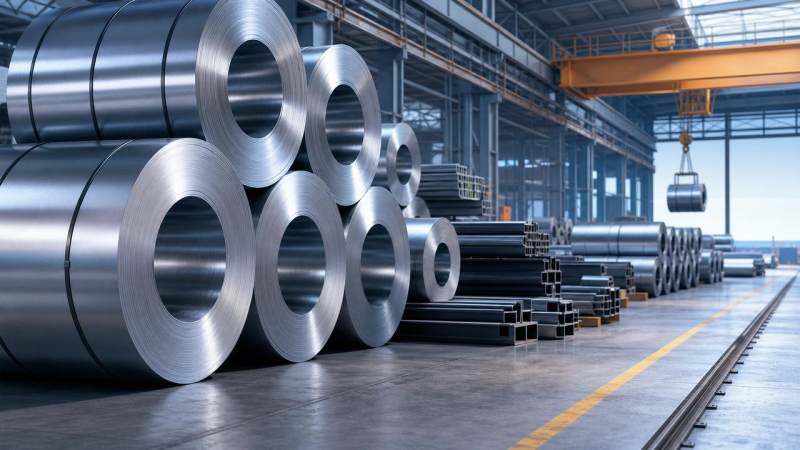
Industry background: why structural steel buyers should still monitor coil pricing
Many budget holders assume that coil pricing matters only to service centers or sheet processors. In reality, the wider steel ecosystem is closely connected. Mills often allocate production based on margin opportunity among coils, plates, sections, and processed steel products. If the steel coil price per ton rises due to stronger manufacturing demand or export orders, it may influence the pricing environment for angle steel, channel steel, steel beams, and cold formed profiles as well.
This matters for companies sourcing structural steel from China. Hongteng Fengda, as a structural steel manufacturer and exporter, serves construction, industrial, and manufacturing projects across North America, Europe, the Middle East, and Southeast Asia. In such markets, buyers are not just comparing a single item price; they are managing project packages that include multiple steel categories, specification standards, customized processing, and delivery schedules. Watching the steel coil price per ton helps create a broader cost outlook before finalizing multi-item procurement plans.
Business value for financial approvers and budget controllers
For financial decision-makers, the real value of understanding the steel coil price per ton lies in better control rather than perfect prediction. Market prices will move. The goal is to reduce surprise, improve the quality of assumptions, and build procurement plans that can absorb normal volatility.
A strong pricing view helps in five areas. First, it improves budget setting by separating market-driven costs from avoidable internal inefficiencies. Second, it supports approval timing by identifying whether a quote should be locked now or revisited later. Third, it strengthens supplier negotiation because buyers can discuss the drivers behind a price rather than only pressing for discounts. Fourth, it helps evaluate inventory carrying risk. Fifth, it supports project bid accuracy when steel cost exposure is material to final profitability.
Typical decision scenarios where price awareness creates value
Different organizations use steel differently, so the same market movement will not affect all buyers in the same way. The table below shows how the steel coil price per ton becomes relevant across common business situations.
A mid-project example of product planning and value alignment
In many projects, understanding market direction is only the first step. The second is matching product choice to application value. For example, if a buyer needs an anti-skid steel solution for transportation, construction platforms, equipment floor areas, machinery, shipbuilding, or decorative applications, a patterned plate may deliver both functional and budget advantages. In such a case, SS440 Patterned steel plate can be considered as part of the sourcing mix.
This product is available in materials such as Q235B, A36, 235JR, S235, S335JR, SS400, SS440, SM400A, and SM400B, with thickness from 2-8mm, width from 600mm-1800mm, and length from 2m-12m or according to project requirements. Certified to standards including ASTM, DIN, JIS, BS, GB/TC, ISO, SGS, and BV, it combines anti-skid performance, decorative appearance, bending resistance, and potential steel-saving benefits. For finance teams, that means evaluation should not focus only on the steel coil price per ton benchmark, but also on lifecycle suitability, installation efficiency, and whether a product reduces secondary processing or material waste.
How to budget better when steel markets are unstable
A better budget is not created by guessing the market top or bottom. It is created by building disciplined assumptions and clear purchase triggers. One effective method is to split steel exposure into three layers: base material price, conversion or processing cost, and logistics or trade-related cost. This gives finance teams a cleaner view of what is changing and why.
Another useful practice is scenario budgeting. Instead of approving a single fixed assumption, set a base case, a moderate upside case, and a stress case for the steel coil price per ton. This approach is especially valuable for long lead-time imports and projects with phased material release. A scenario model supports faster approvals because stakeholders have already agreed on the range of acceptable outcomes.
It is also wise to align procurement timing with demand certainty. If project drawings, quantities, or technical standards are still changing, locking too much material too early may create more risk than price movement itself. By contrast, if specifications are stable and market indicators suggest tightening supply, early commitment may protect both cost and lead time.
Practical evaluation points before approving a steel purchase
Before signing off on a steel order, financial approvers should ask a focused set of questions. What is the quote validity period? Is the offer based on current raw material conditions or a forward-looking assumption? Are freight and exchange rates included or exposed? Is the supplier’s production schedule reliable? Does the quoted steel coil price per ton align with market references for the grade, origin, and order size?
Supplier quality also matters. A low headline price may not be low in total cost if it comes with weak documentation, inconsistent tolerances, delayed shipments, or poor communication. Buyers working with experienced exporters benefit from more stable execution, especially when products must meet international standards and customized fabrication needs. In complex projects, dependable lead time and lower sourcing risk can be financially more valuable than a small nominal unit discount.
Common mistakes when reading price signals
One common mistake is treating spot prices as if they represent every order condition. Actual procurement depends on grade, volume, mill source, coating or processing requirements, packaging, destination, and payment terms. Another mistake is ignoring lead time. A low market quote has limited value if the delivery window does not match project need. A third mistake is focusing only on commodity headlines while overlooking inland transport, port congestion, or destination duties.
A final mistake is using the steel coil price per ton as a static annual assumption. In volatile periods, monthly or even biweekly review may be necessary for exposed projects. Good budgeting is dynamic. It recognizes that approval quality depends on the freshness of the information behind it.
Moving from market awareness to stronger procurement control
The steel coil price per ton will always reflect a changing market, but that does not mean budgets must remain uncertain. When finance teams understand the cost drivers, monitor total landed cost, and work with capable steel suppliers, they can turn market noise into decision structure. The result is better forecasting, fewer approval surprises, and more resilient project planning.
For companies sourcing structural steel and related products from China, the best outcomes usually come from combining market monitoring with supplier reliability. Hongteng Fengda supports global buyers with consistent quality, stable production capacity, and customized steel solutions for construction and industrial use. If your team wants to manage steel cost exposure more effectively, now is the right time to review sourcing strategy, compare specification needs carefully, and build a procurement plan that responds intelligently to changes in the steel coil price per ton.
Please give us a message


Please enter what you want to find