For project managers overseeing commercial construction, optimizing the use of every steel Profile is crucial for maximizing structural integrity and controlling costs. As building frames grow more complex, selecting the right cold-formed or standard components from a reliable manufacturer like Hongteng Fengda ensures compliance with international standards while reducing sourcing risks. Discover how strategic material selection and precise engineering can elevate your project's efficiency, durability, and overall return on investment.
The Reality of Commercial Frame Engineering
Let’s be honest about what happens on the ground. Many commercial building projects look flawless on the CAD drawings, but when it comes to procurement and erection, material waste becomes a glaring issue. Why? Because design teams often lean towards excessive safety margins, specifying heavier sections for non-critical areas. As a project manager, your job is to bridge the gap between structural conservatism and budget reality.
Take secondary framing, for instance. For wall girts and roof purlins, cold formed steel profiles are usually the go-to choice. They are lightweight, easy to handle on-site, and cost-effective. But when you move to the primary load-bearing skeleton, the rules change entirely. You need sections that can handle massive shear and bending moments without adding unnecessary dead load to the foundation.
Modern projects increasingly rely on BIM to clash-detect and optimize material usage before a single piece of steel is ordered. However, the software is only as good as the input data. If the structural model uses generic profiles instead of exact manufacturer sections, the procurement list will inevitably face discrepancies during the detailing phase. Furthermore, the type of commercial building dictates the approach. A large-span retail center requires wide flange sections to minimize interior columns, maximizing leasable space. In contrast, a multi-story office building prioritizes column buckling resistance and floor-to-floor height efficiency. Recognizing these nuances early prevents costly redesigns later in the procurement cycle.
Selecting the Right Profile for Load-Bearing Zones
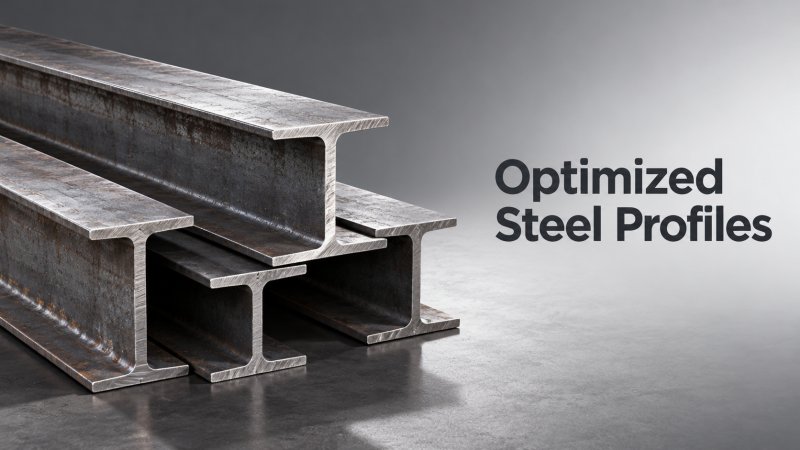
When dealing with main columns and long-span beams, the distribution of the cross-sectional area dictates the overall efficiency of the frame. In commercial structures, main girders must withstand significant bending stresses. This is where utilizing a high-efficiency H-beam makes a tangible difference. Its optimized geometry provides a reasonable strength-to-weight ratio, ensuring strong bending resistance in all directions.
Looking at the technical parameters, flange thicknesses ranging from 8 to 64mm and web thicknesses between 5 and 36.5mm offer a wide spectrum of load capacities. The flange width (50-400mm) and web width (100-900mm) allow engineers to fine-tune the section modulus according to specific span requirements. It is also vital to understand the manufacturing process. Hot rolled sections are generally preferred for heavy primary structures due to their uniform mechanical properties and residual stress distribution. Cold rolled profiles, while excellent for lighter gauge applications, have different yield behaviors.
However, a word of caution: do not blindly chase the highest grade or the thickest section. For most mid-to-high-rise commercial buildings, standard grades like S355JR, ASTM A992, or even Q345B are more than sufficient. Pushing for high-strength alloys like Q460C without a strict structural necessity will only inflate your material costs and complicate on-site welding. The goal is an economical section, not an over-engineered one.
Navigating Supply Chain and Sourcing Risks
Getting the material specs right is only half the battle. If the steel doesn't arrive on time, or if a batch fails inspection, your project schedule collapses. Sourcing from major manufacturing hubs like China offers immense advantages in production capacity and customization, but it also introduces cross-border logistics and quality consistency risks.
This is where partnering with an established structural steel manufacturer and exporter like Hongteng Fengda becomes critical. They understand that global buyers need more than just cheap tonnage; they need strict adherence to international standards such as EN10025, JIS G3101, or ASTM A572. One common headache in global sourcing is material equivalence. A project specified for ASTM A36 might receive Q235B from an Asian mill. While they are often considered equivalent in yield strength, the chemical composition and testing protocols can differ. A reliable supplier will proactively clarify these substitutions and provide the necessary mill test certificates to satisfy local inspectors.
Proper packaging is another often-overlooked factor. Steel profiles bundled without adequate wooden sleepers or waterproof tarpaulins can suffer from edge damage or surface rust during ocean transit. Ensuring your supplier uses export-standard packaging prevents costly surface remediation upon arrival.
When evaluating suppliers, look beyond the FOB price. Calculate the total cost of ownership. A slightly higher unit price from a manufacturer with modern facilities and strict quality control will save you money by eliminating rework, reducing transport damage, and ensuring dependable lead times. Consistent quality across multiple shipments is what keeps your erection crew working smoothly.
Practical Tips for On-Site Optimization
Once the materials reach the site, the focus shifts to execution. Unplanned on-site cutting and modification are silent budget killers.
To mitigate this, engage with your supplier early in the procurement phase. Many manufacturers can provide lengths from 1m to 12m, or even cut to exact project requirements. If your design team can standardize the modular dimensions, you drastically reduce the need for field welding and cutting.
When it comes to connections, there is always a trade-off between field welding and bolted connections. While welding offers continuous load transfer, it requires skilled labor, weather-dependent conditions, and non-destructive testing. Pre-engineered bolted connections, facilitated by precise factory drilling, significantly speed up erection times and reduce on-site quality control variables. Discussing connection preferences with your steel fabricator early on can streamline the entire assembly process.
Another practical consideration is surface treatment and handling. If your commercial project is located in a high-humidity or coastal environment, specifying galvanized or specialized corrosion-resistant coatings upfront is non-negotiable. While this increases the initial procurement invoice, it drastically reduces lifecycle maintenance costs. For standard indoor commercial complexes, basic anti-rust primers combined with proper on-site stacking protocols—ensuring materials are kept off the bare ground and covered during heavy rain—are usually adequate to prevent premature degradation. Additionally, plan your lifting and rigging in advance. Heavy sections require specific rigging points to prevent local buckling or deformation during the hoisting process. Marking these points at the factory before shipping can save your crane operators hours of guesswork on site.
Aligning Material Strategy with Project ROI
Optimizing steel usage in commercial frames isn't about using the absolute minimum amount of metal. It’s about deploying the right material, in the right place, at the right time. It requires a holistic view that spans from early design interventions to rigorous supply chain management and refined on-site execution.
By making informed choices between cold-formed and hot-rolled sections, avoiding unnecessary over-specification, and relying on reliable partners who deliver consistent quality, project managers can transform material optimization into a solid competitive advantage. The ultimate measure of success isn't just a structurally sound building, but one that is delivered on budget, compliant with all local codes, and on schedule.
Please give us a message


Please enter what you want to find