Mid-year mill order meaning shifts are quietly disrupting global steel supply chains — impacting everything from steel pipe and galvanized pipe lead times to ASTM A6 tolerances on H beam and angle vs channel availability. For procurement teams sourcing steel coil, L angle, steel plate, steel rebar, or SS pipe — especially for 2026 infrastructure and industrial projects — misalignment with current mill scheduling can mean cost overruns, delays, or non-compliant galvanized steel deliveries. As a China-based structural steel manufacturer serving North America, Europe, and the Middle East, Hongteng Fengda helps buyers decode these changes in real time, ensuring OEM and standard orders (including cold-formed profiles and custom components) stay on-spec, on-time, and on-budget.
Why “Mill Order Meaning” Shifts Mid-Year — And Why It Matters for 2026 Projects
“Mill order meaning” refers not to contract language, but to how mills internally prioritize, sequence, and allocate production capacity across product families, grades, and delivery windows. Starting Q3 2024, major Chinese structural steel mills—including those supplying ASTM A36, EN 10025 S355JR, and GB/T 700 Q235B—have adjusted their internal order logic due to raw material volatility, export quota recalibration, and rising demand for cold-formed steel profiles in solar mounting and modular construction.
This shift directly impacts delivery timelines: standard angle steel orders now face 8–12 week lead times (up from 6–9 weeks in Q1), while custom H-beam configurations require 14–18 weeks if scheduled after July. Crucially, mills now treat “standard specification” and “OEM-compliant” orders as separate scheduling tracks—with priority given to orders backed by confirmed letters of credit and pre-validated dimensional inspection protocols.
For 2026 project planners, this means procurement plans finalized before June may no longer reflect actual mill capacity windows. A delay of just 3 weeks in confirming final specs can push first shipment from Q1 to Q2 2026—triggering cascading schedule risks across civil works, fabrication, and erection phases.
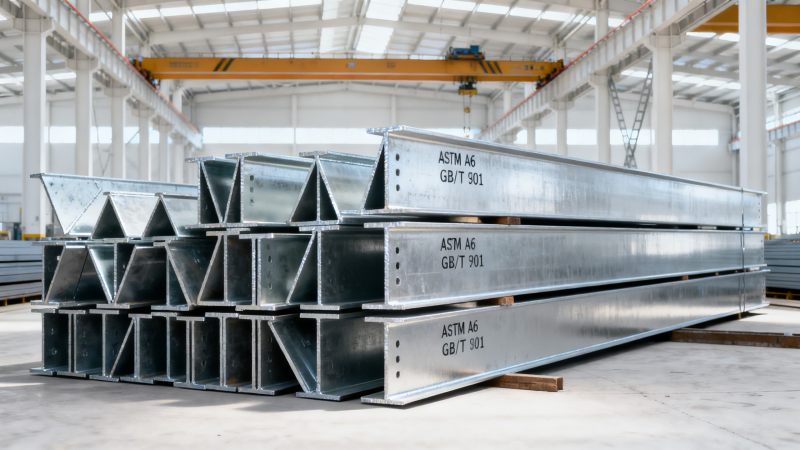
How to Realign Your 2026 Steel Procurement Plan — 4 Critical Checks
Rebuilding procurement alignment requires more than rescheduling—it demands verification at four interdependent levels:
- Specification Lock Timing: Confirm whether your mill requires full dimensional drawings, welding procedure specs (WPS), and surface finish requirements signed off by August 31 for Q1 2026 shipments.
- Material Traceability Scope: Verify if mill certificates must include heat number traceability per ASTM A6/A6M or EN 10204 3.2—and whether third-party inspection (e.g., SGS or Bureau Veritas) is mandatory pre-shipment.
- Logistics Buffer Planning: Factor in 10–14 days for inland transport from mill to port, plus 25–35 days ocean transit to U.S. Gulf ports or Rotterdam—especially critical for hot-rolled coil and galvanized pipe where container availability fluctuates monthly.
- Compliance Validation Window: Ensure your quality team has 7–10 business days post-arrival to conduct visual, dimensional, and tensile testing before release to fabrication lines.
Hongteng Fengda embeds these checks into our Procurement Alignment Framework, offering free pre-submission reviews for 2026 structural steel orders—including angle steel, channel steel, steel beams, and cold-formed profiles—helping clients avoid mid-cycle rework or compliance hold-ups.
What’s Changing for Key Product Categories?
These adjustments reflect operational realities—not arbitrary policy changes. At Hongteng Fengda, we maintain dedicated scheduling buffers for international clients: 3% extra capacity reserved for urgent 2026 project releases, with guaranteed response within 48 hours for spec clarification requests.
Where Does Stainless Steel Mesh Fit In?
While structural steel dominates infrastructure planning, auxiliary components like 306 Stainless Steel Welded Mesh play mission-critical roles in filtration, chemical containment, and architectural façades—especially where corrosion resistance, micron-level retention, and thermal stability intersect.
Our mesh portfolio supports applications from mine industry sieves (32–36μm retention) to high-end residential cladding (170–190μm open area, 0.93mm cloth thickness). With diameters ranging from 0.0008″ to 0.12″ and roll widths up to 240″, it integrates seamlessly into both OEM assemblies and retrofit upgrades—without requiring re-engineering of existing frame systems.
Unlike generic stainless mesh suppliers, Hongteng Fengda offers certified weld integrity reports per ANSI/AMCA 210, full traceability to wire heat numbers, and optional passivation per ASTM A967—ensuring long-term performance in acidic or saline environments common across Middle Eastern oil & gas facilities and Southeast Asian coastal infrastructure.
Why Partner With Hongteng Fengda for 2026 Structural Steel Procurement?
We don’t just supply steel—we co-manage procurement risk across the entire project lifecycle. Our China-based manufacturing hub combines ISO 9001-certified quality control, ASTM/EN/GB-compliant rolling lines, and direct access to iron ore and scrap feedstock contracts—giving us predictable input cost visibility through Q2 2026.
When you engage with us, you gain:
- Free 2026 Capacity Reservation: Secure mill slots with zero deposit until PO issuance—valid for 90 days.
- Spec-to-Ship Verification: Joint review of drawings, tolerances, and test reports before production launch.
- Lead Time Guarantees: Written commitments for angle steel (≤12 weeks), channel steel (≤11 weeks), and cold-formed profiles (≤15 weeks)—with liquidated damages for missed dates.
- Global Compliance Support: Pre-validated documentation packages for CBP, EU CE marking, and GCC Standardization Organization (GSO) certification.
Ready to audit your 2026 structural steel plan against current mill dynamics? Contact our technical procurement team for a no-cost Milling Schedule Alignment Review—including timeline mapping, tolerance validation checklist, and alternative grade recommendations (e.g., Q345B vs S355JR) based on your project’s regional compliance needs and budget constraints.
Please give us a message


Please enter what you want to find