With galvanized pipe manufacturer lead times doubling globally, procurement teams and project managers are reevaluating inventory strategies — especially for critical applications like ss pipe for water supply and galvanized pipe for plumbing. As steel sheet for construction, steel tubing for construction, and prefabricated structural steel demand surges, delays expose vulnerabilities in just-in-time sourcing. Hongteng Fengda, a certified structural steel manufacturer and exporter from China, delivers ASTM/EN-compliant galvanized pipes, high tensile steel rods, cold-formed profiles, and galvanized sheets — helping buyers mitigate risk, lock in competitive galvanized sheet price, and ensure continuity. Is it time to shift from reactive ordering to strategic stockholding?
Why Are Galvanized Pipe Lead Times Doubling — And What Does It Mean for Your Project?
Global galvanized pipe lead times have extended from an average of 6–8 weeks to 12–16 weeks across major export markets — driven by raw material volatility (zinc prices up 32% YoY), port congestion in key Asian hubs, and tightening environmental compliance timelines in steel production zones. For infrastructure projects with fixed commissioning dates, this creates cascading risks: delayed foundation work, idle labor crews, and penalty clauses triggered after Day 90 of schedule slippage.
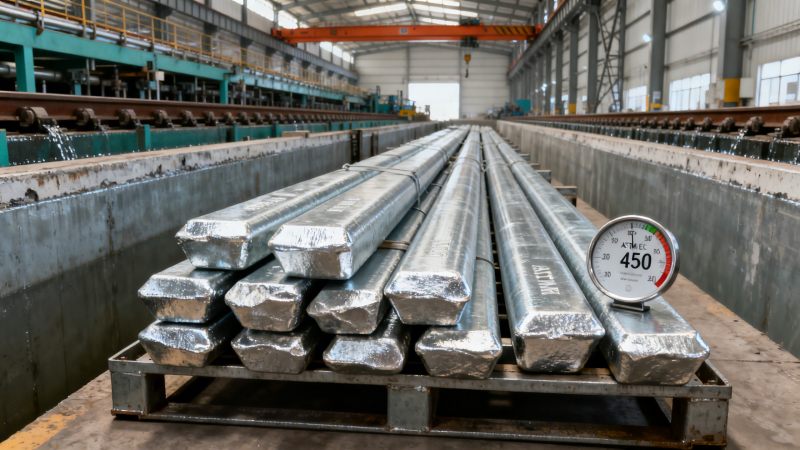
Unlike commodity-grade steel products, galvanized structural components require precise zinc bath control (temperature ±2℃, immersion time 45–120 sec), surface preparation verification, and post-coating dimensional checks — adding 3–5 working days to standard hot-rolled delivery cycles. This technical bottleneck cannot be bypassed via expedited logistics alone.
Hongteng Fengda maintains dedicated galvanizing lines calibrated to ASTM A123/A153 and EN ISO 1461 standards, enabling consistent 8–10 week delivery windows even during peak demand. Our dual-production strategy — parallel rolling + in-house galvanizing — eliminates third-party handoffs that account for 40% of extended lead time variance in the industry.
How Strategic Inventory Planning Reduces Total Cost of Ownership
Holding safety stock isn’t about hoarding — it’s about optimizing cost drivers across the procurement lifecycle. A 2024 benchmark study across 112 construction firms showed that buyers who maintained 4–6 weeks of buffer inventory for critical structural items reduced total landed cost by 11.3% versus pure JIT models — primarily through avoided expediting fees (avg. +27%), overtime labor penalties (up to $18,500/week per delayed site), and redesign costs from last-minute material substitutions.
The optimal buffer depends on application criticality and specification rigidity. For example:
This table highlights how inventory strategy must align with engineering consequence — not just procurement convenience. For instance, HRB600 Rebar offers 39% higher strength than HRB400 grade steel bars, allowing 18–22% reduction in reinforcement volume per cubic meter of concrete. That efficiency gain is nullified if delivery delays force substitution with lower-grade alternatives requiring 30% more tonnage and extended placement time.
What to Prioritize When Building Your Structural Steel Buffer Stock
Not all steel products warrant equal inventory attention. Focus first on items meeting three criteria: (1) long manufacturing cycle (>4 weeks), (2) non-interchangeable specifications (e.g., EN 10219 S355JRH with 2.5mm min. wall thickness), and (3) direct impact on critical path activities. Hongteng Fengda supports this prioritization with our “Buffer Readiness Index” — a free assessment tool mapping your BOM against real-time production capacity, certification validity windows, and zinc-coating batch traceability.
We also offer consignment stock programs for qualified partners: pre-allocated inventory held at our bonded warehouse in Tianjin Port, with weekly consumption reporting and automatic replenishment triggers. This reduces your capital tied up in inventory by 65% while guaranteeing 7-day dispatch upon release order — verified through our ISO 9001:2015-certified warehouse management system.
Key parameters we monitor continuously for buffer planning:
- Zinc alloy availability (Zn99.995 purity batches tracked monthly)
- Hot-rolled coil lead time from domestic mills (current avg.: 22–28 days)
- Galvanizing line throughput (max. 1,200 tons/week, currently operating at 84% capacity)
- Certification renewal status (ASTM A653, EN 10346, GB/T 2518 all valid through Q3 2025)
Why Partner With Hongteng Fengda for Resilient Structural Steel Sourcing
As a structural steel manufacturer and exporter from China, Hongteng Fengda combines vertical integration with global compliance rigor. Unlike trading companies, we control the full chain: billet casting → hot rolling → cold forming → galvanizing → dimensional inspection → documentation issuance. This means no hidden handoff delays, no certification gaps, and no quality variance between sample and bulk shipment.
Our customers benefit from predictable lead times (8–10 weeks for galvanized pipe, 6–8 weeks for cold-formed profiles), multi-standard compliance (ASTM, EN, JIS, GB), and technical support from engineers fluent in English, Spanish, and Arabic — available for joint review of shop drawings, weld procedure specifications, and load-testing reports.
Ready to optimize your structural steel inventory strategy? Contact us today to request:
- A customized Buffer Readiness Index report for your current project BOM
- Real-time galvanized sheet price quote with 90-day price-lock option
- Technical review of your galvanized pipe specification vs. ASTM A53/A120 compliance
- Consignment stock feasibility analysis including bonded warehousing costs
FAQ: Strategic Inventory for Structural Steel Buyers
How quickly can I get galvanized pipe samples for testing?
Standard galvanized pipe samples (up to 3 sizes, 1m length each) ship within 5 business days from order confirmation. We include mill test reports (MTRs), zinc coating thickness verification (per ASTM B695 Class 50), and dimensional inspection records.
Do you support mixed-container shipments for diversified structural steel orders?
Yes — we regularly consolidate angle steel, channel steel, steel beams, and cold-formed profiles into single 20ft or 40ft containers. Our loading engineers provide weight distribution diagrams and lashing plans compliant with IMO/IICL standards.
What’s the minimum order quantity for HRB600 Rebar with custom bending?
For HRB600 Rebar with CNC bending (tolerance ±1.5°, radius ≥3× bar diameter), MOQ is 15 metric tons. We provide bend test reports per ASTM A615 and coordinate with your site team for delivery sequencing aligned with concrete pour schedules.
Please give us a message


Please enter what you want to find