When estimating beams weight for structural projects, even a 3% error in I-beam weight calculation can trigger budget overruns, safety risks, and delivery delays. Whether you're measuring a steel beam on-site, comparing angle vs channel options, or specifying steel square rod, steel round bar, or steel girder quantities, precision matters—from procurement to installation. As a trusted structural steel manufacturer & exporter from China, Hongteng Fengda ensures accurate i-beam weight data, certified compliance (ASTM/EN/GB), and reliable steel angle, channel steel, and cold-formed profiles. Learn why weight of I beam isn’t just a number—it’s the foundation of cost control, logistics planning, and project success.
The Hidden Cost of Inaccurate Beams Weight Estimation
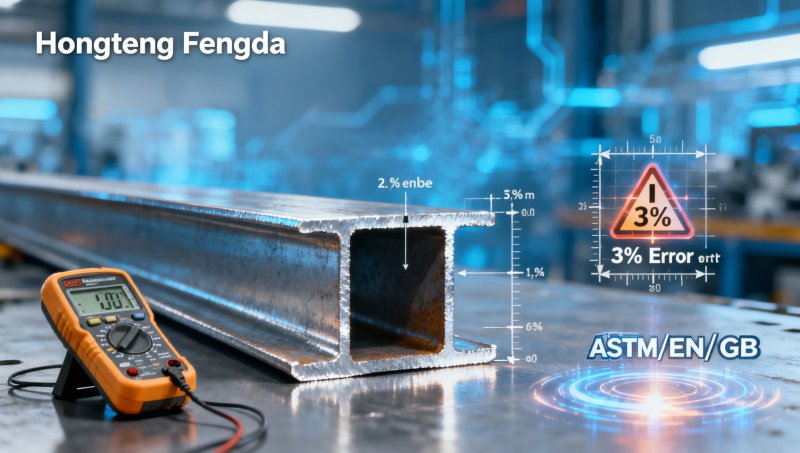
A seemingly minor discrepancy—just 3%—in calculating the beams weight of structural components carries compound consequences across project lifecycles. For example, an I-beam specified at 1,000 tons with a 3% overestimation results in 30 extra tons of material—enough to inflate raw material costs by USD $12,000–$18,000 (based on current global hot-rolled structural steel pricing). More critically, this miscalculation cascades into freight loading plans, crane capacity assessments, and even foundation design margins. Underestimating the weight of I beam poses greater danger: insufficient anchorage or undersized lifting lugs may compromise worker safety during erection. According to EN 1993-1-1 and AISC 360 standards, load-bearing calculations require verified unit weights—not theoretical approximations—to ensure structural integrity under dynamic and static loads.
Procurement teams often rely on catalog-based i beam weight tables without validating dimensional tolerances or coating thickness variations. Yet ASTM A6/A6M permits ±0.5% tolerance on nominal section weight for rolled beams—and galvanizing adds up to +8% additional mass depending on zinc layer thickness. That means two identical IPE300 beams—one bare, one hot-dip galvanized with 275 g/m² coating—can differ by over 24 kg per meter. Such variances directly impact container payload limits, especially for export shipments from China where sea freight is priced per TEU or metric ton. At Hongteng Fengda, every batch undergoes third-party verified weight audits using calibrated floor scales traceable to NIM China, ensuring documented accuracy before shipment.
How to Measure a Steel Beam Correctly: From Field Verification to Digital Modeling
Accurate field measurement of a steel beam begins not with a tape measure—but with understanding its specification origin. The most reliable method to determine actual beams weight is direct weighing combined with precise dimensional verification. On-site teams should use digital ultrasonic thickness gauges (e.g., Olympus 38DL PLUS) to confirm flange/web thickness, laser distance meters for length, and calibrated load cells for gross weight. Subtract tare weight (e.g., pallet + straps) to derive net unit weight. This empirical approach outperforms formula-based estimates—especially for non-standard or custom cold-formed profiles where theoretical density assumptions fail.
For pre-construction planning, BIM-integrated workflows now support real-time weight validation. Tools like Tekla Structures allow engineers to assign material properties—including exact density values for galvanized vs. bare steel—and auto-calculate total tonnage per member, level, and phase. When comparing angle vs channel, or selecting between steel square rod, steel round bar, or steel girder solutions, these models flag discrepancies exceeding ±1.5% against supplier-certified data. Hongteng Fengda delivers native Tekla-compatible .db files with each order, embedding certified weight parameters aligned with EN 10025-2 and GB/T 706 specifications—eliminating manual entry errors during detailing.
Material Selection Impacts: Why Coating Matters for Weight Accuracy
Galvanization significantly influences final component weight—a factor frequently overlooked in early-stage budgeting. Hot-dip galvanized coatings add measurable mass due to zinc’s density (7.14 g/cm³ vs. steel’s 7.85 g/cm³) and variable layer thickness. For instance, a standard S355JR IPE400 beam (13.4 kg/m bare) gains ~1.05 kg/m when coated with 275 g/m² zinc—representing a 7.8% increase. Pre-galvanized coils used in cold-formed sections introduce further variability: zinc layers ranging from 80–275 g/m² shift unit weight proportionally. This explains why sourcing from Galvanized Steel Coil Manufacturers demands full transparency on base steel thickness *and* coating mass—not just total coil weight.
Hongteng Fengda maintains strict process controls across both hot-dip and pre-galvanizing lines. Our DX53D+Z and SGCC coils are tested per ASTM A924/A924M for coating mass uniformity, with zinc layer thickness verified via X-ray fluorescence (XRF) spectroscopy. Every coil certificate includes measured base thickness, final coated thickness, and calculated weight contribution—enabling precise downstream fabrication weight modeling. This traceability is critical for clients specifying steel wire rope anchors, steel angle bracing, or steel girder connections where corrosion resistance and mass interdependence affect fatigue life and seismic performance.
Standard Compliance as a Weight Assurance Mechanism
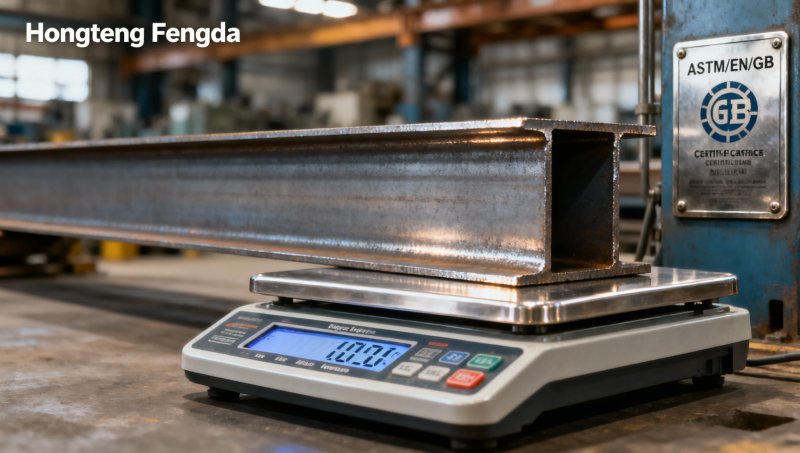
International standards don’t just define strength—they embed weight accountability. ASTM A6 mandates that mill test reports include “actual weight per foot” alongside chemical composition and mechanical test results. EN 10025-2 requires certified weight verification for all structural sections delivered to EU markets. These requirements exist because weight correlates directly with section modulus, moment capacity, and fire resistance duration. A deviation beyond ±2.5% from declared weight may invalidate structural certification under ISO 9001 Clause 8.5.2—triggering re-inspection, hold points, or rejection.
At Hongteng Fengda, compliance isn’t checklist-driven—it’s engineered into production. Our ERP system cross-references every order against mill test reports, dimensional scans, and weight logs. If a batch of steel channel shows >1.2% variance from certified weight, it triggers automatic quarantine and root-cause analysis. We maintain full audit trails for ASTM, EN, JIS, and GB-certified products—including dual-certified EN 10025-2 + GB/T 706 grades—ensuring seamless acceptance across North America, Europe, and Southeast Asia. This rigor protects your project timeline far more effectively than any post-facto weight correction.
From Calculation to Confidence: Partnering for Precision
Ultimately, managing beams weight risk isn’t about chasing theoretical perfection—it’s about building redundancy into your supply chain. Reliable how to measure a steel beam protocols, certified material data, and transparent galvanizing documentation form the triad of weight assurance. Whether evaluating angle vs channel for lateral bracing, specifying steel square rod for architectural framing, or designing crane-supporting steel girders, precision starts long before cutting or welding begins.
Hongteng Fengda delivers that confidence through integrated quality systems, real-time weight traceability, and engineering-grade documentation. As a structural steel manufacturer & exporter from China, we combine modern rolling mills, ISO/IEC 17025-accredited lab testing, and global logistics expertise to turn weight accuracy into competitive advantage. Reduce procurement uncertainty, avoid costly rework, and accelerate handover—all backed by verifiable data.
Ready to eliminate weight-related budget surprises? Contact Hongteng Fengda today for certified i beam weight data sheets, dimensional verification reports, and customized structural steel solutions tailored to your project’s technical and commercial requirements.
Please give us a message


Please enter what you want to find