Lead times for 304 stainless coil are shifting in ways that directly affect project timing, sourcing stability, and budget planning.
What once felt routine now requires closer evaluation of mill schedules, raw material costs, export flow, and order flexibility.
In the steel industry, delayed 304 stainless coil can interrupt fabrication, inventory turnover, and downstream delivery commitments.
That is why understanding lead-time risk by application scenario matters more than following a single market average.
As a structural steel manufacturer and exporter from China, Hongteng Fengda supports global steel supply with stable production, strict quality control, and dependable coordination.
When project-driven buying makes 304 stainless coil lead times more sensitive
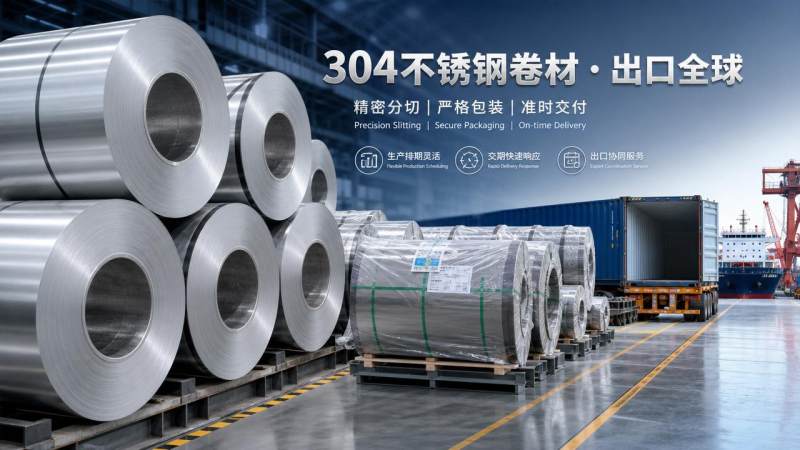
Lead-time pressure is not the same across every order.
A flexible stock purchase faces fewer risks than a specification-heavy order tied to engineering milestones.
For standard thicknesses and common finishes, 304 stainless coil may still move within a manageable schedule.
However, custom widths, special surface requirements, and mixed-container export plans often extend actual delivery time.
Construction-linked supply is especially vulnerable because fabrication sequences depend on material arrival windows, not only on quoted prices.
If the shipment misses one installation phase, the total project cost may rise through labor idle time and storage disruptions.
Which sourcing scenarios are seeing the biggest changes
Standard replenishment orders
Stock-oriented replenishment usually experiences the least volatility.
Even here, 304 stainless coil lead times can change when nickel sentiment shifts or mills rebalance production toward higher-margin items.
The main judgment point is whether the requested size sits within regular rolling plans.
Custom processing and OEM supply
Orders needing slitting, protective film, edge conditioning, or special packaging often face added coordination steps.
In this scenario, 304 stainless coil lead times depend on both mill output and downstream processing capacity.
A fast rolling date does not guarantee a fast departure date.
Export shipments with fixed vessel windows
Export supply introduces a second layer of uncertainty.
Port congestion, container availability, customs timing, and documentation accuracy can all reshape practical lead time.
For international buyers, 304 stainless coil should be judged by ex-factory readiness and shipping readiness separately.
Projects requiring cross-material sourcing
Some projects combine stainless products with structural steel sections, beams, channels, and custom fabricated components.
In these cases, one delayed item can hold the full shipment.
Integrated supply planning becomes more valuable than chasing the shortest quoted cycle for one material line.
What is actually driving 304 stainless coil lead times now
Several factors are working together, and none should be reviewed in isolation.
- Raw material swings, especially nickel and energy costs, can alter mill production priorities.
- Mill maintenance cycles reduce available rolling slots for common grades such as 304 stainless coil.
- Peak export periods increase pressure on booking space and inland transport.
- Higher demand for cut-to-size or processed material slows final dispatch.
- Quality documentation and third-party inspection may add days for regulated projects.
The key insight is simple.
A quoted lead time for 304 stainless coil is no longer a complete risk indicator unless processing and shipping stages are included.
How application scenarios change the right lead-time strategy
This comparison shows why one sourcing method cannot fit every 304 stainless coil requirement.
What to ask before confirming a 304 stainless coil order
Strong lead-time control starts with better questions.
- Is the quoted timeline based on stock, rolling schedule, or finished export readiness?
- Are thickness, width, and finish part of a standard production plan?
- Will processing steps add waiting time after the coil is produced?
- Can packing, inspection, and shipping documents be completed without delay?
- Is there a backup plan if vessel schedules or port traffic shift suddenly?
These questions help reveal whether the 304 stainless coil timeline is realistic or only commercially attractive.
Why material alternatives and complementary products may matter
In some applications, buyers review more than one stainless format while managing delivery risk.
For corrosion-focused environments, plate products may fit fabrication needs better than delayed coil conversion.
A useful example is 316L Stainless Steel Plate, often considered for chemical, food, marine, and welded structural applications.
This grade offers strong corrosion resistance, low carbon characteristics, and tensile strength of at least 520MPa.
Available thickness can range from 0.3mm to 200mm, with finishes such as BA, 2B, NO.1, and HL.
When delivery timing is critical, evaluating alternative forms alongside 304 stainless coil can protect fabrication continuity.
Common mistakes when evaluating changing lead times
- Treating mill completion as the same as shipment readiness.
- Ignoring the extra days required for slitting, testing, or export packing.
- Comparing suppliers only by price instead of schedule transparency.
- Assuming all 304 stainless coil specifications carry equal availability.
- Overlooking how mixed orders can be delayed by one non-stainless item.
Most avoidable delays come from hidden process gaps rather than from one dramatic market event.
How to reduce sourcing risk and move faster with better visibility
A more reliable approach combines forecast discipline, technical clarity, and supplier coordination.
- Standardize frequently used 304 stainless coil sizes whenever possible.
- Release forecasts early for projects with fixed installation dates.
- Separate production, processing, and shipping milestones in every quotation review.
- Use suppliers with export experience and stable documentation processes.
- Consolidate structural steel and stainless needs when schedule coordination matters more than unit price alone.
Hongteng Fengda supports global steel projects with consistent quality, international standard compliance, and dependable delivery coordination.
If your next order involves 304 stainless coil alongside structural steel sections or customized components, a coordinated supply review can reduce timing surprises.
The best next step is to confirm specifications, processing scope, and shipment targets early, then compare suppliers by execution visibility, not price alone.
Please give us a message


Please enter what you want to find