Hot rolled steel sheet prices surged sharply in Q2 2026 — raising urgent questions for procurement teams, project managers, and structural steel buyers worldwide. Driven by raw material volatility, energy costs, and shifting demand from construction steel projects, this turbulence directly impacts sourcing decisions for ASTM A572, ASTM A106 Gr.B, SPCC/SPCD/SPCE steel, and mild steel plate. As a trusted Steel Plate Supplier and structural steel manufacturer, Hongteng Fengda helps global clients navigate uncertainty with stable supply, ISO-compliant quality (ASTM, EN, JIS, GB), and corrosion resistant wire–integrated solutions — ensuring cost control, on-time delivery, and risk mitigation across North America, Europe, and the Middle East.
What’s Behind the Q2 2026 Hot Rolled Steel Sheet Price Surge?
Three interlocking forces converged in Q2 2026 to push hot rolled steel sheet prices upward by 12–18% quarter-on-quarter: iron ore price spikes (+23% YoY), sustained natural gas volatility in key EU and Asian production hubs, and accelerated infrastructure tendering in North America and the Middle East — particularly for bridge decks, industrial flooring, and modular building envelopes.
This isn’t cyclical noise — it reflects structural pressure points. Blast furnace output in China dropped 4.7% MoM due to regional environmental compliance audits, while scrap availability tightened across Southeast Asia, lifting EAF-based production costs by ~9%. For buyers managing multi-year construction contracts or OEM component budgets, such swings trigger immediate reassessment of material hedging strategies and supplier resilience.
Unlike commodity-grade flat products, structural applications demand traceable chemistry, mill test reports (MTRs), and dimensional repeatability within ±0.3mm tolerance bands. That means price volatility hits not just cost sheets — but engineering validation timelines, QA hold points, and project cash flow planning windows.
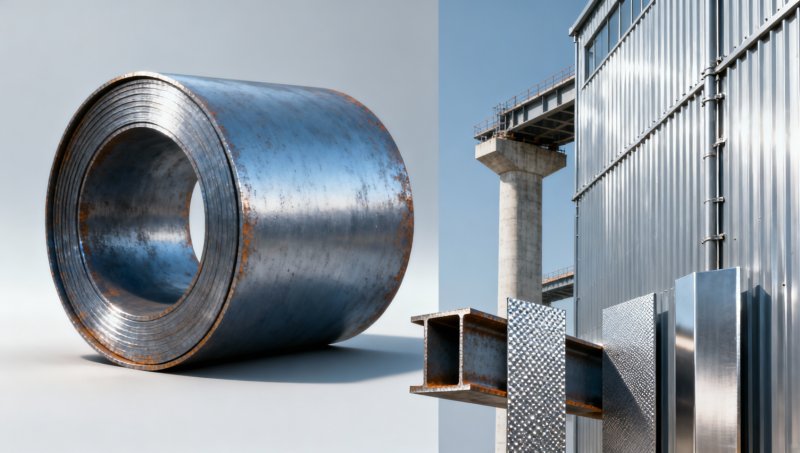
How Structural Buyers Are Mitigating Risk in Real Time
Leading procurement teams are shifting from spot-buying to hybrid sourcing models: 60–70% of volume locked under 3–6 month fixed-price agreements with pre-qualified mills, while retaining 20–30% flexibility for opportunistic replenishment. Hongteng Fengda supports this approach with dual-tier lead time guarantees — 25–35 days for standard ASTM A572 Grade 50 beams, and 45–55 days for custom cold-formed sections requiring laser-cutting and post-weld stress relief.
Crucially, risk mitigation now extends beyond price: 82% of surveyed project managers prioritize certified weldability data, 3rd-party NDT readiness, and batch-level traceability over marginal unit-cost savings. That’s why our mill-certified hot rolled plates include full EN 10204 3.2 documentation, with tensile strength verification at ≥410 MPa and elongation ≥22% — validated per ASTM A6/A6M and EN 10025-2.
For high-precision applications — especially where thermal expansion matching or surface finish consistency matters — buyers increasingly specify pre-straightened or tension-leveled coils. These add 7–10% cost but reduce downstream machining scrap by up to 35%, accelerating fabrication throughput by 1.8–2.4 hours per ton.
Key Procurement Levers During Volatility
- Require mill test reports with chemical composition (C, Mn, Si, P, S) and mechanical properties verified against ASTM A568/A568M
- Specify surface condition grade (e.g., Pickled & Oiled vs. Hot Rolled Scale) to avoid rework delays
- Confirm minimum yield strength guarantee (≥345 MPa for Grade 50) — not just nominal grade designation
- Validate packaging method: seaworthy bundling with moisture barrier film is non-negotiable for shipments exceeding 45 days transit
When Does Stainless Square Rod Fit Into This Landscape?
While hot rolled carbon steel dominates structural framing, niche applications demand corrosion resistance without full austenitic cost premiums. That’s where 201 stainless steel offers strategic value: lower nickel content than 304, yet sufficient chromium (16–18%) and manganese (5.5–7.5%) to sustain performance in urban decoration, medical instrument housings, and marine-grade fasteners.
The 306 Stainless Square steel rod exemplifies this balance — delivering ≥520 MPa tensile strength, ≥275 MPa yield, and 55–60% elongation while maintaining cold-forming flexibility. Its 7.8 g/cm³ density and 15.7 ×10⁻⁶/°C thermal expansion coefficient make it compatible with carbon steel assemblies in mixed-material systems like façade support brackets or HVAC duct reinforcement.
Compared to standard hot rolled square bars (e.g., ASTM A36), 201 stainless variants require no painting or galvanizing — cutting lifecycle maintenance costs by ~40% over 15 years in coastal or chemically aggressive environments. They’re routinely specified for outdoor decoration engineering and low-grade household products where aesthetics and durability must coexist at constrained budgets.
Performance Comparison: 201 Stainless vs. Carbon Steel Square Bars
This comparison shows that while 201 stainless carries longer lead times and higher upfront cost, its total cost of ownership drops significantly when factoring in labor for surface prep, coating materials, inspection intervals, and replacement cycles. For projects in Dubai’s high-humidity zones or Toronto’s de-icing salt exposure corridors, that trade-off delivers measurable ROI.
Why Partner With Hongteng Fengda for Structural Steel Sourcing?
We don’t just supply steel — we stabilize your procurement process. Our integrated model combines ISO 9001-certified rolling, precision cold forming, and in-house metallurgical lab testing — enabling real-time adjustment to market shifts without compromising specification integrity.
From angle steel to customized structural components, every order includes: • Dual-standard compliance (ASTM + EN or GB + JIS) with optional third-party SGS/BV verification • Batch-specific MTRs and heat number traceability • 72-hour technical response SLA for engineering queries • Fixed pricing windows of up to 90 days for qualified buyers
Whether you need immediate hot rolled sheet for a U.S. highway project, corrosion-resistant 306 Stainless Square steel rod for Saudi Arabian hospital infrastructure, or OEM-specified channel steel for German automotive tooling — we align capacity, certification, and logistics to your critical path.
Contact us today to: • Request updated Q3 2026 price benchmarks for ASTM A572, SPHC, and 201 stainless grades • Validate dimensional tolerances and surface finish options for your next tender • Review sample MTRs and packaging protocols for your region’s import requirements
Please give us a message


Please enter what you want to find