Choosing between Z-beam and C section purlins affects structural strength, installation efficiency, and project cost. For buyers asking is cheap steel from China reliable, the answer depends on material standards, manufacturing control, and application fit. This guide compares H-beam, Z-beam, and related steel Profile solutions to help engineers, procurement teams, and project managers make informed decisions.
How do Z-beam and C section purlins differ in real projects?
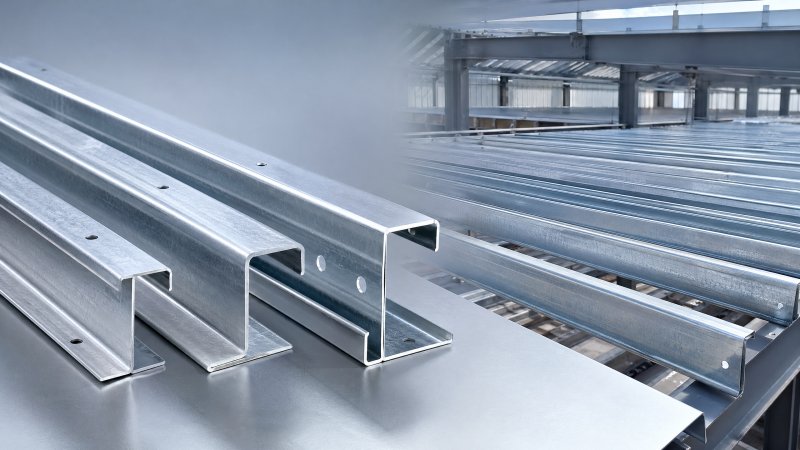
In steel building systems, purlins transfer roof and wall loads to the main frame. The most common cold formed options are Z section and C section purlins. Both can be manufactured in multiple thickness ranges, often from light-gauge profiles for small sheds to heavier sections for industrial buildings. The practical difference is not just shape. It affects overlap capacity, span strategy, fastening layout, and stock planning across the full project cycle.
A C section has a symmetrical channel-like geometry that is easy to handle, simple to align, and widely used where single-span framing or short bay spacing is acceptable. A Z-beam or Z purlin has an offset flange arrangement that allows lapped continuity over interior supports. In many warehouse, workshop, and agricultural roof systems, that overlap can reduce bending demand and support more efficient structural layouts across 2-span or 3-span runs.
Buyers often compare Z purlin, C purlin, and even heavier hot-rolled members such as H-beam in the same early discussion. That can create confusion. H-beam is typically selected for primary load-bearing frames, columns, and major rafters, while Z and C sections are secondary framing members. In procurement reviews, separating primary structure from secondary structure is one of the first 3 checks that prevents overdesign and unnecessary steel cost.
For technical evaluators, the correct question is not which shape is universally better. The better question is which section best matches span, roof slope, wind uplift, cladding system, corrosion environment, and installation sequence. In many projects, the right answer includes both profiles in different zones rather than only one profile throughout the building.
Quick structural distinction
- C section purlins are commonly preferred where simple end supports, straightforward bracing, and easier connection detailing matter most.
- Z section purlins are often chosen for multi-span roof systems because lapping over supports can improve continuity and reduce required section size in some layouts.
- Hot-rolled beams such as H-beam generally belong to the primary structural frame, not to standard light roof purlin lines.
Comparison table for design and procurement teams
The table below gives a practical comparison that helps engineers, buyers, and project managers review Z-beam vs C section purlins from both structural and commercial angles.
This comparison shows why a lower unit price alone does not determine the better option. A section that appears cheaper per ton may result in higher total installed cost if it increases support count, labor hours, or site errors. That is why experienced buyers compare at least 4 dimensions together: section efficiency, coating requirement, fabrication accuracy, and erection speed.
Which technical factors matter most when selecting purlins?
Technical selection starts with load path and service conditions. Designers usually review dead load from sheeting and insulation, live load from maintenance access, and environmental loads such as wind uplift or snow. Even when two sections share a similar depth, effective performance can differ because flange geometry, bracing method, and lap detail change the working behavior of the member.
Dimensional consistency is also critical. In secondary steelwork, tolerance issues can delay roofing, misalign bolt holes, and cause repeated field adjustment. Buyers should ask for thickness tolerance, height tolerance, and standard reference before placing mass orders. For many cold formed steel profiles, practical checks include thickness control such as +/-0.02 mm and section height tolerance around +/-2 mm when applicable to the agreed specification and manufacturing route.
Material grade should match both structural demand and corrosion environment. In carbon steel applications, common grades may include Q195, Q235, Q235B, or Q345B, while some industrial or coastal environments may require galvanized or stainless solutions depending on exposure level. Standards such as ASTM, EN, JIS, and GB are important not because one is automatically better, but because all parties need a clear basis for chemistry, mechanical properties, and inspection acceptance.
Lead time is another technical-commercial factor. A standard section may move from production to shipment faster than a fully customized profile. In many export projects, buyers review a 2-stage schedule: first, drawing and parameter confirmation; second, rolling, inspection, packing, and shipment booking. This planning is especially important when the roofing contractor needs phased delivery in 2-4 week windows rather than a single bulk arrival.
What should engineers and buyers verify first?
- Confirm whether the member is for roof purlin, wall girt, bracket, or light beam use, because section choice changes by application.
- Check span arrangement, especially whether the project uses simple span, 2-span continuity, or 3-span continuity.
- Define material grade, coating type, and compliance standard before asking for final pricing.
- Review tolerance, hole pattern, and bundle identification to reduce installation mistakes on site.
A practical product option for related applications
In projects where a channel profile is better suited than a Z section, buyers may also consider Channel In Steel for construction, steel structure purlin work, wall beams, lightweight roofs, brackets, mechanical columns, and light manufacturing beams. Available material options include carbon structural steel and galvanized channel steel, with common thickness ranges of 1.5 mm-25 mm, heights of 80 mm-160 mm, and lengths of 6 m-12 m or customer-requested cuts.
For procurement teams, this kind of channel product is useful when the project needs a U channel steel format with good weldability, anti-corrosion performance, and compatibility with standards such as AISI, ASTM, DIN, JIS, BS, and GB/T. Typical grades may include Q195, Q195L, Q235, Q235B, Q345B, Duplex, and stainless options such as 201, 202, 304, and 316, depending on structural demand and environment.
How should procurement teams compare cost, risk, and supply reliability?
When people ask whether steel from China is reliable, the useful answer comes from process review rather than price assumptions. A low quote without standard confirmation, coating detail, inspection agreement, or packaging plan can create hidden costs later. Reliable sourcing usually depends on 5 checkpoints: grade traceability, manufacturing capability, tolerance control, export packaging, and response speed during pre-shipment issue handling.
In B2B steel procurement, total cost should include more than raw material value. Project teams should examine section optimization, galvanizing route, scrap risk, freight loading efficiency, and on-site labor hours. A slightly higher ex-works price can still be the better choice if it reduces rework, accelerates installation, or lowers corrosion maintenance over the service period. This is especially true for industrial roofing where downtime or installation delay can affect multiple contractors at once.
Manufacturers with export experience can reduce uncertainty by supporting specification alignment across different markets. Hongteng Fengda serves customers in North America, Europe, the Middle East, and Southeast Asia with structural steel products, cold formed profiles, channel steel, beams, and customized components. For global buyers, this matters because projects often require translation between ASTM, EN, JIS, and GB-based specifications during quotation and technical review.
From a financial approval viewpoint, supplier stability is as important as the section type itself. Consistent production capacity and dependable lead times help avoid partial shipment problems and schedule penalties. For many projects, buyers prefer a supplier that can support both standard sections and OEM processing in one workflow, reducing coordination across 2 or 3 separate vendors.
Cost and risk comparison matrix
The table below helps procurement and commercial teams compare not only section price, but also the broader cost impact of Z-beam and C section purlin decisions.
This matrix is useful for technical, commercial, and finance stakeholders because it converts the purlin decision into measurable review points. In many cases, the safest sourcing approach is not the lowest nominal quote, but the offer with the clearest manufacturing and delivery definition.
Common sourcing risks to avoid
- Comparing offers without confirming whether the section is pre-punched, plain, galvanized, or black steel.
- Assuming identical section depth means identical capacity, without checking thickness, lip detail, and overlap condition.
- Skipping packing and marking requirements, which can slow installation during the first 24-72 hours on site.
- Ignoring cross-standard alignment when the design basis, test expectations, and purchase contract use different code systems.
Which purlin works better by application scenario?
Application-based selection is often more useful than abstract section debate. For a small building with short bay spacing, light cladding, and a straightforward erection sequence, C section purlins can be a practical choice. They are familiar to many installers and often easier to inspect visually during receiving and placement.
For larger roof planes, longer building lengths, and repeated interior supports, Z section purlins frequently bring advantages because overlap can support continuity across multiple spans. This can be attractive in warehouses, logistics buildings, and manufacturing workshops where steel efficiency and erection rhythm matter over hundreds of linear meters.
Wall systems also change the decision. In many wall girt applications, C sections remain popular because the connection logic is direct and service penetrations are easier to coordinate. However, final selection still depends on load direction, cladding weight, spacing, and whether the member needs to coordinate with openings, edge framing, or bracket supports.
Project managers should also think in installation phases. If the structure will be erected in 3 zones with staggered deliveries, profile identification and bundle labeling become operational issues, not just engineering details. The best section is the one that fits the construction method, available labor skill, and required completion date.
Scenario-based selection guide
The following table summarizes where each option is often more suitable, while recognizing that final engineering checks still depend on the actual project design.
This scenario guide helps avoid a common mistake: using a section because it is familiar rather than because it fits the building system. Good project outcomes usually come from matching the member to the application, not from forcing one profile into every use case.
What do buyers often misunderstand about purlin selection?
A common misconception is that a thicker section is always the safer choice. In reality, safety and efficiency depend on the full system, including span, bracing, lap condition, fastener placement, and load assumptions. Adding thickness without correcting layout or connection details may increase cost without solving the real structural issue.
Another mistake is treating all galvanized steel as the same. Coating process, coating mass, environment, and edge treatment all matter. A dry inland project and a humid coastal or industrial environment may require different corrosion strategies even if the base section geometry is unchanged. Quality control should therefore include coating confirmation, visual inspection, and document consistency, not only dimension checks.
Some buyers also assume that standard stock always delivers faster than custom production. That may be true for certain sizes, but project-specific punching, cut length grouping, and bundle marking can reduce site delays enough to justify a short extra manufacturing window. For projects under schedule pressure, a well-prepared custom batch can be more efficient than a fast but poorly matched stock supply.
Finally, decision makers sometimes separate technical review from procurement review too late. The most efficient sourcing process usually combines 4 roles early: engineering, purchasing, quality, and site management. That reduces redesign, avoids missing details in the purchase order, and gives finance teams a clearer basis for budget approval.
FAQ
Is Z section always better for longer spans?
Not always. Z sections are often attractive in multi-span roof systems because of overlap continuity, but actual suitability depends on spacing, support arrangement, load combination, and connection design. A project with limited continuity benefit or unusual detailing may still use C sections effectively. The right choice should be checked against the structural design basis, not assumed from shape alone.
What are the key inspection items before shipment?
A practical pre-shipment checklist includes 5 items: section size, thickness, length, hole pattern if applicable, and coating condition. Export projects should also verify bundle marks, packing method, and documentation against the purchase order. When tolerances such as +/-0.02 mm for thickness or +/-2 mm for height are part of the agreed product definition, those points should be reviewed clearly in inspection records.
How long is the usual delivery cycle?
Delivery cycle varies by section type, quantity, coating, and customization. In practice, buyers often plan around 2 stages: technical confirmation and production scheduling first, then inspection, packing, and shipment arrangement. For standard or moderately customized structural steel orders, project teams usually build a 2-4 week manufacturing expectation plus transport time according to destination and shipping mode.
How can distributors and contractors reduce sourcing risk?
Work with a supplier that can discuss grades, standards, tolerances, and application logic in one conversation rather than only quoting price. It also helps to consolidate section drawings, coating requirements, and delivery sequence before order release. For repeat buyers, maintaining a standard review sheet with 6 fields such as grade, size, coating, tolerance, packing, and certificate request can significantly reduce claim risk.
Why work with a structural steel manufacturer that understands export projects?
For purlin and structural steel sourcing, the supplier’s value is not limited to production. It includes specification translation, manufacturability review, quality control discipline, and shipment coordination. Hongteng Fengda provides structural steel products and customized solutions for global construction, industrial, and manufacturing projects, with product coverage including angle steel, channel steel, steel beams, cold formed steel profiles, and custom structural components.
This is relevant for buyers who need both standard compliance and commercial flexibility. A supplier familiar with ASTM, EN, JIS, and GB frameworks can help reduce errors during technical clarification, especially when procurement documents, drawings, and local installation practices come from different regions. That can save time during the first 7-15 days of project coordination, when many sourcing problems usually appear.
If you are comparing Z-beam, C section, channel profiles, or heavier beam options for a new project, the most productive next step is to review your application conditions in detail. Useful discussion points include section size range, grade selection, corrosion environment, coating route, tolerance expectation, hole requirements, and delivery sequence. For many buyers, this early clarification prevents costly revisions after order confirmation.
You can contact Hongteng Fengda for parameter confirmation, product selection, customization review, standard alignment, sample support, delivery schedule discussion, and quotation comparison. Whether your project needs simple purlin supply or a broader structural steel package, a clear technical-commercial review helps you control cost, reduce sourcing risk, and keep installation on schedule.
Please give us a message


Please enter what you want to find