Before choosing an angle vs channel steel supplier China buyers can rely on, procurement teams should look beyond price alone.
Material grade, dimensional accuracy, production capacity, export experience, and compliance with ASTM, EN, JIS, or GB standards all matter.
These checkpoints affect total cost, delivery reliability, and installation performance in real structural steel projects.
This guide explains what to verify before selecting an angle vs channel steel supplier China importers can trust.
What should be checked first when comparing an angle vs channel steel supplier China offers?
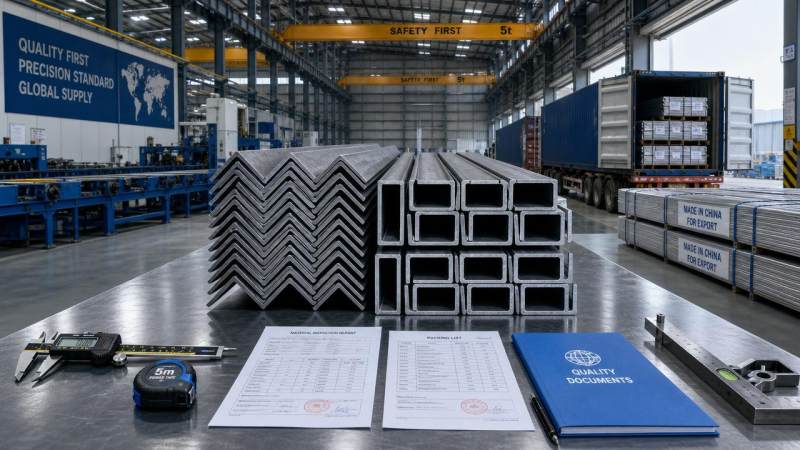
Start with product scope, not only quoted price.
A reliable angle vs channel steel supplier China source should clearly define available sizes, grades, tolerances, and standards.
Angle steel and channel steel serve different structural purposes.
Angle sections often support frames, bracing, edges, and connection parts.
Channel sections are often selected for supports, frames, machinery bases, and load-bearing assemblies.
The supplier should understand these application differences and match materials accordingly.
Ask for a mill catalog, specification sheet, and past export references.
If basic technical data is unclear, later problems usually become expensive.
First-check list
- Available steel grades and equivalent international standards
- Section size range and thickness range
- Length options and cutting service
- Surface condition and corrosion protection choices
- Mill test certificates and inspection reports
- Export packing method and shipping experience
How do material grade and standards affect sourcing results?
This is where many sourcing mistakes begin.
An angle vs channel steel supplier China exporters present may quote attractive prices using different raw material grades.
Lower-cost steel may not meet required yield strength, tensile strength, or weldability.
That creates fabrication issues and may affect structural approval.
Always confirm the requested standard before production begins.
Common references include ASTM, EN, JIS, and GB.
Equivalent grades may look similar on paper, but chemistry and mechanical properties can still vary.
Request MTC documents showing heat number, chemical composition, and mechanical test data.
Why standards verification matters
- It reduces project approval risks
- It supports welding and fabrication consistency
- It improves fit with design drawings
- It prevents claims caused by substitution
For mixed construction supply, some projects also need complementary steel items.
For example, Wire rod may be ordered together for civil engineering construction.
Available grades include HRB335, HRB400, and HRB500.
Common applications cover houses, bridges, roads, railways, foundations, beams, columns, walls, slabs, and rebars.
Typical options include hot rolled or cold rolled processing, ±1% tolerance, and multiple surface treatments.
Its compliance with ASTM, JIS, GB, ISO, SGS, and related standards helps consolidate supply from one qualified exporter.
How can dimensional accuracy and quality control be verified?
Dimensional stability directly affects assembly efficiency.
A dependable angle vs channel steel supplier China factories recommend should control leg length, web height, thickness, straightness, and twist.
Even small deviations can create alignment issues during bolting, welding, and installation.
Ask for inspection photos, measurement records, and quality process details.
Good suppliers usually have incoming material checks, in-process inspection, and final shipment review.
Third-party inspection can be useful for larger orders or custom profiles.
Key quality points to confirm
- Section dimensions match drawing tolerances
- Surface is free from heavy rust, cracks, and lamination
- Length accuracy suits container loading and fabrication needs
- Bundle marking supports traceability
- Test documents match shipped goods
What production and export capabilities indicate a dependable supplier?
Capacity matters when schedules are tight.
A strong angle vs channel steel supplier China buyers prefer should offer stable output, not only one-time quotations.
Check monthly capacity, rolling line capability, processing service, and peak-season lead times.
Also ask whether custom punching, cutting, welding, or galvanizing can be handled in-house.
Export ability is equally important.
Packing, documentation, loading plans, and destination-market familiarity all influence shipping safety and customs efficiency.
An experienced structural steel exporter should understand North America, Europe, the Middle East, and Southeast Asia requirements.
Useful export questions
- What is the normal lead time for standard and custom sections?
- Can the supplier provide ASTM, EN, JIS, or GB documentation?
- How are bundles packed for sea freight?
- What ports are commonly used?
- Can mixed steel products be loaded in one shipment?
How should price, payment, and total cost be compared?
The lowest unit price rarely means the lowest final cost.
When comparing an angle vs channel steel supplier China market options, include technical compliance, scrap loss, coating cost, freight efficiency, and delay risk.
Cheap steel with poor tolerances may increase fabrication hours.
Poor packing can cause corrosion or deformation during transit.
Unclear payment terms may create avoidable financial pressure.
Compare quotations on the same basis.
Confirm whether prices include raw steel, processing, testing, coating, packing, inland transport, and export documents.
Cost comparison table
What common risks and misunderstandings should be avoided?
Several sourcing errors repeat across steel imports.
One mistake is assuming all angle and channel sections are interchangeable if dimensions look close.
Another is approving production using only a photo or simple quote.
Some buyers skip checking coating thickness, section tolerance, or actual standard reference.
Others underestimate lead time during busy steel seasons.
A qualified angle vs channel steel supplier China partners value should help prevent these issues early.
Risk reminder list
- Do not compare quotes without matching grade and standard
- Do not ignore mill certificates and traceability
- Do not overlook packaging for long sea transit
- Do not assume custom processing has no tolerance impact
- Do not wait until shipment to review documentation
How can a final supplier decision be made with more confidence?
Use a structured decision method.
Shortlist suppliers based on standards compliance, dimensional control, production stability, export experience, and communication speed.
Then request a formal quotation with technical annexes.
For custom or repeat business, sample approval or trial orders can reduce risk.
Hongteng Fengda, as a structural steel manufacturer and exporter from China, focuses on angle steel, channel steel, steel beams, cold formed profiles, and custom structural components.
With modern facilities and strict quality control, the company supports projects requiring ASTM, EN, JIS, and GB compliance.
Stable production capacity and dependable lead times help reduce sourcing uncertainty.
Choosing the right angle vs channel steel supplier China market can offer is ultimately a technical and commercial decision together.
Check grades, standards, tolerances, export systems, and total delivered cost before placing an order.
A careful review now helps avoid claims, delays, and performance issues later.
The next practical step is to prepare a clear specification list and request matching documents with the quotation.
Please give us a message


Please enter what you want to find