Choosing between stainless steel coil suppliers and traders can directly affect product quality, delivery reliability, and total sourcing cost. For business evaluators, the real difference lies in manufacturing capability, quality control, certification compliance, customization support, and long-term supply stability. Understanding these factors helps buyers reduce procurement risks and identify partners that can support consistent project performance and global business requirements.
In the steel industry, this distinction matters even more when procurement must align with strict project schedules, international standards, and predictable cost structures. A trader may offer speed in quotation and access to mixed sources, but reliable stainless steel coil suppliers usually provide stronger process control, clearer accountability, and more stable output over 3 to 12 months of repeat purchasing.
For business evaluators working across construction, industrial manufacturing, and export procurement, the goal is not only to compare price per ton. It is to verify whether a partner can maintain thickness tolerance, surface consistency, documentation accuracy, and delivery discipline across multiple batches, ports, and end-use requirements.
Why the supplier-versus-trader distinction matters in stainless steel coil sourcing
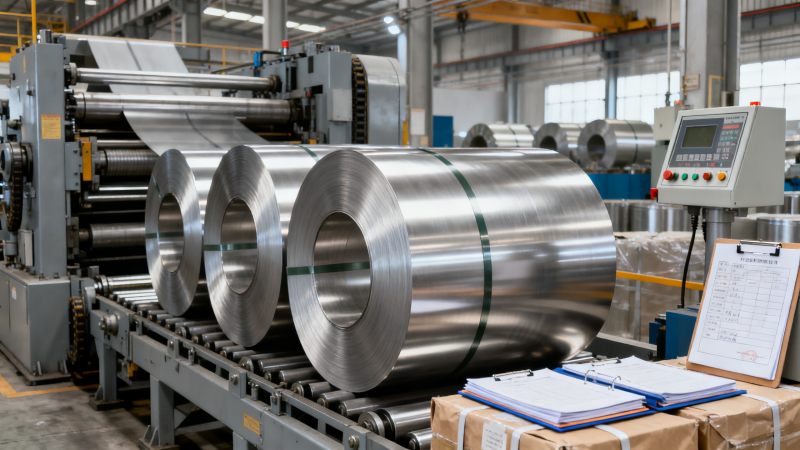
When buyers search for stainless steel coil suppliers, they are often trying to solve 4 practical issues: stable quality, dependable lead time, certification traceability, and controllable landed cost. The problem is that many companies in the market describe themselves as suppliers even when they are mainly intermediaries.
That does not mean traders have no value. In some cases, a trader can help buyers source small volumes, combine products from 2 to 5 mills, or respond quickly to urgent spot demand. However, for medium- to long-term procurement, especially where repeat quality matters, a manufacturer-based partner usually offers better visibility into production, inspection, and capacity planning.
A manufacturer controls more than inventory
Reliable stainless steel coil suppliers with manufacturing capability control raw material selection, rolling schedules, heat treatment coordination, slitting or cut-to-length processing, and final inspection steps. That level of control reduces variation from one batch to the next and makes root-cause analysis faster if defects appear.
By contrast, traders often depend on upstream mills and service centers for technical answers. If a project requires a response within 24 to 48 hours regarding chemistry deviation, edge condition, or test certificate correction, a direct supplier can usually resolve the issue more efficiently.
Price is only one part of total sourcing cost
A lower quote can become expensive if the material causes rework, delayed fabrication, or claims at destination. In stainless steel coil procurement, even a tolerance shift of ±1% or repeated surface defects across 2 or 3 containers can create handling losses, schedule disruptions, and customer dissatisfaction.
Business evaluators should look at the total cost of ownership over the entire order cycle: quotation accuracy, packaging reliability, freight coordination, claim response time, and batch consistency. This wider view helps distinguish a low-price seller from a dependable steel supply partner.
Core differences buyers should verify
The table below highlights the practical differences between a reliable manufacturing supplier and a trading company in stainless steel coil sourcing. These points are especially useful during supplier prequalification and RFQ comparison.
The key conclusion is not that every trader is unsuitable. It is that buyers with recurring orders, OEM requirements, or strict acceptance criteria generally benefit from working with stainless steel coil suppliers that can demonstrate manufacturing depth and stable operating systems.
How to identify reliable stainless steel coil suppliers during business evaluation
A proper evaluation should go beyond brochures and price sheets. In practice, buyers should review at least 6 checkpoints: production capability, material traceability, quality system, export experience, customization support, and after-sales responsiveness. Each point directly affects procurement risk.
1. Manufacturing capability and processing range
Ask whether the company actually manufactures, processes, or only resells. Reliable stainless steel coil suppliers should be able to explain their production flow, available thickness range, coil width options, slitting capability, surface finishes, and monthly output planning. Even if exact capacity is confidential, they should clearly define normal production windows and MOQ expectations.
This matters because projects rarely require only one standard item. Buyers may need different grades, finish conditions, or custom cutting arrangements within the same procurement cycle. A supplier with real processing capability is more likely to maintain consistency across these variations.
2. Quality control and document traceability
For business evaluators, quality assurance should be checked at 3 levels: incoming material verification, in-process control, and final inspection before shipment. The supplier should also provide standard documentation such as mill test certificates, packing lists, and batch identification details linked to each shipment.
Good suppliers can explain how they handle common issues such as surface scratches, edge wave, thickness variation, or packaging damage risk during sea freight. The ability to describe corrective actions in concrete terms is often a stronger indicator than polished sales language.
Practical evaluation checklist
The following checklist can help procurement teams compare stainless steel coil suppliers using measurable criteria instead of general claims.
This approach helps teams separate operationally prepared suppliers from companies that mainly rely on market arbitrage. For industrial sourcing, that distinction often determines whether an order runs smoothly or creates hidden cost after shipment.
3. Standards compliance and export familiarity
Reliable partners should understand common international requirements, including ASTM, EN, JIS, and GB where relevant. For global buyers, this is especially important when the same project involves multiple steel categories such as structural sections, fabricated components, and stainless coil products sourced under one procurement framework.
A company with established export experience is usually better prepared for container loading plans, moisture protection, labeling consistency, and destination document requirements. These details may seem secondary at quotation stage, but they can affect customs clearance and warehouse handling by several days.
4. Customization support and wider steel sourcing capability
Many buyers evaluating stainless steel coil suppliers are not purchasing coils in isolation. They often manage broader steel procurement programs that include structural steel, formed sections, and application-specific components. In this context, supplier versatility becomes commercially valuable.
For example, project buyers may also require rail products for transport infrastructure or industrial layout work. A supplier familiar with complementary steel categories can simplify coordination and reduce the number of vendors involved in one project cycle.
In the middle of a broader steel procurement plan, products such as Rail can be relevant for railway lines, bridge railings, or deck handrail applications. Common grades include U74, U71Mn, PD2, PD3, Q235, 55Q, and 45Mn, with typical lengths from 12m to 30m, thickness from 3mm to 24mm, rail height from 134mm to 170mm, and tolerance around ±1%.
From a sourcing perspective, this kind of product range shows whether a steel partner can work across multiple material types, application scenarios, and export packing requirements. Typical finishes may include oil, black, galvanized, or painted surfaces, while common use cases range from guiding rolling stock wheels to structural railing systems in civil projects.
Risk factors that often expose weak suppliers
Some sourcing risks do not appear in the initial quote. They emerge later through vague specifications, unstable communication, or inconsistent shipment execution. Business evaluators should watch for warning signs early, ideally before issuing a trial order or annual contract.
Common red flags during supplier screening
- Unable to explain production or inspection process in specific steps
- Lead time commitments that sound unusually short, such as 5 to 7 days for all grades without conditions
- Inconsistent descriptions of standards, certificate format, or packaging method
- No clear answer on claim handling, replacement policy, or batch traceability
- Frequent price changes within 24 hours without linking them to raw material movement or validity period
These issues do not automatically disqualify a seller, but they increase the need for due diligence. In many cases, reliable stainless steel coil suppliers are not the ones offering the most aggressive first quote. They are the ones able to explain process details, acceptance limits, and corrective actions without hesitation.
How trial orders reduce sourcing uncertainty
A practical method is to start with a controlled trial order covering 1 or 2 grades, one agreed finish, and a clearly defined inspection standard. This allows the buyer to evaluate quotation accuracy, sample consistency, production communication, packaging quality, and shipment punctuality over a 30- to 60-day cycle.
If the supplier performs well, the scope can expand to larger volume, more customized specifications, or a longer-term supply framework. This staged approach is often more effective than selecting purely on document review.
Suggested 5-step evaluation process
- Shortlist 3 to 5 stainless steel coil suppliers based on product fit and export capability.
- Request technical details, quality documents, and clear lead time ranges.
- Compare packaging plans, tolerance explanations, and response speed within 48 hours.
- Place a trial order with defined acceptance criteria and shipment milestones.
- Review delivery, documentation, and after-sales performance before scaling volume.
This process gives business evaluators a balanced way to judge both commercial competitiveness and operational reliability. It also improves internal reporting when procurement decisions must be justified across quality, logistics, and finance functions.
What long-term buyers should expect from a dependable steel partner
Long-term procurement requires more than one successful shipment. Buyers should expect stable communication, transparent scheduling, and the ability to support changing project requirements across multiple regions. This is especially relevant for companies sourcing from China for North America, Europe, the Middle East, and Southeast Asia, where delivery planning and standards coordination are critical.
A dependable partner in steel supply should be able to support standard specifications and customized solutions, whether the requirement involves structural steel, formed profiles, or stainless-related procurement. Strong quality control, clear documentation, and realistic lead times help reduce sourcing risk and keep project execution on track.
Why integrated steel experience matters
Companies with broader steel manufacturing and export experience often understand how procurement decisions affect downstream fabrication, construction scheduling, and total project efficiency. That perspective is valuable when evaluating stainless steel coil suppliers, because it connects material purchasing to real operating outcomes rather than isolated unit prices.
For buyers looking for a long-term structural steel partner from China, the strongest candidates are usually those that combine modern production facilities, strict quality control, international standards familiarity, and dependable support throughout the order cycle. This creates a more resilient supply chain and fewer disruptions over repeated transactions.
Reliable stainless steel coil suppliers stand apart from traders through stronger manufacturing visibility, tighter quality control, clearer traceability, and more stable delivery performance. For business evaluators, these factors usually matter more than an attractive opening quote because they shape actual project cost, compliance, and supply continuity.
If you are reviewing steel sourcing options for construction, industrial, or manufacturing projects, choosing a partner with proven production discipline and export coordination can reduce procurement risk across every shipment stage. Contact us today to discuss your specifications, request a customized solution, or learn more about reliable steel supply for global projects.
Please give us a message


Please enter what you want to find