Before placing an order for ss metal sheet, checking the right surface finish is essential for both appearance and performance. For procurement teams, the finish affects corrosion resistance, fabrication efficiency, and final application quality. Understanding common finish types and inspection points can help reduce sourcing risks, avoid costly mistakes, and ensure the material meets project and industry requirements.
Why should buyers check the surface finish of ss metal sheet before ordering?
For procurement professionals, surface finish is not a cosmetic detail. It directly influences how the ss metal sheet performs during fabrication, installation, and end use. A finish that looks acceptable in photos may still cause problems in welding, bending, polishing, coating adhesion, or hygiene-related applications. In stainless steel purchasing, finish quality often determines whether the material will satisfy engineering expectations or create claims after delivery.
The first reason to check finish is corrosion behavior. Different finishes have different roughness levels, and rougher surfaces can trap contaminants, moisture, or chlorides more easily. The second reason is visual consistency. If the sheet will be exposed in architectural, appliance, elevator, kitchen, or decorative use, even small variations in texture or reflectivity can lead to rejection. The third reason is processing efficiency. Scratches, roller marks, oil stains, or uneven passivation can slow down production and increase rework costs.
In short, buyers should evaluate the finish of ss metal sheet as carefully as grade, thickness, and size tolerance. A low unit price can quickly lose value if the surface condition fails the final application.
What are the most common surface finishes for ss metal sheet, and how do they differ?
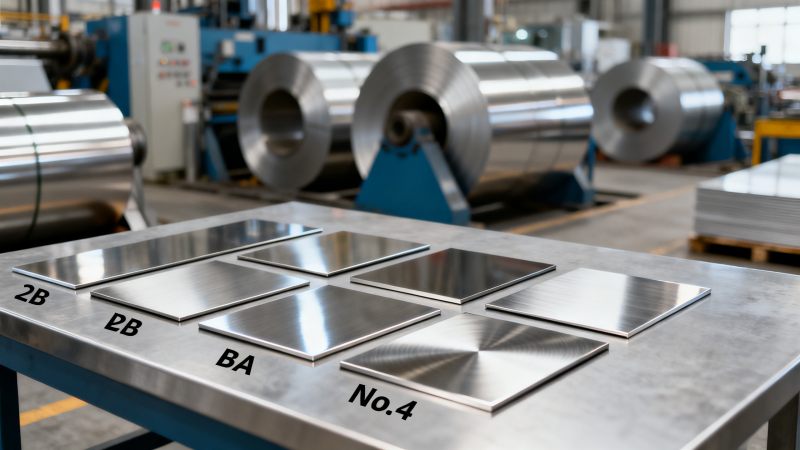
Suppliers may use different trade terms, but most stainless sheet finishes fall into several common categories. Buyers should always ask for both the finish designation and a clear visual reference, because naming alone is not always enough in international sourcing.
For many industrial buyers, 2B is the practical starting point because it balances cost and processability. For visible end products, BA, No.4, HL, or mirror finishes may be more suitable. The right finish for ss metal sheet depends on whether the priority is corrosion resistance, appearance, cleanability, or downstream fabrication.
How can procurement teams judge whether the finish matches the actual application?
A smart purchasing decision begins with the end-use scenario. Buyers should not only ask, “What finish is available?” but also, “What finish is necessary for the project?” For example, food equipment may need a smoother and easier-to-clean surface. Outdoor architectural use may require a finish with stronger resistance to staining and atmospheric corrosion. Components intended for laser cutting or welding may need a clean and stable surface that supports efficient processing.
Buyers should compare at least four factors: exposure environment, appearance requirement, fabrication route, and maintenance expectation. A project near the coast may require more caution than an indoor application. A decorative panel needs better visual consistency than a hidden support part. If the sheet will be bent, stamped, or welded, surface defects can become more visible after forming. If the final user expects easy maintenance, rough finishes may become a long-term problem.
This is also where broader steel sourcing experience matters. In many construction and manufacturing projects, stainless sheet is purchased together with structural products. A supplier with experience in both sheet-related requirements and supporting steel products can often provide more practical advice on standards, lead time coordination, and application compatibility. For example, when buyers also source profiles for frames or support structures, products such as Channel In Steel may be part of the same procurement plan. This product is widely used in construction, automobile manufacture, wall beams, lightweight roofs, brackets, mechanical columns, and steel structure purlins. It is available in grades such as Q195, Q235, Q345B, Duplex, and 201/202/304/316, with thickness from 1.5mm to 25mm, height from 80mm to 160mm, and standards including AISI, ASTM, DIN, JIS, BS, and GB/T. For buyers managing mixed material orders, this kind of integration helps align quality checks across both stainless and structural steel categories.
What exactly should you inspect on the surface of ss metal sheet before confirming the order?
The inspection process should go beyond a simple statement like “surface good.” Procurement teams should define measurable and visual checkpoints before production starts. This is especially important for export orders, OEM projects, and materials used in visible applications.
Key items to inspect include scratches, dents, roller lines, waviness, edge condition, oil contamination, discoloration, and protective film integrity. For brushed or hairline finishes, grain direction and grain uniformity should be specified. For BA or mirror finishes, buyers should verify reflectivity consistency and confirm whether minor polish distortion is acceptable. For industrial-grade 2B sheet, practical acceptance standards should focus on defects that affect processing or corrosion performance rather than decorative perfection.
It is also wise to request sample photos under natural light and indoor light, because some defects only become visible from certain angles. If the ss metal sheet will be cut into smaller parts, buyers should confirm whether the inspection standard applies to the full sheet, the usable central area, or the final component area. This detail can prevent many disputes after delivery.
What are the most common mistakes buyers make when specifying ss metal sheet finish?
One common mistake is ordering by grade only. Stainless grade matters, but finish can determine whether the same grade is suitable for the intended use. For example, 304 stainless with the wrong finish may still underperform in a visible or hygienic environment. Another common error is assuming all suppliers interpret finish terms identically. In global sourcing, “No.4” or “mirror” may vary depending on plant capability, polishing process, and quality expectations.
A third mistake is failing to define packaging and handling requirements. Even a well-finished ss metal sheet can arrive scratched if interleaving paper, PVC film, pallet protection, or lifting methods are inadequate. A fourth mistake is not confirming which side is critical. Some orders require one side prime quality and the other side standard industrial quality. If this is not clearly written, disagreements can arise at inspection.
Buyers also sometimes over-specify finish quality for non-visible parts. This raises cost without creating real value. On the other hand, under-specifying surface standards for decorative use often leads to rejection, replacement, or on-site installation delays. The best purchasing approach is to match finish level to function, not to choose the most polished option by default.
How do finish requirements affect cost, lead time, and supplier selection?
Surface finish has a direct effect on manufacturing steps, inspection workload, and packing standards. As a result, it also affects price and delivery. Standard 2B ss metal sheet usually offers the fastest availability and the broadest sourcing options. Brushed, hairline, and mirror finishes often require additional processing, more careful defect control, and stricter packaging, which can increase both lead time and cost.
From a procurement perspective, the cheapest quote is not always the lowest total cost. If the supplier cannot maintain finish consistency batch after batch, the buyer may face downstream losses in fabrication efficiency, project delays, or customer complaints. It is better to assess supplier capability in terms of coil source stability, polishing line control, inspection method, export packing, and responsiveness to quality claims.
This is where experienced steel exporters add value. Companies serving international construction and manufacturing markets usually understand how to coordinate technical standards, documentation, and packing details across multiple steel products. A manufacturer with strong quality control, broad specification coverage, and export experience can help buyers reduce sourcing risk, especially when the order combines ss metal sheet with other steel items that must meet ASTM, EN, JIS, or GB requirements.
What should be included in your purchase order and pre-shipment checklist?
A reliable order should convert finish expectations into written requirements. Verbal agreements and sample photos alone are not enough. Procurement teams should include material grade, finish type, thickness, size, tolerance, protective film requirement, side quality requirement, edge condition, packing method, and inspection standard. If visual consistency is critical, approved sample references or comparison photos should be attached to the order.
Before shipment, ask for inspection photos or videos showing the surface under adequate lighting, close-up views of representative sheets, edge condition, pallet condition, and labeling. If possible, confirm heat number traceability and test certificates as well. When the ss metal sheet is intended for OEM or project-specific applications, a pre-shipment checklist can save far more money than a post-arrival dispute.
A practical checklist should cover these questions: Is the finish exactly the approved type? Are scratches within the agreed limit? Is the PVC film applied correctly? Are sheet surfaces dry and clean? Is the packaging strong enough for sea transport? Are quantity, dimensions, and marks correct? Once these points are documented, the purchasing process becomes much more controlled.
What is the best final advice for buyers ordering ss metal sheet?
The best approach is to treat surface finish as a purchasing specification, not as a secondary detail. Start from the application, choose the finish that matches function and appearance, define acceptance criteria in writing, and verify supplier capability before mass production. For visible or sensitive applications, approve a sample first. For industrial use, focus on the defects that truly affect fabrication and service life.
When sourcing from overseas, it is especially important to work with a supplier that understands export quality control, international standards, and project coordination. Hongteng Fengda, as a structural steel manufacturer and exporter from China, supports global buyers with stable production capacity, consistent quality, and dependable lead times across construction and manufacturing needs. That kind of supply reliability helps procurement teams reduce uncertainty when planning larger steel purchasing programs.
If you need to move forward with an ss metal sheet order, the first topics to clarify are finish type, visual standard, protective film, application environment, fabrication method, and delivery schedule. Once these details are aligned early, buyers can compare quotes more accurately, avoid quality disputes, and make better sourcing decisions.
Please give us a message


Please enter what you want to find