In real project reviews, a structural galvanized steel C channel for construction is rarely rejected because the nominal size looked wrong on paper. More often, the problem appears later: the member is adequate in simple bending but weak at the connection, the coating performs well in storage but not in a chloride-rich site, or the delivered section matches the order sheet but not the practical loading condition. For technical evaluators, that is why selection cannot stop at web catalog dimensions or a low unit price.
When comparing galvanized C channels, the most important questions sit at the intersection of structural behavior and environmental durability. Load-bearing performance, section stability, fabrication suitability, zinc coating consistency, and long-term corrosion resistance all influence safety margins, maintenance cycles, and total installed cost. A sound review process helps buyers avoid under-specifying a channel that later needs reinforcement, while also preventing over-specification that increases steel tonnage without a real engineering benefit.
The challenge is that C channels often look straightforward. In practice, they are not. Their open section geometry makes them efficient and versatile, but also more sensitive than some closed or doubly symmetric shapes to local buckling, torsion, and orientation-related performance differences. For evaluators working on industrial buildings, support frames, platforms, purlin systems, equipment structures, or secondary load-bearing assemblies, the details matter.
Start with the real load path, not just the section label
Before reviewing coating thickness or steel grade, define what the channel actually needs to do in the structure. A C channel may act as a beam, stud, runner, edge member, bracing component, support rail, or built-up structural element. Those roles create different stress patterns and different failure risks.
Some buyers still compare channels using only web height and flange width. That is too shallow for technical selection. You need to establish whether the member will primarily resist:
- Uniform gravity loads
- Point loads near midspan or near supports
- Axial compression or combined compression and bending
- Lateral loads from wind, seismic action, or equipment vibration
- Eccentric loads that introduce torsion
Once the load path is clear, section property review becomes much more meaningful. Moment capacity, shear capacity, section modulus, radius of gyration, and torsional response should be checked against the intended use rather than treated as generic catalog numbers. A channel that performs acceptably as a short support member may become inefficient in a longer unbraced span where lateral-torsional instability governs.
Why section stability deserves more attention with C channels
Unlike more symmetric rolled sections, a C channel can be more vulnerable to twisting and local instability depending on load direction and support conditions. That does not make it unsuitable. It simply means the evaluator should look carefully at how the section is restrained in the actual assembly.
Three stability questions are especially important:
1. Is the compression flange adequately restrained?
If the channel is used as a beam, the unbraced length has a direct effect on bending resistance. A long unrestrained compression flange can reduce usable capacity well below what a simple section-size comparison suggests.
2. Are the web and flange proportions appropriate?
Thin elements may be efficient in weight, but if the width-to-thickness ratio is too high for the design condition, local buckling can limit performance before the steel reaches its expected strength. This is particularly relevant in cold formed or lighter gauge profiles.
3. Will eccentricity cause torsion?
Connections, bolt lines, shelf angles, or supported cladding systems often place load away from the shear center. With an open section, that eccentricity can introduce rotation that changes serviceability behavior and fastening demand.
These are not academic concerns. They directly affect whether the installed member feels rigid, remains aligned, and carries load the way the designer intended.
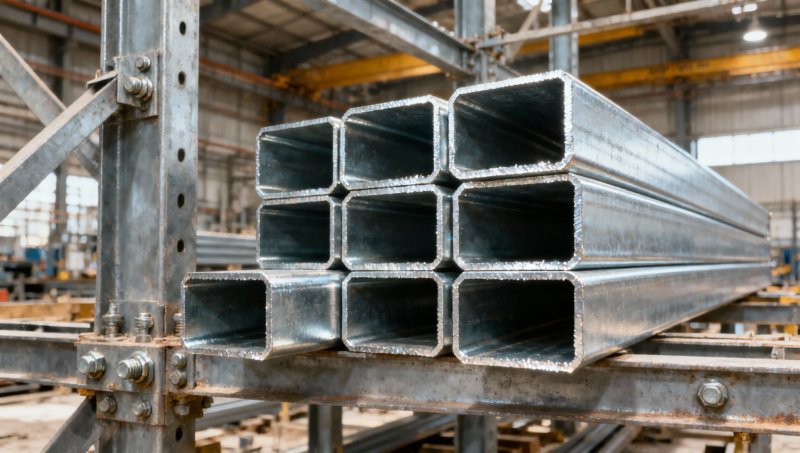
Galvanizing is not one number; coating quality needs context
Technical evaluations often reduce corrosion review to a single request: “galvanized finish.” That is too broad to be useful. For a structural galvanized steel C channel for construction, the coating must be assessed in relation to the base steel, fabrication route, expected service environment, and post-processing steps such as cutting, welding, or punching.
Ask these practical questions during specification review:
- What galvanizing method is used for the supplied channel?
- Is the coating thickness appropriate for the exposure class?
- How uniform is coverage on edges, corners, and interior surfaces?
- Will fabrication after galvanizing damage the protective layer?
- Are touch-up or repair procedures defined for field modifications?
In many construction settings, evaluators are balancing two realities. One is the need for long-term corrosion resistance. The other is the likelihood that the member will be drilled, cut, welded, or site-adjusted after delivery. If the channel is expected to undergo significant secondary processing, coating continuity after fabrication becomes as important as the original zinc layer.
Environmental exposure should also be categorized honestly. Indoor dry service, general outdoor use, industrial atmosphere, coastal exposure, and chemically aggressive zones create very different zinc consumption rates. A channel used under a roof canopy in a dry inland region does not face the same corrosion risk as one installed near marine air, de-icing salts, or persistent condensation.
Base steel quality still matters under the zinc layer
A galvanized surface should never distract buyers from the properties of the substrate. The channel still needs suitable mechanical strength, dimensional accuracy, weldability, and consistency from batch to batch. Technical reviewers should confirm the applicable material standard and ensure the supplied section aligns with the project’s design code framework, whether ASTM, EN, JIS, or GB-based procurement is being followed.
This is where experienced manufacturers tend to stand out. Hongteng Fengda, as a structural steel manufacturer and exporter from China, supplies angle steel, channel steel, steel beams, cold formed profiles, and custom structural components for buyers working under major international standards. For evaluation teams, that matters because standard alignment is not just a paperwork issue. It affects tolerances, inspection expectations, and how confidently a section can be integrated into a global project supply chain.
Dimensional tolerance should be reviewed with equal care. Even a strong section can create assembly issues if web depth, flange width, straightness, or twist fall outside acceptable limits. In modular construction, steel platforms, racking supports, or repetitive framing systems, small dimensional deviations can multiply into fit-up problems and site delays.
Connection detailing often controls the practical success of the channel
A C channel may satisfy member strength checks and still perform poorly if the connection design is too simplistic. Technical evaluators should review how the member will be joined to plates, beams, slabs, anchors, or secondary steel. Open sections are especially sensitive to connection eccentricity and distortion around bolt holes.
Important review points include:
- Bolt edge distance and spacing in the web or flange
- Hole placement relative to high-stress zones
- Need for stiffeners, cleats, or backing plates
- Potential reduction in coating performance at welded areas
- Load transfer in slotted or adjustable connections
In many cases, the difference between a robust and fragile installation is not the channel itself but whether the detail respects the behavior of the section. A technically sound sourcing decision therefore includes both the steel profile and its intended connection logic.
Don’t overlook fabrication compatibility and supply practicality
Selection decisions are rarely made in a vacuum. The best channel on paper may be the wrong choice if it complicates fabrication, extends lead time, or creates avoidable logistics costs. Evaluators should balance structural and corrosion performance with processing needs such as punching, cutting, welding, bundling, and export packing.
In broader construction procurement, this mindset applies to other supporting steel materials as well. For example, where reinforcement, tie systems, or fabricated steel assemblies are sourced together, buyers may also compare products like Wire rod for civil engineering construction. Material options in grades such as HRB335, HRB400, and HRB500, along with surface treatment and processing requirements, can influence how efficiently the entire package is purchased and coordinated, especially on projects involving foundations, beams, columns, walls, and slabs. For technical teams, the lesson is simple: member selection should fit the workflow of the project, not just the calculation sheet.
How to compare candidate suppliers more intelligently
When several manufacturers offer apparently similar galvanized C channels, a more disciplined comparison usually reveals meaningful differences. Rather than asking only for a quote and a delivery date, technical evaluators should request enough information to judge quality consistency and specification reliability.
A useful supplier review checklist may include:
- Applicable production standards and export market familiarity
- Material grade documentation and test certificates
- Section property data and tolerance control
- Galvanizing process details and coating inspection methods
- Capability for customized lengths, holes, and fabricated components
- Packing methods for corrosion protection during transit
- Lead time stability for repetitive or staged orders
This is especially relevant for international buyers. A reliable structural steel exporter should be able to communicate clearly on standards, traceability, and customization, not just provide a broad product list. For global construction and industrial projects, consistency across multiple shipments is often more valuable than a slightly lower initial offer.
Common mistakes that distort C channel selection
Several recurring errors can lead to poor decisions:
Choosing by nominal size alone. Similar dimensions do not guarantee equivalent strength or stiffness.
Ignoring serviceability. Excessive deflection, rotation, or vibration can become the real problem even when ultimate strength is technically adequate.
Treating all galvanized coatings as interchangeable. The environment, process route, and field modifications all affect real durability.
Overlooking installation orientation. A channel loaded in one direction may behave very differently when rotated or connected differently in the field.
Separating procurement from engineering intent. If purchasing teams compare products without understanding bracing, span, connection, and exposure conditions, the wrong section can look deceptively economical.
A practical decision framework for technical evaluators
If you need a workable decision path, review the channel in this order: define the load case, check span and restraint conditions, verify section properties and stability limits, confirm base steel standard, assess galvanizing suitability for the exposure class, and then review fabrication and connection effects. Only after those items are clear does unit cost become a meaningful comparison metric.
For demanding projects, the best sourcing decision is usually the one that reduces uncertainty. A structural galvanized steel C channel for construction should not only meet a dimensional requirement; it should fit the real structural role, survive the environmental conditions, and arrive with the consistency needed for efficient fabrication and installation. When evaluators focus on both load and corrosion factors together, they make decisions that hold up not just at approval stage, but throughout the life of the structure.
Please give us a message


Please enter what you want to find