Steel sheet price can vary far more than many buyers expect, and thickness and surface finish are often the biggest cost drivers. For distributors, agents, and sourcing professionals, understanding these factors is essential for quoting accurately, protecting margins, and meeting project demands. This guide explains how different specifications affect final pricing and how to make smarter purchasing decisions in the global steel market.
Understanding What Shapes Steel Sheet Price
In the steel industry, steel sheet price is never determined by base metal cost alone. Buyers often focus on market trends, mill quotations, and freight, but specification details can change the final number much more than expected. Two orders that look similar on paper may carry very different prices because of thickness tolerance, finish requirements, raw material grade, and downstream processing needs.
For distributors and agents, this matters at every stage of the business cycle. If a quote is too general, margins can disappear after production review. If the specification is too narrow without understanding end use, a deal may be lost on price. That is why a practical understanding of steel sheet price should begin with how material is made, how it is finished, and how it is expected to perform in service.
In global trading, especially for buyers working with Chinese manufacturers and exporters, the cost structure also includes production stability, standard compliance, packaging, and shipment efficiency. Companies such as Hongteng Fengda, a structural steel manufacturer and exporter from China, support overseas buyers by combining reliable production, customized solutions, and quality control aligned with ASTM, EN, JIS, and GB standards. This reduces sourcing uncertainty and helps customers evaluate not only unit price, but total supply value.
Why Thickness Has a Direct Impact on Final Cost
Thickness is one of the clearest drivers of steel sheet price because it affects both material consumption and production conditions. A thicker sheet simply uses more steel per square meter, so the raw material portion rises immediately. However, the impact does not stop there. Heavier sheets may require different rolling schedules, more energy, stricter handling, and in some cases different packaging and transportation arrangements.
Thin-gauge sheet can also be expensive in its own way. When the material is very thin, tighter flatness control, better surface consistency, and more precise rolling become important. This means buyers should not assume that “thinner always means cheaper.” The final steel sheet price depends on the balance between weight, precision, scrap rate, and acceptable tolerance.
Thickness tolerance is especially important for resellers and project suppliers. If the end user requires strict dimensional control, the mill may need additional inspection or higher-grade processing. A sheet quoted at nominal thickness may seem competitive, but the delivered cost can rise if special tolerance standards are required. In sectors such as fabrication, equipment manufacturing, food processing, or transportation, dimensional reliability can be worth the premium.
A useful pricing habit is to compare on both per-ton and per-piece basis. A per-ton quote helps track commodity exposure, while a per-sheet or per-blank quote better reflects what your customer actually buys and uses. This is often where many misunderstandings about steel sheet price begin.
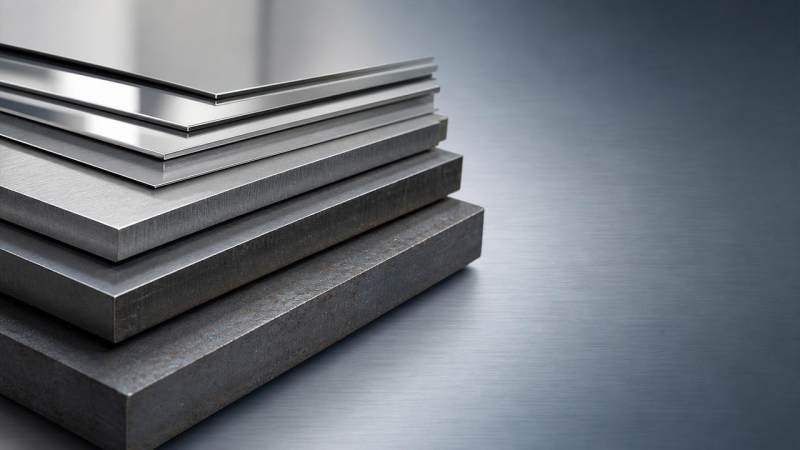
How Surface Finish Changes Cost Beyond Appearance
Surface finish is frequently underestimated by new buyers, yet it can significantly reshape steel sheet price. A basic industrial finish and a decorative or high-cleanliness finish may start from the same steel grade, but they follow different processing routes. Additional pickling, polishing, brushing, bright annealing, protective film application, and inspection all increase production time and handling cost.
Finish also affects commercial value because it is tied to end-use expectations. For visible architectural parts, kitchen equipment, appliance panels, trim parts, and packaged food equipment, appearance is not optional. Scratches, waviness, or inconsistent reflectivity can trigger claims even if mechanical properties are acceptable. As a result, mills and processors usually charge more for premium finishes because the rejection risk is higher and quality requirements are tighter.
Common finish types such as BA, 2B, NO.1, NO.4, HL, 4K, and 8K serve different applications and cost levels. In pricing discussions, buyers should always clarify whether the finish is only functional or also decorative. This single distinction can prevent costly quote revisions later.
Industry Context: Why Buyers Are Watching Specifications More Closely
The global steel market has become more specification-sensitive for several reasons. First, volatile raw material and energy costs have made margin control more difficult. Second, customers in North America, Europe, the Middle East, and Southeast Asia increasingly request documented quality, standard compliance, and application-specific performance. Third, freight and lead-time pressure means distributors want fewer surprises after order confirmation.
This explains why steel sheet price is now evaluated through a broader lens. Buyers are not just comparing tonnage cost. They are comparing delivered usability, processing risk, standard conformity, and supplier consistency. For trading companies, stockists, and industrial distributors, this shift creates a clear advantage for suppliers that can explain specification impact in a transparent way.
A reliable Chinese manufacturer with modern production facilities and strict quality control can be especially valuable here. Stable output, clear documentation, and customized processing reduce the hidden costs that often outweigh a small difference in listed steel sheet price.
A Practical Product Example in the Middle of Pricing Decisions
A good example of how thickness and finish affect cost can be seen in 430 Stainless Steel Plate. This material is widely used in automotive trim, electrical components, kitchen supplies, food and beverage packaging, medical equipment construction, agriculture and ship parts, conveyor belts, vehicles, bolts, nuts, springs, screens, and even parts for trains and airplanes. Its appeal comes from a practical combination of corrosion resistance, formability, useful mechanical properties, and resistance to nitric acid attack in certain chemical applications.
From a pricing perspective, the specification range is broad: thickness can run from 0.3 mm to 200 mm, with multiple width and length options. That alone means the steel sheet price can vary greatly between a thin decorative sheet and a heavy industrial plate. Add finish choices such as BA, 2B, NO.1, NO.4, 4K, HL, and 8K, and the final cost can shift further depending on whether the buyer needs a functional industrial surface or a polished aesthetic result. Certified supply under ISO, SGS, and BV expectations may also influence commercial value for export projects.
For distributors, the lesson is simple: the more application-focused the quote, the more accurate the pricing. Mechanical properties such as tensile strength of at least 520, yield strength of at least 275, elongation of 55 to 60, and hardness limits can help justify a price level when end users ask why one specification costs more than another.
Where Different Buyers See Different Price Sensitivity
Not every customer values the same cost driver. Understanding buyer type helps explain why steel sheet price discussions can become complex.
For agents and resellers, steel sheet price should always be matched with market positioning. A low initial quote may win attention, but if the sheet arrives with finish defects or inconsistent gauge, the commercial cost becomes much higher through claims, delayed projects, or damaged customer trust.
Practical Ways to Evaluate Price More Accurately
A disciplined approach helps buyers compare offers fairly. First, define the exact grade, thickness range, tolerance expectation, surface finish, and sheet dimensions. Second, clarify whether the application needs cosmetic quality, processing quality, or only structural usability. Third, check if certification, third-party inspection, export packaging, and protective film are included. These details often explain large differences in steel sheet price between suppliers.
It is also wise to review lead time against specification complexity. Standard stock-friendly material may be competitive and fast, while custom thickness or premium finish can require longer production windows. For global buyers, shorter lead time from a dependable supplier may be more valuable than a slightly lower unit cost from a less stable source.
Another practical step is to ask how the supplier manages quality control. A manufacturer with modern facilities and export experience can usually provide better consistency across multiple batches. That matters for repeat orders, especially when distributors serve customers who expect the same steel sheet price logic and product quality month after month.
Common Mistakes That Distort Steel Sheet Price Analysis
One common mistake is comparing only by ton price without checking usable output. Another is assuming all finishes with similar names are commercially equal. Buyers also sometimes overlook freight effects on heavy thicknesses or fail to account for protective packaging on high-appearance surfaces. In stainless and specialty sheet transactions, small specification differences can create major cost differences.
A further mistake is separating technical and commercial review. In reality, steel sheet price should be evaluated together with application need. If the end use is decorative, finish quality is a core cost factor. If the end use is fabrication, flatness and mechanical consistency may matter more than mirror-like appearance. Good sourcing decisions come from aligning specification with function, not from chasing the lowest number in isolation.
Moving from Price Checking to Better Supply Decisions
For distributors, agents, and industrial resellers, steel sheet price is best understood as a result of material weight, processing complexity, finish quality, compliance expectations, and delivery reliability. Thickness changes the amount of steel and often the production route. Finish changes labor, inspection, risk, and end-use value. Together, these factors explain why two sheets that seem similar can have very different final costs.
When working with export-oriented manufacturers, buyers should look beyond the list price and evaluate consistency, standard coverage, customization capability, and shipment dependability. Hongteng Fengda supports global construction, industrial, and manufacturing buyers with stable production capacity, customized structural steel solutions, and professional service designed to reduce sourcing risk.
If you want to improve quote accuracy, protect margins, and choose the right specification for your market, start by reviewing thickness, finish, and application together. That is the most reliable way to understand steel sheet price and turn cost knowledge into stronger commercial decisions.
Please give us a message


Please enter what you want to find