Steel Sheet Pile is often the best choice when projects demand strong earth retention, water resistance, and fast installation. For buyers comparing Steel Beam options, reviewing steel beam factory price, or evaluating Galvanized and S355JR grades, understanding where sheet piles outperform other structural steel solutions helps reduce cost, risk, and construction delays.
In the steel industry, the right structural product depends on ground conditions, load paths, installation constraints, corrosion exposure, and total project cost over time. For project managers, procurement teams, technical evaluators, safety officers, and distributors, steel sheet pile selection is rarely just a material decision. It is a construction method decision that affects excavation stability, pumping requirements, labor efficiency, and schedule control.
For global buyers sourcing from China, the evaluation usually goes beyond section size and unit price. It includes compliance with ASTM, EN, JIS, or GB standards, mill production stability, surface condition, grade suitability, and delivery coordination. This article explains when steel sheet pile is the best choice, where it may not be the first option, and how professional steel manufacturers such as Hongteng Fengda can support practical, lower-risk structural steel procurement.
What Steel Sheet Pile Does Better Than Other Structural Steel Options
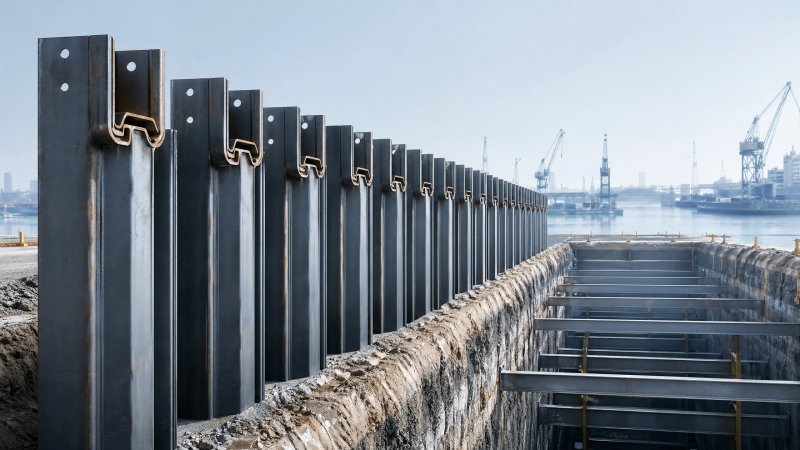
Steel sheet pile is a rolled or formed steel section designed to interlock and create a continuous wall. Unlike a standard steel beam or channel, sheet piles are not chosen mainly for open-span bending. Their main job is lateral soil retention, water cutoff support, excavation protection, and temporary or permanent wall formation. This makes them highly effective in ports, river works, deep basements, cofferdams, flood control barriers, retaining walls, and utility trench support.
The best applications usually share 3 conditions. First, the project needs excavation support deeper than about 2–3 meters. Second, the site has groundwater, soft soil, loose fill, or nearby structures that cannot tolerate excessive movement. Third, the contractor needs a faster installation method than cast-in-place retaining systems. In these conditions, sheet piles can reduce earthwork risk and help shorten the critical path.
Compared with reinforced concrete retaining walls, steel sheet pile systems can often be installed with fewer wet trades and less curing delay. Compared with steel beams used with lagging, interlocking piles can provide a more continuous barrier against soil loss and water seepage. For temporary works, they may also be extracted and reused, which can improve project economics when the installation sequence is well planned.
For technical reviewers, the key performance indicators are usually section modulus, moment resistance, interlock performance, corrosion allowance, and drivability. For buyers, however, performance should be linked to measurable site outcomes: lower dewatering demand, fewer excavation collapses, reduced vibration risk through appropriate installation method, and more predictable labor hours per linear meter.
Typical Situations Where Sheet Piles Outperform
- Waterfront or marine work requiring both soil retention and water resistance in one installed steel system.
- Urban excavation sites where limited access makes large concrete formwork and curing operations less practical.
- Temporary cofferdams or trench enclosures where recovery and reuse can improve total project value over 1–3 construction phases.
- Projects with aggressive schedules where installation speed matters more than architectural finish.
The comparison below helps procurement and engineering teams understand how steel sheet pile differs from other common structural solutions during early planning.
The key conclusion is that sheet piles are strongest when one steel product must solve 2 problems at the same time: structural retention and practical water management. That dual function is why they are often preferred in marine, foundation, and underground construction packages.
How to Judge Whether Steel Sheet Pile Is the Best Choice for Your Project
Not every project needs steel sheet pile. The right decision starts with 4 basic checks: excavation depth, groundwater level, adjacent load sensitivity, and whether the wall is temporary or permanent. In shallow dry excavations under about 1.5–2 meters, simpler support systems may be adequate. But once excavation depth, seepage, and lateral movement control become critical, sheet piles deserve serious evaluation.
Ground condition is the next filter. Dense gravel, hard layers, or obstruction-heavy fill can affect drivability and interlock integrity. Soft clay, loose sand, silty soil, and reclaimed ground often favor sheet piles because these conditions demand continuous support and careful water control. However, the installation method must match the site. Common choices include vibratory driving, impact hammer driving, or press-in installation, each with different noise and vibration profiles.
For procurement teams, the most common mistake is comparing only section tonnage or ex-works price. A lower steel beam factory price does not automatically mean a lower installed cost. If a beam-based system needs more accessories, slower excavation cycles, extra dewatering, or more labor-intensive assembly, the total package cost can rise by 10%–25% depending on the site. Sheet piles may carry a higher section-specific cost yet still lower the total project spend.
Material grade also matters. Buyers frequently ask about galvanized options and grades such as S355JR. In permanent or semi-permanent works, a higher strength grade can help meet design moments with efficient section selection, while corrosion protection strategy depends on service life, exposure category, and maintenance plan. In some inland temporary works, untreated or lightly protected surfaces may be acceptable. In marine or splash-zone exposure, the corrosion allowance must be reviewed much more carefully.
A 5-Point Evaluation Framework
- Define wall function: temporary support, permanent retaining wall, cutoff wall, or combined use.
- Confirm depth and loading: excavation depth, surcharge, nearby traffic, structures, or equipment.
- Assess hydrogeology: water table, seepage pressure, tidal fluctuation, and pumping limitations.
- Review installation constraints: noise, vibration, site access, headroom, and extraction possibility.
- Compare total cost over the full cycle: material, transport, installation, support bracing, recovery, and schedule impact.
Decision Factors by Stakeholder
Technical evaluators usually focus on section capacity, embedment assumptions, and standard compliance. Quality and safety teams focus on consistency, mill traceability, dimensional tolerance, and handling safety. Financial approvers usually compare material cost versus schedule savings and risk reduction. Distributors and agents look at grade availability, MOQ flexibility, and repeat order stability. A strong supplier must be able to answer all of these perspectives with clear documentation.
The table below summarizes practical selection signals before final design freeze and RFQ release.
If 3 or more of these factors are present, steel sheet pile is often worth prioritizing during option comparison. That does not replace engineering design, but it gives buyers and project teams a more accurate starting point for supplier discussions and cost planning.
Procurement, Standards, and Product Integration for Smarter Steel Sourcing
Once sheet pile becomes a serious candidate, purchasing success depends on more than availability. International buyers should check standard system alignment, dimensional tolerance, chemistry and mechanical property documents, packaging method, and realistic lead time. For many projects, the procurement window ranges from 2–6 weeks depending on rolling schedule, quantity, finishing requirements, and port shipment arrangements.
Hongteng Fengda supports global construction, industrial, and manufacturing buyers with structural steel products that align with ASTM, EN, JIS, and GB requirements. This matters when a project combines multiple steel categories in one package. A retaining structure may use sheet piles for excavation support, steel beams for superstructure connections, and cold formed profiles or custom components for secondary framing, bracing, or installation accessories.
In many mixed-material projects, buyers also source bars, profiles, and components together to simplify documentation and logistics. One practical example is Hot rolled Carbon Steel Round Bar, which is commonly specified in construction, water supplying systems, railings, handrails, staircases, fence fabrication, shipment support, and general steel manufacturing. Available in carbon steel grades such as S235JR, S355JR, A53(AB), A106(A.B), 16Mn, ST37, ST52, and others, it typically covers diameter ranges from 5–2500mm and standard lengths including 2m, 5m, 6m, and 12m.
For procurement managers, this kind of product integration helps reduce fragmented purchasing. A single project may require wear-resistant round bars for fabrication, support members in S355JR, and retaining steel elements under a different structural standard. Surface conditions such as passivation, oiling, lacquer sealing, phosphating, galvanized finish, PVC protection, or anti-rust oil can also be matched to handling, storage, and transport needs. Typical export preparation includes standard seaworthy packaging and lead times around 7–15 workdays after deposit or L/C for regular items, subject to quantity and mill scheduling.
What Buyers Should Ask Before Ordering
- Which standard governs the project: ASTM, EN, JIS, or GB, and are equivalent grades acceptable?
- What are the required lengths, tolerances, and whether cut-to-length service is needed?
- Will the shipment combine different structural steel products in one loading plan?
- Is the project temporary, permanent, or reusable, and how does that affect finish and protection?
The next table shows a practical RFQ checklist that helps both technical and commercial teams avoid rework during quotation comparison.
Well-structured RFQs improve quote accuracy and shorten negotiation cycles. In cross-border steel sourcing, that often matters as much as the nominal ton price because documentation gaps are a common source of delay.
Installation Risks, Common Misjudgments, and Site-Level Control Points
Even when steel sheet pile is the right product, poor planning can reduce its value. One common misjudgment is assuming any pile profile will drive easily in any soil. Obstructions, cobbles, old concrete, and dense strata can slow progress and damage interlocks. Pre-construction investigation should include enough ground information to support method selection, not only final structural design. On constrained sites, a trial section can be useful before full mobilization.
Another mistake is underestimating water behavior. Sheet piles improve water control, but interlocks are not automatically fully watertight in all conditions. Projects with high seepage pressure, contaminated groundwater, or strict inflow limits may require sealants, combined systems, or additional pumping strategy. A realistic review should compare expected inflow under dry, rainy, and peak groundwater conditions, especially where excavation depth exceeds 4–5 meters.
Noise and vibration management also matter. Vibratory hammers are fast, but they may not suit every urban environment. Press-in methods can reduce vibration but may affect cycle time and equipment planning. Safety and quality teams should define acceptance criteria before work starts, including alignment tolerance, top level tolerance, visible interlock condition, and monitoring frequency near sensitive structures or utilities.
From a commercial standpoint, the lowest steel cost can become expensive if installation productivity falls below plan. If a contractor expects 25–40 linear meters per shift but ground resistance cuts output by half, labor and equipment cost can rise quickly. That is why procurement should involve engineering, operations, and project control teams together rather than making the decision on material price alone.
Site Control Checklist
- Verify ground profile and obstruction risk before final installation method approval.
- Inspect pile straightness, interlock condition, and identification marking at delivery.
- Set alignment guides and monitoring points before driving starts.
- Track production rate, refusal behavior, and deviation daily.
- Review extraction or permanent cutoff requirements early to avoid sequence conflict.
FAQ for Buyers and Project Teams
How long is the usual delivery cycle? For standard structural steel products, common lead times can range from 7–15 workdays for ready production items, while project-specific rolling or larger mixed orders may require 2–6 weeks depending on quantity, grade, and shipping schedule.
Is galvanized sheet pile always necessary? Not always. Temporary inland works may not require galvanizing if service duration is short and storage is controlled. Permanent or corrosive environments require a more careful corrosion strategy based on expected life, exposure condition, and maintenance access.
Can S355JR be a good option? Yes, where design requirements, availability, and project standards align. Higher strength grades can improve section efficiency, but grade choice should always be checked against the governing structural design code and supplier documentation.
What should distributors and resellers focus on? Stable supply, repeatable quality, documentation readiness, flexible product mix, and dependable shipment coordination matter more over the long term than a one-time low quotation.
When to Move Forward With Sheet Piles and How to Source With Confidence
Steel sheet pile is usually the best choice when a project needs fast earth retention, practical water resistance, and efficient installation in one integrated steel system. It becomes especially valuable in marine work, deep excavation, temporary cofferdams, underground structures, and urban sites where movement control and schedule reliability matter. In these cases, the correct comparison is not sheet pile versus beam price alone, but total installed value and risk reduction.
For decision-makers, the most reliable path is to combine technical review with procurement planning early. Confirm standards, grade options, installation limits, corrosion approach, and delivery timing before issuing final purchase orders. Projects that do this well tend to reduce variation, limit field changes, and improve coordination across engineering, commercial, safety, and operations teams.
Hongteng Fengda supports international buyers with structural steel manufacturing and export capability across angle steel, channel steel, steel beams, cold formed profiles, and customized structural steel components. For buyers balancing compliance, lead time, and sourcing stability, that integrated approach can simplify mixed-product procurement and reduce cross-border supply risk.
If you are evaluating steel sheet pile, comparing structural steel options, or building a combined procurement package for construction or industrial use, now is the right time to discuss the project scope in detail. Contact us to get a customized solution, review product specifications, and explore the most suitable steel supply plan for your next project.
Please give us a message


Please enter what you want to find