Choosing the right steel rebar supplier can make or break a project, yet many warning signs only become obvious after delays, quality disputes, or unexpected costs arise. For procurement teams, recognizing these red flags early is essential to reducing sourcing risk, protecting budgets, and ensuring consistent supply. This article outlines the issues buyers should watch before contracts are signed and shipments are on the way.
Why procurement teams need a checklist before approving a steel rebar supplier
A steel rebar supplier is rarely judged by price alone in successful procurement. Buyers must verify whether the supplier can deliver compliant material, stable output, traceable documentation, and responsive after-sales support under real project pressure. Problems often appear late because many risks stay hidden during quotation and only surface during production, loading, customs clearance, or site inspection.
That is why a checklist-based review works better than a general impression. It helps procurement personnel compare suppliers using fixed standards, identify non-obvious risk points, and avoid being misled by polished brochures or aggressive pricing. In the steel industry, especially for export sourcing, a structured review can prevent disputes over chemistry, mechanical properties, weight tolerance, delivery schedule, packaging, and test certificates.
The first-screen checklist: what to confirm before requesting a final quote
Before moving a steel rebar supplier into the negotiation stage, procurement teams should confirm several basic points. If the supplier cannot answer these clearly, the risk is already elevated.
- Check whether the supplier is a manufacturer, trader, or mixed operator. This affects price transparency, lead time control, and accountability.
- Confirm applicable standards such as ASTM, EN, JIS, or GB, and verify whether the supplier has recent production records under those standards.
- Ask for mill test certificates, quality inspection workflow, and traceability method by heat number or batch number.
- Review export markets served. A steel rebar supplier with regular shipments to North America, Europe, the Middle East, or Southeast Asia is often more familiar with documentation and compliance expectations.
- Verify production capacity, monthly output, and realistic lead time under peak season conditions.
- Ask how claims are handled if dimensional deviation, rust issues, missing bundles, or third-party inspection failures occur.
If these early answers are vague, delayed, or inconsistent, that steel rebar supplier may become difficult to manage later when project timing becomes critical.
Red flags that often appear too late in steel rebar sourcing
1. Inconsistent technical communication
One of the earliest red flags is when sales staff discuss grades, tolerances, and standards loosely. If a steel rebar supplier mixes standard names, gives uncertain answers about yield strength, elongation, or chemical composition, or avoids clarifying tolerances in writing, buyers should slow down immediately. Poor technical communication usually leads to quality disputes later.
2. Quotation details are incomplete
A low quotation means little if it does not clearly define specification, unit basis, weight basis, packaging, inspection terms, shipment window, and Incoterms. Late-stage cost surprises often come from omitted items such as bundling, marking, port handling, testing, export documents, or special packing for humid transport routes.
3. Certificates are available, but not verifiable
Some suppliers send certificates quickly but cannot explain how those documents relate to the actual production lot. Procurement teams should verify whether test reports match heat numbers, dimensions, and quantities in the order. A reliable steel rebar supplier should support document cross-checking, not treat it as an unnecessary request.
4. Production photos replace process transparency
Factory photos and loading videos are useful, but they are not proof of process control. Buyers should ask about raw material sourcing, testing frequency, handling of nonconforming products, and calibration of measuring equipment. If the supplier only provides marketing images and avoids real process details, caution is justified.
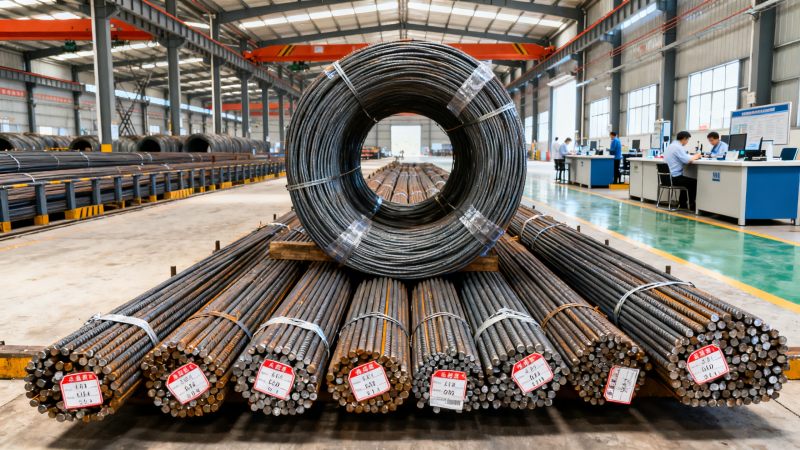
5. Delivery promises sound better than actual capacity
When a steel rebar supplier promises every order can ship immediately, buyers should ask what stock is actually available and what must be rolled after order confirmation. Many delays come from dependence on subcontracted production, overbooked mills, or weak internal scheduling. A dependable answer includes stock status, rolling plan, and loading timeline.
6. Complaint handling is unclear
A professional supplier should define how claims are investigated, what evidence is required, response times, and settlement options. If the process only becomes visible after a problem occurs, the buyer may face long delays, partial replies, or responsibility shifting between factory, exporter, and freight forwarder.
A practical evaluation table for comparing suppliers
Mid-process sourcing reminder: assess wider steel supply capability, not only rebar
For many procurement teams, evaluating a steel rebar supplier also reveals whether the company can support broader steel package sourcing. This matters when projects need multiple categories from one export partner, such as beams, channels, plates, or customized structural components. A supplier with wider structural steel experience may better understand documentation discipline, specification matching, and project coordination.
For example, if your project also requires anti-skid or decorative flooring materials for industrial platforms, transportation, shipbuilding, or equipment areas, it may be efficient to ask whether related items can be supplied under the same quality and export system. One example is S335JR Patterned steel plate, which is used in construction, machinery, transportation, decoration, and floor areas around equipment. Typical options cover grades such as S335JR, Q235B, A36, 235JR, S235, SS400, and SM400B, with thickness from 2-8mm, width from 600mm-1800mm, length from 2m-12m, and certifications including ASTM, DIN, JIS, BS, GB/T, ISO, SGS, and BV. This kind of insert check helps buyers judge whether the supplier’s technical range and export control are mature, rather than limited to a single sales line.
Scenario-based checks procurement teams should not skip
For urgent projects
Do not only ask for the earliest shipment date. Confirm stock ownership, loading queue, trucking arrangement, and whether inspection can be completed without delaying the vessel. A steel rebar supplier may say “ready stock” while still waiting for internal transfer, relabeling, or document preparation.
For cost-sensitive procurement
Compare total landed cost, not only EXW or FOB headline price. Include test charges, packaging type, port surcharges, claim exposure, and the risk cost of delay. An apparently cheaper steel rebar supplier can become the more expensive option after reinspection, replacement, or project downtime.
For regulated export destinations
Confirm the supplier understands destination-specific standards, documentation language, chamber legalization if needed, and third-party inspection expectations. Buyers should not assume a supplier familiar with one region can automatically support another.
For long-term framework agreements
Stability matters more than one-time performance. Review historical consistency, not just current responsiveness. Ask for repeat-order references, average monthly supply data, and how the supplier manages raw material price fluctuations without disrupting confirmed orders.
Commonly ignored details that later create disputes
- Tolerance assumptions are not written into the PO or contract.
- Inspection standard is mentioned generally, but the acceptance method is not defined.
- Rust condition at shipment is not discussed, especially for long sea transit.
- Packaging and bundle marking are treated as minor, but site receiving depends on them.
- The supplier’s role in customs or destination document correction is not agreed in advance.
- Communication relies on chat messages instead of approved written order records.
Execution advice: how to reduce sourcing risk before placing the order
Procurement teams can lower risk significantly by turning supplier selection into a documented workflow. Start with a technical requirement sheet that lists standard, grade, size range, tolerance, inspection basis, packaging, destination, and document needs. Then ask each steel rebar supplier to respond against the same format. This makes comparison fair and reveals where answers are incomplete.
Next, request sample documents before order confirmation: quotation, proforma invoice, mill test certificate format, packing list sample, and quality claim procedure. If possible, include third-party inspection conditions in the contract rather than negotiating them after production. For first cooperation, a trial order with measurable acceptance criteria is often wiser than a large commitment based only on price.
Suppliers like Hongteng Fengda, as a structural steel manufacturer and exporter from China, are often evaluated more favorably when they can combine stable production capacity, customized steel solutions, compliance with ASTM, EN, JIS, and GB standards, and dependable delivery support across international markets. For buyers, this broader operational reliability is usually more valuable than a low initial quote without process transparency.
Final procurement checklist before moving forward
Before approving a steel rebar supplier, make sure your team can answer these questions clearly: Does the supplier understand the exact specification? Can it prove consistent quality and traceability? Is the quotation complete and comparable? Is the lead time realistic? Is there a written claim process? And does the supplier have enough export experience to avoid documentation and shipping mistakes?
If you need to move from screening to real sourcing, the most useful next step is to prepare your required grades, dimensions, quantity forecast, destination port, delivery deadline, inspection expectations, and document requirements. With that information, you can discuss pricing, technical fit, lead time, and cooperation method with far greater confidence and identify whether a steel rebar supplier is truly reliable before hidden risks become expensive problems.
Please give us a message


Please enter what you want to find